

Jyotirgamaya.online is a venture of Divine Deeds Pvt Ltd
You can find us on






You can find us on

 Thursday 11 June, 2026
Puja will be held at Shri AdiNarayana Perumal Temple, Coimbatore, and you can experience from your home!
Parama Ekadashi, also revered as Purushottama Ekadashi, is the rarest and most spiritually potent Ekadashi in all of Vedic tradition. It falls only during Adhika Maasa, a sacred intercalary month that arrives once in 32 months. The Padma Purana declares that a single sincere observance of this vrat grants punya equal to bathing at all sacred tirthas combined. Bhagwan Vishnu himself reveals to Yudhishthira that this one Ekadashi bestows moksha, dissolves pitru dosha across seven generations, and opens the path to Vaikunta. Book your Parama Ekadashi Puja with certified Vedic pandits at Jyotirgamaya and receive the complete anushthan with full vidhi, online support, and prasad dispatch.


Parama Ekadashi falls only in Adhika Maasa, arriving once in 32 months. The Padma Purana declares it the most powerful of all 24 Ekadashis in the lunar year.

Observing this vrat with full vidhi and jagaran is said in the Brahma Vaivarta Purana to release the soul from the cycle of rebirth and bestow Vaikunta prapti.

Tarpan and puja performed on Parama Ekadashi pacifies the pitrus and dissolves accumulated pitru dosha, ensuring peace for ancestors across seven generations.

Bhagwan Vishnu himself tells Yudhishthira in the Padma Purana that the punya of this one Ekadashi equals the merit of bathing at all sacred tirthas combined.
What Is Parama Ekadashi and Why Is It the Rarest Vrat in Vedic Dharma
Among all the Ekadashis observed through the year, Parama Ekadashi holds a singular position in Vedic tradition. It is the Ekadashi of Adhika Maasa, the sacred intercalary month that the lunar calendar inserts once every 32 to 33 months to realign with the solar cycle. Because Adhika Maasa itself is rare, Parama Ekadashi arrives only once in that same span, making it the least frequent and most spiritually charged of all Ekadashi vrats.
The name Parama means supreme or the highest. The name Purushottama connects directly to Bhagwan Vishnu in his aspect as Purushottama, the highest among all Purushas, the one who transcends both the perishable and the imperishable. The Padma Purana dedicates an entire chapter to this Ekadashi, narrating how Bhagwan Vishnu himself described its glory to Raja Yudhishthira. The Brahma Vaivarta Purana reinforces this narrative, placing Parama Ekadashi above all other Ekadashis in terms of the punya it bestows.
The Ekadashi occurring on this occasion falls on Adhika Jyeshtha Krishna Paksha Ekadashi, the eleventh tithi of the waning fortnight in the sacred intercalary Jyeshtha month. The nakshatra is Revati, ruled by Bhagwan Vishnu himself, adding an additional dimension of auspiciousness to this puja. Revati nakshatra is described in the Taittiriya Brahmana and the Vishnu Purana as the nakshatra that brings nourishment, completion, and divine grace. A puja performed under Revati in Adhika Maasa on Ekadashi tithi is triple-sanctified by the Vedic reckoning.
The Sacred Katha of Parama Ekadashi from the Padma Purana
The Padma Purana narrates the story of a poor Brahmin named Sumedha and his devoted wife Pavitra in the kingdom of a righteous king. Though faithful, virtuous, and learned in the Vedas, Sumedha lived in extreme poverty, struggling to feed his family. His wife Pavitra, who was a woman of extraordinary dharma-nishtha, sought counsel from the great sage Kaundinya Muni when Adhika Maasa arrived.
Sage Kaundinya explained that Adhika Maasa, though considered an additional and sometimes inauspicious month for certain new undertakings in popular belief, is in fact the most Vishnu-priya month of all. He said that Bhagwan Vishnu himself claimed Adhika Maasa as his own when all the other months were distributed among the devas, and that whoever observes the Ekadashi of this month with full faith and vidhi will receive liberation from all karmic bondages.
Pavitra observed the Parama Ekadashi vrat with full panchamrut abhisheka, archana with Tulasi and pushpa, naivedya, jagaran, and deep surrender to Bhagwan Vishnu. The result, as the Padma Purana records, was a complete transformation of fortune. Sumedha and Pavitra attained not only material abundance but ultimately moksha, freed from the cycle of rebirth. Sage Kaundinya declared to her that the punya accumulated through this one Ekadashi was equal to performing ashwamedha yagna, bathing at all tirthas, and giving away all wealth in charity.
Spiritual Significance of Parama Ekadashi Puja in Vedic and Pauranic Tradition
The Vishnu Purana establishes that every Ekadashi is dear to Bhagwan Vishnu, but the Ekadashi of Adhika Maasa is in a category entirely its own. While the 24 Ekadashis of the regular lunar year each carry their own names and specific phala, Parama Ekadashi carries the combined essence of all of them. The Skanda Purana refers to Adhika Maasa as Purushottama Maasa and says that religious acts performed in this month yield a hundred times the normal phala.
The Revati nakshatra under which this Ekadashi falls in 2026 deepens its significance further. Revati is the final nakshatra in the zodiac, associated with completion, crossing over, and liberation. It is the nakshatra in which the journey ends and moksha becomes accessible. Jyotish texts including the Brihat Parashara Hora Shastra and the Muhurta Chintamani describe Revati as a nakshatra that is particularly auspicious for Vishnu puja, tarpan, and vrats oriented toward moksha and pitru shanti.
The Bhagavata Purana affirms that fasting on Ekadashi with a pure heart is equivalent to all forms of tapas combined. The Narada Purana adds that whoever is unable to fast completely may observe Ekadashi through puja, jagaran, vishnu smarana, and naivedya, and they will receive the full phala of the vrat. This makes the Parama Ekadashi Puja accessible to all devotees regardless of physical capacity, and the guidance of qualified pandits ensures the puja is performed with the correct mantras, sankalpa, and offerings.
Parama Ekadashi Puja Seva at Jyotirgamaya - What We Offer
At Jyotirgamaya, the Parama Ekadashi Puja is performed by experienced Vedic pandits trained in Vaishnava puja vidhi. Every element of the seva follows the prescriptions of the Padma Purana and the Vishnu Purana, ensuring that the puja is not merely a ritual but a complete offering of devotion to Bhagwan Vishnu in his Purushottama swarupa.
Seva Components
The puja begins with a formal Sankalpa in the devotee's name and gotra, invoking Bhagwan Vishnu with the specific intent of the devotee, be it moksha, pitru shanti, mangalya, or sarva mangala. The Sankalpa performed under Revati nakshatra during Adhika Maasa carries special potency as described in the Muhurta Chintamani.
Who Should Book the Parama Ekadashi Puja
The Parama Ekadashi Puja is beneficial for every devotee who seeks Bhagwan Vishnu's grace, but the Padma Purana and Narada Purana identify specific situations where this puja brings accelerated results.
Phala and Benefits of Parama Ekadashi Puja as Described in Vedic Texts
The classical texts are unusually specific about the phala of Parama Ekadashi observance. The following benefits are drawn directly from the Padma Purana, Brahma Vaivarta Purana, Skanda Purana, and Vishnu Purana.
In the spiritual realm, physical boundaries hold no power, ensuring a connection between you and the divine.

Experience the spiritual essence from the comfort of your home by tuning into live streams of the rituals performed by experienced priests.

If you miss the live event, a recorded video will be provided, allowing you to watch the sacred rituals at your convenience.

Receive blessed prasad delivered directly to your home, ensuring you remain connected to the divine blessings.

Participate in the rituals remotely without the need to visit the temple.

Stay spiritually connected through live and recorded rituals, with blessings brought to you through prasad delivery.
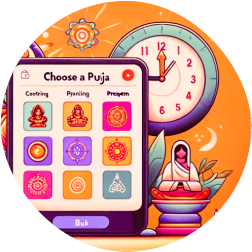
1
Select one or more main rituals as per your spiritual need.
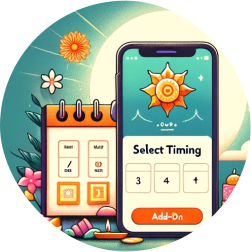
2
Add optional offerings to deepen your spiritual experience.

3
Confirm securely so all selected rituals and offerings are included.
Frequently Asked Questions About Parama Ekadashi Puja
Q: What is Parama Ekadashi and when does it occur?
Parama Ekadashi is the Ekadashi tithi observed during Adhika Maasa, the intercalary lunar month that occurs once in approximately 32 months. In 2026, it falls on 11 June, which corresponds to Adhika Jyeshtha Krishna Paksha Ekadashi under Revati nakshatra.
Q: Why is Parama Ekadashi also called Purushottama Ekadashi?
The Adhika Maasa itself is called Purushottama Maasa because Bhagwan Vishnu in his aspect as Purushottama claimed this month as his own when other months were distributed among the devas. The Ekadashi of this month therefore carries his direct name and is considered most dear to him.
Q: What is the significance of Revati nakshatra on this Ekadashi?
Revati is the final and most moksha-oriented nakshatra in Vedic Jyotisha, directly associated with Bhagwan Vishnu. Puja performed on Ekadashi under Revati combines three layers of auspiciousness: the Ekadashi vrat phala, the Adhika Maasa amplification, and the Revati nakshatra's moksha-granting quality.
Q: Can NRIs participate in this puja remotely?
Yes. Jyotirgamaya performs the puja with your name, gotra, and sankalpa. Live darshan is provided through a streaming link and prasad is dispatched to your home address anywhere in India. International prasad dispatch is available on request.
Q: Is Parama Ekadashi puja beneficial for pitru dosha?
Yes. The Padma Purana, Garuda Purana, and Brahma Vaivarta Purana all specifically mention that Parama Ekadashi puja dissolves pitru dosha and brings peace to ancestors across seven generations.
Q: What if I cannot fast on Ekadashi?
The Narada Purana clearly states that performing or sponsoring a proper puja on Ekadashi with sincere devotion grants the full phala of the vrat even for those unable to observe a complete fast due to health or other valid reasons.
Q: How is Parama Ekadashi different from regular Ekadashis?
Regular Ekadashis occur twice every lunar month, giving 24 Ekadashis in a year. Parama Ekadashi occurs only once in approximately 32 months, making it exceptionally rare. The Skanda Purana states that its punya is a hundred times that of any regular Ekadashi, and the Padma Purana places it above all other Ekadashis in terms of moksha-granting power.
Observe Parama Ekadashi with Full Vedic Vidhi on 11 June 2026
Parama Ekadashi arrives once in 32 months. The 2026 observance falls under Revati nakshatra during Adhika Jyeshtha, a combination that will not repeat for several decades. For devotees seeking moksha, pitru shanti, resolution of karmic obstacles, or Bhagwan Vishnu's direct grace, this is a rare and irreplaceable opportunity. The Padma Purana assures us that those who observe this vrat through puja and sincere sankalpa will be freed from the burden of accumulated karma and set firmly on the path toward Vaikunta.
Book your Parama Ekadashi Puja on Jyotirgamaya today. Our pandits are performing the full seva on your behalf on 11 June 2026 with Panchamrut Abhisheka, Sarvalankara, Tulasi Archana, Mangalaarti, Vishesha Naivedya, and Grand Tulasi Haar Samarpan, all in the name of your family and ancestors.
9 April 2029


