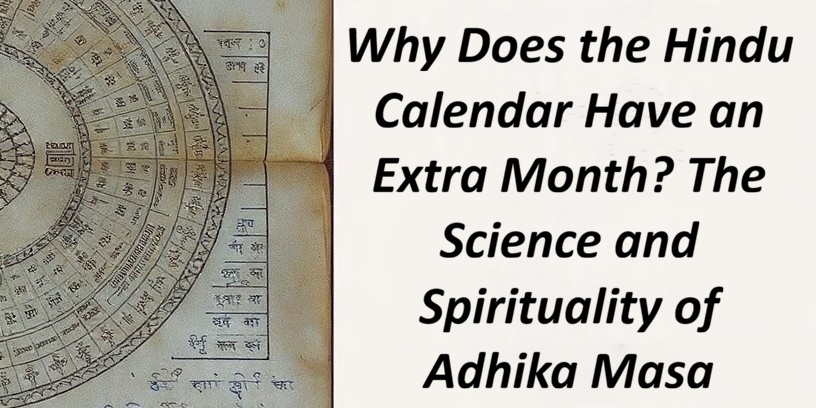
Why Does the Hindu Calendar Have an Extra Month? The Science and Spirituality of Adhika Masa
By: Pratima Argade
21 May 2026 at 2:16 AM
Why Does the Hindu Calendar Have an Extra Month? The Science and Spirituality of Adhika Masa Every few years, something unusual happens in the Hindu calendar. A month appears twice. Or an extra month slips in between two regular months. Family groups light up with questions. Wedding planners call to say the auspicious dates need to shift. And pandits begin reminding everyone that Mal Maas has begun and Purushottam Maas sevas should be booked. That extra month is Adhik Maas, also known as Adhika Masa, Mal Maas, or Purushottam Maas.
Most people accept its existence without questioning it. But the moment you understand why this extra month exists, how precisely Vedic scholars calculated it thousands of years ago, and why Bhagwan Vishnu chose to personally accept and bless this astronomically necessary month, the entire experience of Adhik Maas changes. It goes from being a calendar curiosity to a profound meeting point of ancient science and living spirituality. Let us start from the beginning.
Two Ways of Measuring Time: Sun and Moon
To understand Adhik Maas, you first need to understand that the Hindu tradition uses two different celestial bodies to measure time, and these two do not agree with each other.
- The Moon governs the lunar calendar. Each lunar month is the time it takes the moon to complete one full cycle from new moon to new moon, which is approximately 29.5 days. Twelve such lunar months make one lunar year of about 354 days.
- The Sun governs the solar year. The earth takes approximately 365 days and 6 hours to complete one full orbit around the sun. This is the solar year, and it governs our seasons, the agricultural cycle, and the timing of solstices and equinoxes.
The gap between a lunar year and a solar year is approximately 11 days every year.
This gap is not an error. Both the sun and the moon are honoured in Sanatana Dharma as sacred luminaries. The sun, Surya Bhagwan, governs the outer world of seasons and visible time. The moon, Chandra Deva, governs the inner world of mind, emotions, and tidal rhythms. Both are necessary. And both must be honoured in the calendar.
But keeping both in alignment requires a correction. This correction is Adhik Maas.
The Mathematics Behind Adhik Maas: A 2,000-Year-Old Calculation
The 11-day annual gap between the lunar year and the solar year accumulates over time. After 3 years, the gap becomes approximately 33 days, which is just over one full lunar month.
Vedic astronomers, particularly those working within the tradition of the Surya Siddhanta and the Vedanga Jyotisha, calculated that inserting one extra lunar month approximately once every 32 months, 16 days, and 8 hours keeps the lunar and solar calendars in alignment.
This is an extraordinarily precise calculation. Modern astronomy confirms that this interval of approximately 32.5 months for the insertion of an intercalary month is accurate to within a very small margin of error.
To put this in perspective: the Gregorian calendar used worldwide today adds one extra day every four years as a leap day to keep the calendar aligned with the solar year. The Vedic calendar adds one extra month every 32 months to keep the lunar calendar aligned with the solar year. Both are solutions to the same fundamental problem of reconciling different cycles of time. But the Vedic solution is older, more mathematically elegant, and richer in meaning.
The specific timing of when Adhik Maas falls varies in each cycle. It does not always fall in the same Hindu month. In 2026, Adhik Maas falls as an additional Jyeshtha month.
Adhik Maas 2026 dates:
- Start Date: 17 May 2026
- End Date: 15 June 2026
Why Does the Timing of Adhik Maas Vary?
A common question people ask is: why does Adhik Maas sometimes fall in Jyeshtha, sometimes in Shravana, sometimes in Ashwin? Why does it not follow a fixed pattern?
The answer lies in how the extra month is identified.
In the Hindu lunar calendar, each month is associated with a specific solar transit called Sankranti. A Sankranti is the moment when the sun moves from one zodiac sign to the next. There are 12 such transits in a solar year, one for each zodiac sign.
A lunar month in which no solar Sankranti occurs is called Adhik Maas or the extra month. Because the sun does not complete a full sign transit during that lunar month, the month is considered incomplete in terms of solar alignment and is therefore designated as the intercalary or extra month.
The Sankranti that is missing from the Adhik Maas will belong to the lunar month that immediately follows it. This is why the Adhik month always carries the same name as the month following it. In 2026, the extra month carries the name Jyeshtha because the Mithuna Sankranti that would normally fall within a Jyeshtha month is absent during the extra month and occurs in the regular Jyeshtha month that follows.
This system of identifying Adhik Maas is precise, consistent, and rooted in deep observation of the solar and lunar cycles.
The Spiritual Problem: A Month Without a Deity
Now here is where the science opens into spirituality.
In the Hindu calendar, each of the twelve regular months is governed by a specific devata. These devatas are not symbolic assignments. In the Vedic understanding, time itself is sacred and alive. Each unit of time, each month, each tithi, each nakshatra, carries the presence of a specific divine energy.
When the extra month appeared in the calendar, it had no Sankranti and therefore no presiding devata. It was astronomically necessary but spiritually homeless.
The Puranas describe this condition poetically. The extra month knew it was needed. Without it, the calendar would fall into disarray. Festivals would drift. Sacred seasons would lose their moorings. And yet no deity claimed it. No divine energy governed it. It was the necessary outsider, the extra that nobody wanted.
People began calling it Mal Maas, the inauspicious or impure month, and avoided all celebrations during this time. The extra month served its mathematical purpose but received no honour.
This created a sacred imbalance that the Puranas say could not continue.
The Divine Resolution: How Bhagwan Vishnu Transformed Mal Maas into Purushottam Maas
The extra month, in its grief and sense of rejection, approached Bhagwan Vishnu.
What followed is one of the most beautiful moments in all of Puranic literature.
The month placed its sorrow before Bhagwan Vishnu and asked for grace. It did not ask for equal status with other months. It did not demand recognition or honor. It simply asked: "I exist. I serve a purpose. Can I not also receive your grace?"
Bhagwan Vishnu, the preserver of all creation and the one who sees the innermost truth of every being, responded with complete acceptance. He declared:
"I accept this month as My own. I name it Purushottama after My supreme name. Whoever performs worship, daana, japa, and vrata during this month shall receive blessings multiplied beyond all ordinary measures. Their karmic burdens shall lighten and My grace shall flow into their lives abundantly."
With that declaration, Mal Maas became Purushottam Maas.
Astronomically, nothing changed. The extra month still exists because the mathematics of the solar and lunar cycles requires it. But spiritually, everything changed. The month that had no deity now had the Supreme Deity. The month considered inauspicious became the most auspicious period in the three-year cycle.
What This Reveals About the Vedic Understanding of Time
The story of Adhik Maas becoming Purushottam Maas is not just a devotional tale. It reveals something profound about how Sanatana Dharma understands time itself.
In the Vedic worldview, time is not an empty container in which events happen. Time is itself a living reality, filled with specific divine energies, karmic possibilities, and spiritual potential. Different times carry different qualities.
Brahma Muhurta, the hour before sunrise, carries a specific quality of clarity and spiritual receptivity. Pradosh Kala, the dusk period, carries a specific energy of Bhagwan Shiva's grace. Ekadashi carries the energy of Bhagwan Vishnu's direct presence. And Adhik Maas, once blessed by Bhagwan Vishnu Himself, carries the energy of His supreme grace in a sustained and concentrated way across an entire month.
This understanding means that choosing the right time for worship, for daana, for vrata, and for spiritual practice is not superstition. It is the intelligent use of natural spiritual rhythms. Just as a farmer plants in the right season and a sailor reads the tides, a sincere seeker uses sacred time to amplify the power of their spiritual effort.
Adhik Maas is one of the most powerful of all such sacred times.
Why Simple Acts Carry Extraordinary Weight During Adhik Maas
The Puranas are emphatic about this: the punya or spiritual merit earned during Adhik Maas is multiplied far beyond what the same acts would earn in any other month.
The Padma Purana states that the merit of performing daana, vrata, and puja during Purushottam Maas equals the merit of performing those same acts thousands of times during ordinary months.
The Bhavishya Purana gives a list of simple acts that carry extraordinary weight during Adhik Maas:
- Lighting a deepa before Bhagwan Vishnu
- Chanting Vishnu Sahasranama even once
- Offering Tulasi to Bhagwan Vishnu
- Feeding a cow
- Offering food to a hungry person
- Listening to Vishnu katha or Bhagavata Purana
- Observing Ekadashi vrata
None of these require great wealth or elaborate preparation. They require sincerity, a clean heart, and the intention to connect with the divine. During Adhik Maas, that intention carries far beyond what it normally would.
This is the science of sacred time: the same effort, in the right moment, yields different results.
Adhik Maas 2026: The Dates and Key Observances
In 2026, Adhik Maas runs from 17 May 2026 to 15 June 2026.
This is a 30-day sacred window. Here are the most important observances within it:
- Kamala Ekadashi (Padmini Ekadashi) This Ekadashi falls in the Shukla Paksha of Adhik Maas and is one of the most powerful Ekadashis of the entire year. Observing the Kamala Ekadashi vrata with devotion is said to remove deep karmic burdens and invite the grace of Bhagwan Vishnu and Maa Lakshmi.
- Parama Ekadashi (Purushottam Ekadashi) This Ekadashi falls in the Krishna Paksha of Adhik Maas and carries Bhagwan Vishnu's own name. It is described in the Puranas as capable of removing the accumulated karma of many janmas when observed sincerely.
- Akhanda Deepa Seva On 30 May 2026 (Saturday) and 01 June 2026 (Monday), Akhanda Deepaarti is being offered to Shriman Narayana and Shri Parameshwara at their respective temples at Jyotirgamaya. This is a seva for success, health, wealth, peace, and fulfillment of wishes.
- Navagraha Shanti Homa Being conducted on 24 May 2026 or 14 June 2026. For sarva graha dosha nivaran and progress in all aspects of life.
Who Benefits Most from Adhik Maas Sevas?
Because Adhik Maas is specifically powerful for karma shuddhi and graha shanti, those dealing with the following situations stand to gain the most from sincere sevas during this period:
- Recurring obstacles or unexplained delays in career, marriage, or financial goals
- Known Rahu, Ketu, Shani, or Mangal dosha in the birth chart
- Pitru dosha or unresolved ancestral karma in the family lineage
- Health challenges that are not responding as expected
- Emotional restlessness, anxiety, or a sense of spiritual disconnection
- A sincere desire to purify karma before beginning a new chapter of life
The Puranas make clear: Bhagwan Vishnu's grace during Purushottam Maas flows to all who approach with sincerity. There is no condition of caste, region, or social position. The only requirement is a sincere heart and a genuine intention.
Sevas at Jyotirgamaya for Adhik Maas 2026
At Jyotirgamaya, we offer six carefully chosen authentic sevas for Adhik Maas 2026, performed by experienced Vedic pandits in proper temple settings with a full sankalpa taken in your name and gotra.
- Kamala Ekadashi Maha Puja Seva: For karmic balance, peace, prosperity, and spiritual and material progress
- Parama Ekadashi / Purushottam Ekadashi Maha Puja Seva: For deep karma shuddhi, removal of karmic burdens, and divine grace
- Akhanda Deepa Seva on 30 May and 01 June 2026: For success, good health, wealth, peace, and wish fulfillment
- Gau Seva: For karmic balance, inner peace, and relief from graha and pitru dosha
- Annadana to old age homes and orphanages: Highest punya karma for karmic balance and inner peace
- Navagraha Shanti Homa on 24 May or 14 June 2026: For sarva graha dosha nivaran and all-round progress
Prasadam is delivered to your home after the seva. When rituals are performed with your name and gotra in the sankalpa by qualified pandits in a sacred temple, the spiritual benefit reaches you completely regardless of your location.
Book your Adhik Maas 2026 seva here: Adhik Maas Puja Seva Booking at Jyotirgamaya
Frequently Asked Questions
Q. Why does the Hindu calendar have an extra month?
The Hindu lunar calendar has approximately 354 days while the solar year has 365 days. This creates an annual gap of about 11 days. To prevent lunar months from drifting out of seasonal alignment over time, Vedic scholars calculated that an extra lunar month must be inserted approximately once every 32 months, 16 days, and 8 hours. This extra month is called Adhik Maas or Adhika Masa.
Q. How did Vedic scholars calculate when to add the extra month?
The extra month is identified by the absence of a solar Sankranti, the moment when the sun moves from one zodiac sign to the next, within a lunar month. A lunar month in which no solar Sankranti occurs is designated as Adhik Maas. This system of identification is consistent, mathematically precise, and confirmed by modern astronomy.
Q. When is Adhik Maas in 2026?
Adhik Maas 2026 runs from 17 May 2026 to 15 June 2026. This is an extra Jyeshtha month in the Hindu lunar calendar for this cycle.
Q. Is the Hindu leap month similar to the Gregorian leap day?
Both serve the same purpose of aligning the calendar with the solar year. The Gregorian calendar adds one extra day every four years. The Vedic calendar adds one extra month approximately every 32 months. The Vedic solution is older, mathematically more sophisticated, and carries deep spiritual significance alongside its astronomical function.
Q. Why does Adhik Maas fall in a different month each time it comes?
Adhik Maas always falls in whichever lunar month lacks a solar Sankranti during that cycle. Since the sun's movement through the zodiac and the moon's cycles do not repeat in a fixed pattern relative to each other, the specific lunar month that becomes Adhik Maas varies each time. In 2026 it is an extra Jyeshtha month. In previous cycles it has fallen in other months.
Q. Does the science behind Adhik Maas take away from its spiritual significance?
Not at all. In Sanatana Dharma, science and spirituality are never in conflict. The astronomical necessity of Adhik Maas is precisely what made it available as a vessel for Bhagwan Vishnu's grace. The mathematical gap created the sacred space. The divine filled that space with extraordinary blessing. Understanding the science deepens rather than diminishes the spiritual experience of Purushottam Maas.
Conclusion: Science Created the Space. Bhagwan Filled It with Grace.
Adhik Maas exists because the sun and the moon move at different speeds. That is the science. Ancient Vedic astronomers understood this with extraordinary precision and built a system to correct for it that has endured for thousands of years.
But what makes Adhik Maas truly unique in all of human culture and all of world religion is what happened next. Bhagwan Vishnu looked at this astronomically necessary month, this practical correction in the calendar, and said: I accept this as My own. I name it after Myself. I will fill it with My grace.
In doing so, He transformed a mathematical necessity into a spiritual treasure.
Adhik Maas 2026, running from 17 May to 15 June, is one such treasure. It comes rarely. It goes quickly. And what is offered during it, however simple and sincere, returns many times over.
Use this sacred window well.
Perform your Divine Seva this Purushottam Maas. Invite Peace. Invite Prosperity. Invite Divine Grace.
Book Your Adhik Maas 2026 Seva at Jyotirgamaya
Om Namo Bhagavate Vasudevaya