How Often Does Adhik Maas Come? The Vedic Calculation Behind This Rare Sacred Month
By: Pratima Argade
22 May 2026 at 10:45 AM
One of the most common questions people ask about Adhik Maas is also one of the simplest: how often does it come?
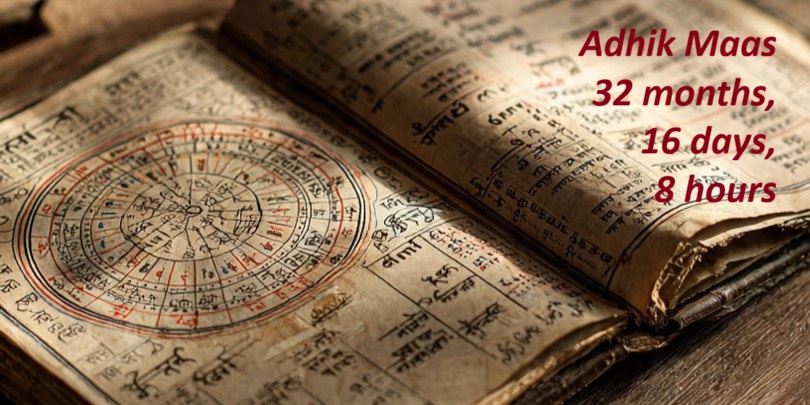
The short answer is once every 32 months, 16 days, and 8 hours.
But that short answer raises more questions. Why 32 months and not exactly 3 years? Why do some people say it comes every 2 to 3 years while others say every 3 years? Why does it fall in a different Hindu month each time? And if it comes roughly every two and a half to three years, why does it feel like people talk about it so rarely?
This post answers all of these questions. By the end, you will not only understand how often Adhik Maas comes but also why its rarity is itself a spiritual teaching, and why Adhik Maas 2026, running from 17 May to 15 June 2026, is an opportunity you genuinely cannot afford to miss.
The Simple Answer: Once Every 32 Months
Adhik Maas, also called Adhika Masa, Mal Maas, or Purushottam Maas, occurs approximately once every 32 months, 16 days, and 8 hours.
In more familiar terms, this is roughly once every two years and eight months. Some people round it up and say once every three years, which is close but not quite precise.
Within a span of 19 years, Adhik Maas occurs exactly 7 times. This 19-year cycle is known in Vedic astronomy as the Metonic cycle, and it is one of the most elegant mathematical patterns in all of calendar science. After 19 solar years, the lunar calendar and the solar calendar return to almost exactly the same alignment. In those 19 years, 7 extra lunar months are needed to maintain that alignment.
This gives us the average: 19 years divided by 7 extra months equals approximately 2 years and 8 months, or 32 months and a fraction, per occurrence of Adhik Maas.
The Vedic Calculation: How Ancient Scholars Got This Right
Vedic astronomers calculated the interval of Adhik Maas with extraordinary precision thousands of years ago. Their primary tool was direct and sustained observation of the movements of the sun and the moon across the sky, combined with a sophisticated mathematical framework developed within the tradition of the Vedanga Jyotisha and the Surya Siddhanta.
Here is the logic they followed:
Step 1: Measure the two calendars
A solar year is approximately 365 days, 5 hours, 48 minutes, and 46 seconds.
A lunar year of 12 months is approximately 354 days, 8 hours, 48 minutes, and 34 seconds.
The difference between a solar year and a lunar year is approximately 10 days, 21 hours, and 0 seconds, which rounds to about 11 days per year.
Step 2: Calculate when the gap fills a full lunar month
A full lunar month is approximately 29 days and 12 hours.
At a rate of 11 days of gap per year, a full lunar month of 29.5 days accumulates in approximately 2.71 years, which is about 32.5 months.
This is where the figure of 32 months, 16 days, and 8 hours comes from. It is the precise interval at which the accumulated gap between the lunar calendar and the solar calendar equals exactly one full lunar month, requiring the insertion of Adhik Maas.
Step 3: Identify which month becomes Adhik Maas
Not every lunar month is a candidate for becoming Adhik Maas. The extra month is specifically the lunar month in which no solar Sankranti occurs. A Sankranti is the moment when the sun moves from one zodiac sign, or Rashi, to the next. There are 12 Sankrantis in a solar year, one for each Rashi.
Because there are only 12 solar Sankrantis but sometimes 13 lunar months in a year, one lunar month in approximately every 32 months will not contain a Sankranti. That month is identified as Adhik Maas.
This identification system is elegant, consistent, and self-correcting. It does not require a central authority to declare when Adhik Maas occurs. Any pandit or Vedic astronomer who knows the position of the sun and the phases of the moon can determine it independently from first principles.
Why Does Adhik Maas Fall in a Different Month Each Time?
This is a question many people find confusing. If Adhik Maas comes every 32 months, why is it sometimes called Adhik Jyeshtha, sometimes Adhik Shravana, sometimes Adhik Ashwin?
The answer lies in the relationship between the solar and lunar cycles, which do not repeat in a simple fixed pattern relative to each other.
Think of it this way. The sun moves through the 12 zodiac signs at a steady pace of approximately one sign per month. The moon moves through its phases at a pace of approximately 29.5 days per cycle. These two rhythms occasionally fall out of step in a way that leaves one lunar month without a solar sign transit. The specific lunar month in which this happens depends on where exactly in the zodiac the sun is during that particular 32-month interval.
Since that position shifts slightly with each cycle, the month that becomes Adhik Maas shifts too. In 2026, it is Jyeshtha that becomes the extra month, giving us Adhik Jyeshtha. In a previous cycle it may have been Ashwin or Bhadrapada. In a future cycle it may be Kartika or Shravana.
The Adhik month always carries the same name as the regular month that follows it, because both months share the same solar Sankranti, the one that was absent in the Adhik month appearing in the regular month after it.
How Many Times Does Adhik Maas Come in a Lifetime?
Here is something worth sitting with.
If a person lives to 70 years of age, they will experience Adhik Maas approximately 26 times during their lifetime. If they live to 80, approximately 30 times.
That may sound like a reasonable number. But consider this: most people are unaware of Adhik Maas for the first 15 to 20 years of their lives. Many more are simply too occupied with daily life during their working and family years to pay attention to the spiritual calendar. And in old age, health and mobility may limit active participation.
When you subtract those years, the number of Adhik Maas occurrences during which a person is both aware and in a position to actively engage with the month's spiritual potential may be as few as 10 to 15 in an entire lifetime.
That is not a large number.
In 2026, Adhik Maas runs from 17 May to 15 June. This particular occurrence will not come again. The next Adhik Maas will arrive approximately in late 2028 or early 2029, and it will fall in a different Hindu month entirely, with different dates and a different set of circumstances in your life.
This is why the Puranas and our pandits urge us not to let this month pass without intention. It is not fear. It is simply the mathematics of rarity applied to spiritual opportunity.
The 19-Year Metonic Cycle in Vedic Astronomy
The most precise way to understand the frequency of Adhik Maas is through the 19-year Metonic cycle.
The Metonic cycle is the period after which the phases of the moon repeat on the same dates of the solar year. After exactly 19 solar years, there are almost exactly 235 lunar months. The difference between 19 solar years and 235 lunar months is less than 2 hours, making it one of the most precise natural coincidences in astronomical observation.
Within those 19 solar years and 235 lunar months:
- 12 months times 19 years gives 228 regular lunar months
- The remaining 7 months (235 minus 228) are the 7 Adhik Maas occurrences
So in every 19-year period of your life, you will encounter Adhik Maas exactly 7 times.
Vedic astronomers understood this cycle and built it into their calendar calculations long before the Greek astronomer Meton is credited with observing it in 432 BCE. The Vedanga Jyotisha, considered one of the oldest Vedic texts on astronomy, contains calculations consistent with this 19-year cycle.
This is not coincidence. It is the result of sustained, precise, multi-generational observation of the sky by scholars who understood that the movements of celestial bodies carry not just astronomical information but spiritual significance.
Adhik Maas 2026: This Cycle's Rare Window
In the current 19-year Metonic cycle, Adhik Maas 2026 is one of the 7 sacred windows.
Adhik Maas Dates:
- Adhik Maas 2026 Start Date: 17 May 2026
- Adhik Maas 2026 End Date: 15 June 2026
This is Adhik Jyeshtha Maas, the extra Jyeshtha month of 2026. The next Adhik Maas after this will arrive in a different month and a different year, approximately 32 months from now.
- Within this 30-day window, the most spiritually significant days are:
- Kamala Ekadashi (Padmini Ekadashi) The Ekadashi of Shukla Paksha during Adhik Maas. One of the most powerful Ekadashis of the entire year for karma shuddhi, peace, and prosperity.
- Parama Ekadashi (Purushottam Ekadashi) The Ekadashi of Krishna Paksha during Adhik Maas. Carries Bhagwan Vishnu's own name and is said in the Puranas to remove the karma of many janmas.
- Akhanda Deepa Seva On 30 May 2026 (Saturday) and 01 June 2026 (Monday) at Shriman Narayana and Shri Parameshwara temples. For success, health, wealth, peace, and wish fulfillment.
- Navagraha Shanti Homa On 24 May 2026 or 14 June 2026. For sarva graha dosha nivaran and all-round progress in life.
Why Rarity Makes This Month Spiritually Significant
In Sanatana Dharma, rarity and spiritual power are often connected. Consider the following:
A solar eclipse lasts for a few minutes. Yet the Puranas say that japa and daana performed during a solar eclipse carry extraordinary merit. Brahma Muhurta, the hour before sunrise, lasts only 48 minutes each day. Yet it is considered the most powerful time for spiritual practice. Kumbha Mela comes every 12 years in each location. Yet it is considered one of the most spiritually potent gatherings on earth.
Adhik Maas follows the same principle. It arrives rarely. Its rarity concentrates its spiritual potential. Because it does not come every year, the invitation it carries is not routine. It is special. And when something special is met with sincere intention, the results are special too.
The Puranas put it directly: the punya earned through daana, vrata, japa, and seva during Adhik Maas is multiplied far beyond what the same acts would earn during ordinary months. Bhagwan Vishnu Himself presides over this month, having accepted it as His own and named it Purushottama after His supreme name.
When the Supreme Deity personally presides over a period of time, that period carries a quality of grace that is simply not available at other times.
What to Do With This Rare Window
Knowing that Adhik Maas comes once every 32 months, the practical question becomes: what do you do with it?
The Puranas recommend a combination of inner discipline and outward devotion:
Inner Discipline During Adhik Maas:
- Maintain purity of body, speech, and thought
- Reduce time spent in sensory entertainment and increase time in satsang and reflection
- Practice forgiveness toward those who have caused you harm
- Cultivate gratitude for what you have received
Outer Devotion During Adhik Maas:
- Perform daily Vishnu puja and chant Om Namo Narayanaya or Vishnu Sahasranama
- Observe both Ekadashi vratas with full devotion
- Perform Annadana, offer food to those who are hungry
- Perform Gau Seva, feed and care for cows
- Light a deepa before Bhagwan Vishnu at home each evening
- Participate in or sponsor authentic temple sevas and homas
- Read or listen to Vishnu Purana, Bhagavata Purana, or Purushottam Maas Mahatmya
Even one sincere act performed each day of this month, sustained across all 30 days from 17 May to 15 June 2026, creates a cumulative spiritual effect that the Puranas say extends far beyond the month itself.
Sevas at Jyotirgamaya for Adhik Maas 2026
At Jyotirgamaya, we offer six authentic sevas for Adhik Maas 2026, performed by experienced Vedic pandits with full sankalpa in your name and gotra. Prasadam is delivered to your home after each seva.
- Kamala Ekadashi Maha Puja Seva: Panchamrut abhisheka, Tulasi archana, Mangalaarti, and Grand Tulasi Haar Samarpan. For karmic balance, peace, and prosperity.
- Parama Ekadashi / Purushottam Ekadashi Maha Puja Seva: For deep karma shuddhi, spiritual and material progress, and divine grace.
- Akhanda Deepa Seva on 30 May and 01 June 2026: For success, health, wealth, peace, and fulfillment of sincere wishes.
- Gau Seva throughout Adhik Maas: For karmic balance, inner peace, and ease of graha and pitru dosha.
- Annadana to old age homes and orphanages: Highest punya karma for karmic balance and inner peace.
- Navagraha Shanti Homa on 24 May or 14 June 2026: For sarva graha dosha nivaran and progress in all areas of life.
Book your Adhik Maas 2026 seva here: Adhik Maas Puja Seva Booking at Jyotirgamaya
Frequently Asked Questions
Q. How often does Adhik Maas come?
Adhik Maas comes once every 32 months, 16 days, and 8 hours. In practical terms, this is approximately once every two years and eight months. Within any 19-year period, Adhik Maas occurs exactly 7 times.
Q. Does Adhik Maas come every 3 years?
Not exactly. The common saying that Adhik Maas comes every 3 years is an approximation. The precise interval is 32 months and a fraction, which is closer to 2 years and 8 months than to 3 full years. Saying every 3 years is close enough for casual conversation but not accurate for calendar planning.
Q. When is the next Adhik Maas after 2026?
The next Adhik Maas after 2026 will arrive approximately 32 months after June 2026, placing it around late 2028 or early 2029. The exact month and dates will depend on which lunar month lacks a solar Sankranti at that time and should be confirmed closer to the date with a Vedic panchang or pandit.
Q. Why does Adhik Maas fall in a different month each time?
Adhik Maas is always the lunar month in which no solar Sankranti occurs. Since the relative positions of the sun and moon shift slightly with each 32-month cycle, the specific lunar month in which no Sankranti falls also shifts. This is why Adhik Maas is sometimes called Adhik Jyeshtha, sometimes Adhik Shravana, sometimes Adhik Ashwin, depending on the year.
Q. How many times does Adhik Maas come in a person's lifetime?
In a lifetime of 70 years, a person will experience Adhik Maas approximately 26 times. In a lifetime of 80 years, approximately 30 times. However, the number of occurrences during which a person is both spiritually aware and in a position to actively observe the month is considerably fewer, making each occurrence genuinely precious.
Q. When is Adhik Maas 2026?
Adhik Maas 2026 runs from 17 May 2026 to 15 June 2026. These dates are confirmed as per our pandit.
Conclusion: 32 Months of Waiting for One Month of Grace
Every 32 months, the cosmos offers a sacred window. A month unlike any other. A month where the ordinary rules of spiritual accumulation are suspended and where simple acts of devotion carry extraordinary weight.
Adhik Maas does not come every year. You cannot reschedule it. You cannot save it for when the timing feels more convenient. It arrives on its own precise schedule, calculated by Vedic astronomers with a precision that has held firm for thousands of years, and it passes on that same schedule regardless of what else is happening in the world.
Adhik Maas 2026 runs from 17 May to 15 June. That is 30 days.
30 days to lighten karma. 30 days to invite Bhagwan Vishnu's grace. 30 days to perform sevas that the Puranas say return multiplied blessings for peace, prosperity, health, and divine protection.
The next Adhik Maas is 32 months away. This one is here now.
Perform your Divine Seva this Purushottam Maas. Invite Peace. Invite Prosperity. Invite Divine Grace.
Book Your Adhik Maas 2026 Seva at Jyotirgamaya
Om Namo Bhagavate Vasudevaya