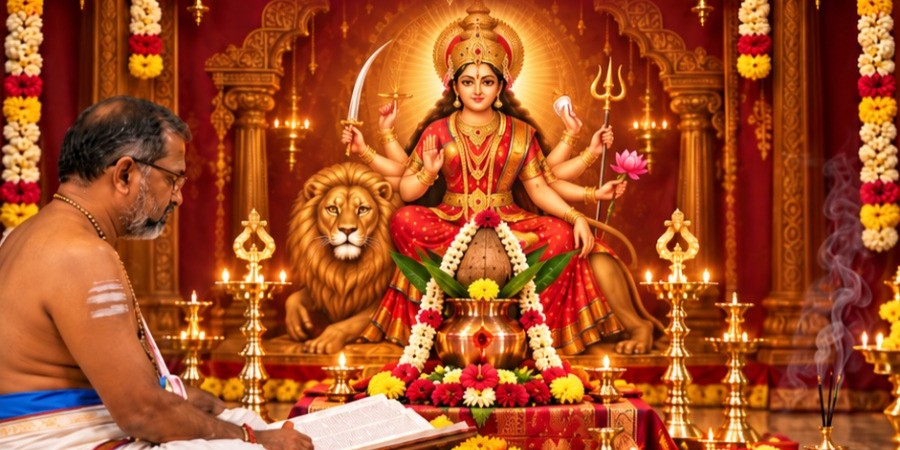
Durga Saptashati Path: Meaning, Benefits, Rules and Best Days to Recite
By: Pratima Argade
12 October 2026 at 3:04 AM
Every Navaratri, the sound of Chandi Path fills temples and homes. Some people recite it with deep focus. Others sit quietly and listen with folded hands. Many ask a question that is very simple and very honest: what is this text, and why does it matter so much?
Durga Saptashati is one of the most loved texts of Devi worship. It tells us how Devi Durga protects the world when fear, ego and evil rise too high. It also gives hope to every person who feels weak or lost in life.
In this guide, we explain Durga Saptashati in simple words. You will learn its meaning, its story, the three charitras, the benefits devotees believe in, the rules to follow and the best days to recite it.
What Is Durga Saptashati?
Durga Saptashati is a sacred text of 700 shlokas, divided into 13 chapters. The word Saptashati comes from “sapta” meaning seven and “shati” meaning hundred, so it simply means seven hundred. It is a part of the Markandeya Purana, in the chapters that are numbered 81 to 93, and it is the central text for the worship of Devi.
The text is also known as Devi Mahatmyam, which means the glory of Devi. In many families, it is treated as the heart of Shakti worship. Devotees read it in Navaratri, on Ashtami and Navami, on Fridays, and during difficult times in life.
Other Names of Durga Saptashati
Many people search for the same text with different names. Here are the most common ones:
- Chandi Path
- Chandi Saptashati
- Devi Mahatmyam
- Sri Durga Saptashati
- Durga Path
- Saptashati Parayanam
All of these names point to the same sacred text.
The Story Behind Durga Saptashati
The text begins with a very human story. A king named Suratha lost his kingdom to his enemies. Even the ministers he trusted turned against him. Alone and sad, he went into a forest.
There he met a merchant named Samadhi. His own family had pushed him out of his house and taken his wealth. Yet, strangely, both men still worried about the people who had hurt them.
Confused by their own minds, they went to Sage Medhas and asked, “Why can we not let go?” The sage explained that Mahamaya, the great power of Devi, holds the minds of all beings. Then he told them the glory of Devi, and this teaching became the Devi Mahatmyam.
This is why many people see Durga Saptashati as more than a story of battles. It is also a teaching that helps a troubled mind find strength, faith and peace.
The Three Charitras of Durga Saptashati
Durga Saptashati is divided into three parts called charitras. Each charitra praises one form of Devi.
Prathama Charitra: Mahakali (Chapter 1)
Bhagwan Vishnu is resting in deep yoganidra at the end of a cycle of creation. Two demons, Madhu and Kaitabha, rise from his ear and try to harm Brahma. Brahma prays to Devi, who leaves Bhagwan Vishnu so that he wakes up and ends the demons.
This part teaches that when Devi awakens, even the biggest problems can end. Mahakali is linked with protection and the end of fear.
Madhyama Charitra: Mahalakshmi (Chapters 2 to 4)
The demon Mahishasura defeats the devatas and takes over heaven. The devatas join their energies, and from this combined light, Devi appears. She ends Mahishasura after a great battle, and the devatas sing her praise.
Mahalakshmi is linked with strength, courage, prosperity and victory over enemies.
Uttama Charitra: Mahasaraswati (Chapters 5 to 13)
This is the longest part. The demons Shumbha and Nishumbha trouble the devatas, and Devi appears again to protect them. She ends Chanda, Munda and Raktabija, and finally the two brothers themselves. This part includes the well known Devi Stuti and the Narayani Stuti.
In the last chapter, King Suratha and the merchant Samadhi worship Devi. The king receives a kingdom again, and the merchant receives true knowledge and freedom from attachment. Mahasaraswati is linked with wisdom, devotion and moksha.
A simple way to remember: Mahakali gives protection, Mahalakshmi gives strength and prosperity, and Mahasaraswati gives wisdom and devotion.
Why Is Durga Saptashati Recited in Navaratri?
Navaratri means nine nights, and these nights are given to Devi in her different forms. Our tradition sees this time as the best period to connect with her Shakti.
Since Devi Mahatmyam is the main text that praises Devi, reciting it in these nine days feels natural and complete. Many families read all 13 chapters in one sitting. Others divide the chapters across the nine days as per their family tradition or the guidance of their guru.
Best Days for Durga Saptashati Parayanam
You can recite Durga Saptashati on any day with devotion. But some days are considered very special.
- Ashtami: This is Mahashtami, linked with Mahagauri, the calm and pure form of Devi, and with the strong protective Shakti of Durga. In the Phalashruti, the part of the text that explains the fruits of reading, Devi speaks of the glory of those who hear her praise with devotion on Ashtami and Navami. Many families choose Ashtami for protection from fear and troubles.
- Navami: This is Mahanavami, linked with Siddhidatri Devi, the giver of siddhi. Many families choose it for success in work and fulfilment of sincere wishes.
- Dashami: This is Vijayadashami, the day of victory. It closes Navaratri with peace, and many choose it for a fresh start after a long effort.
Apart from Navaratri, Fridays, Tuesdays, Pournami and Amavasya are also loved by devotees for Devi worship.
If you cannot recite on these days yourself, you can take part in our Navaratri Vishesha Durga Saptashati Parayanam, where Vedic pandits recite on Ashtami, Navami and Dashami with sankalpa in your name.
Rules to Follow Before Reciting Durga Saptashati
Durga Saptashati has a strict flow and needs care. These simple rules are widely followed. Please also follow your family tradition and the guidance of your guru, as practices can differ.
- Take a bath and wear clean clothes before you begin.
- Choose a clean and calm place, and sit on a clean asana.
- Keep an image or idol of Devi Durga in front of you, and light a lamp.
- Offer flowers, kumkum and naivedya offering to Devi.
- Face east or north while sitting.
- Take a sankalpa, which means clearly saying your name, your gotra and the reason for which you are reciting.
- Keep your food simple and sattvic during the days of recital. Many devotees avoid onion and garlic in these days.
- Pronounce the shlokas slowly and correctly. If you are not sure, listen to a trusted recording or ask a pandit.
- Try not to stop in the middle of a chapter. If you must stop, ask a knowledgeable person how to restart.
- Keep your mind calm, and avoid anger and harsh words in these days.
Remember that devotion is the heart of this path. If you do not know the full method, even a simple and sincere prayer is dear to Devi.
How to Recite Durga Saptashati at Home
Here is a simple way to do it. Please adjust it as per your family tradition.
- Set up your puja space and light the lamp.
- Pray to Bhagwan Ganesha so that the recital goes without obstacles.
- Take sankalpa in your name and gotra.
- Worship Devi with flowers, kumkum, incense and naivedya offering.
- Recite the prayers that traditionally come before the main chapters. These are Devi Kavacham, Argala Stotram and Keelaka Stotram. Many traditions also recite Ratri Suktam.
- Recite the 13 chapters of Devi Mahatmyam with focus.
- Recite the closing prayers and ask Devi for forgiveness for any mistake.
- End with aarti and prayers for the wellbeing of your family.
A full recital can take a few hours, so choose a time when you will not be disturbed. If time is short, you can follow your family custom of reading selected chapters, or ask a pandit to guide you.
Benefits of Durga Saptashati Path
As per our tradition, devotees believe that sincere recital of Durga Saptashati may bring:
- Protection from fear, negative energy and unseen obstacles
- Courage and inner strength to face hard times
- Peace and harmony in the family
- Support in long pending problems in work and life
- Fulfilment of sincere wishes made in the sankalpa
- Saubhagya and happiness for the family
- A calm and positive mind
- The blessings of Mahakali, Mahalakshmi and Mahasaraswati together
These are beliefs of faith and should not be seen as guaranteed results. The real gift of this path is a steady mind, and a steady mind helps us take better decisions in life.
Durga Saptashati Parayanam and Chandi Homa: What Is the Difference?
Many people ask if Saptashati Parayanam and Chandi Homa are the same. They are connected but not the same.
Durga Saptashati Parayanam is the recital of the text with puja. Chandi Homa is a fire ritual in which oblations are offered into the sacred fire, along with the recital of the shlokas of Saptashati. Some devotees choose the parayanam, some choose the homa, and some choose both.
If you wish to know about the homa, you can read about our Navratri Havan, which includes Durga and Saraswati Homa sevas.
What If You Cannot Recite It Yourself?
Today, many people live far from home, have a busy schedule, or do not know the correct way to recite the shlokas. Durga Saptashati has clear rules of pronunciation and flow, and a wrong recital can disturb the meaning.
In such cases, many families ask experienced Vedic pandits to perform the parayanam on their behalf. The pandit takes sankalpa in the name and gotra of the sevakartha and recites the text in the traditional way. This is also a good choice for NRI families who wish to take part in Navaratri from abroad.
At Jyotirgamaya, you can choose Ashtami, Navami or Dashami Durga Saptashati Parayanam, or a simple Kumkumarchana with Durgashtakam recital and Mangalaarti. You can read all the details on our Durga Saptashati Parayanam page.
Frequently Asked Questions
Q. What is Durga Saptashati?
Durga Saptashati is a sacred text of 700 shlokas in 13 chapters from the Markandeya Purana. It praises Devi Durga and is also called Chandi Path and Devi Mahatmyam.
Q. How many chapters are there in Durga Saptashati?
There are 13 chapters, divided into three charitras. The first charitra has one chapter, the second has three chapters, and the third has nine chapters.
Q. Is Durga Saptashati the same as Chandi Path?
Yes. Durga Saptashati, Chandi Path, Chandi Saptashati and Devi Mahatmyam are different names for the same text.
Q. Which day is best to read Durga Saptashati?
Ashtami and Navami of Navaratri are the most loved days, and Dashami is chosen for victory and peace. Fridays and Tuesdays are also liked by devotees.
Q. Can anyone read Durga Saptashati at home?
Devotion is the most important thing. Many families read it at home with care for pronunciation and cleanliness. Since practices can differ among traditions, it is good to follow your family custom or ask a knowledgeable person.
Q. How long does it take to read Durga Saptashati?
A full recital can take a few hours, depending on the speed and the prayers included. Some families divide the chapters across several days.
Q. Can I take part if I live abroad?
Yes. Devotees in any country can book an online seva, where pandits recite the text with sankalpa in their name.
Final Thoughts
Durga Saptashati reminds us of something simple. Even when we lose our position, our comfort or our people, a path always remains open. Devi shows that fear and darkness are not final, and that faith can turn a weak moment into a strong one.
Whether you recite it yourself, listen to it, or ask pandits to perform it for you, may Devi Durga bless you and your family with strength, peace and happiness.
To explore more sevas and book your puja, visit JyotirGamaya Online