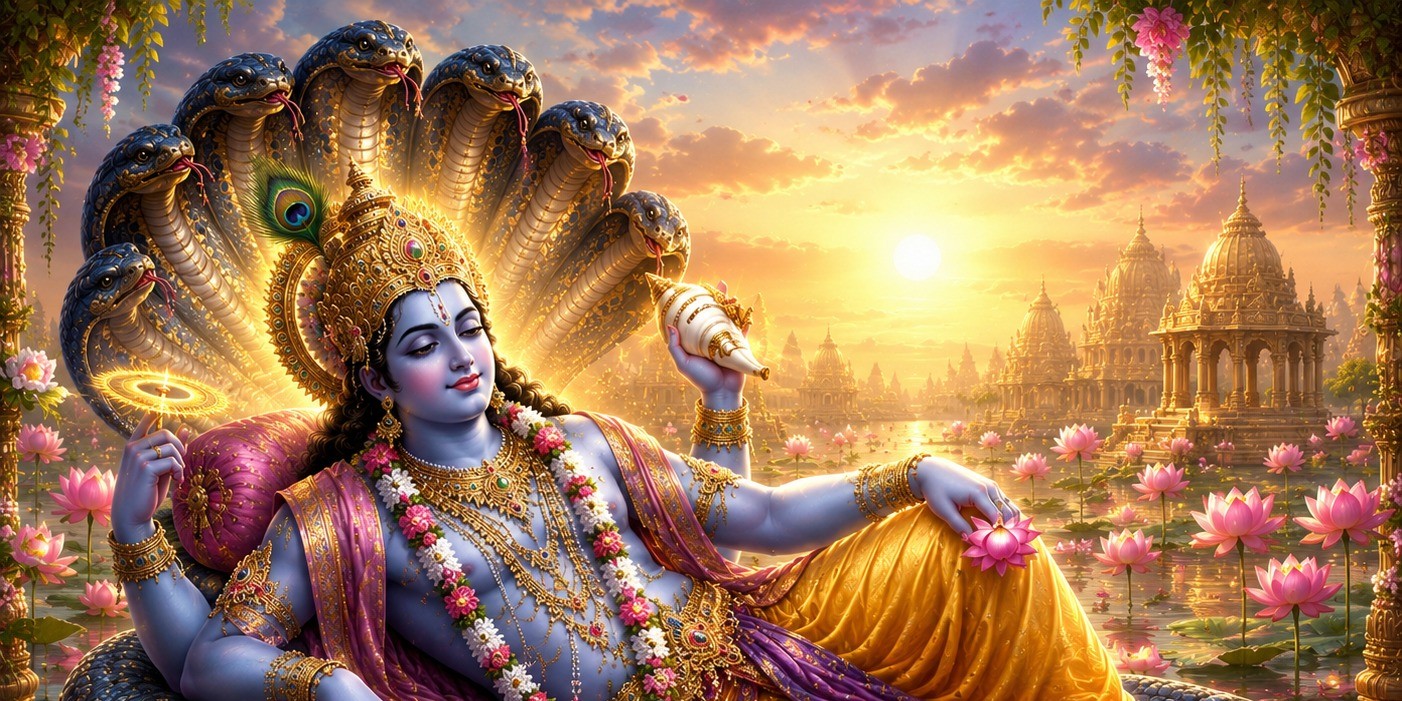
The Moving Story of How Bhagwan Vishnu Accepted the Rejected Month and Made It His Own
By: Pratima Argade
22 May 2026 at 11:22 AM
In all of Sanatana Dharma, there is a recurring pattern that appears across the Vedas, the Puranas, the Itihasas, and the Upanishads again and again.
The pattern is this: what the world rejects, Bhagwan accepts.
What appears broken, incomplete, or without value in human eyes often becomes the very thing that Bhagwan Vishnu, or Bhagwan Shiva, or Devi, chooses to fill with the deepest grace.
Dhruva was a young child turned away from his father's lap. Bhagwan Vishnu gave him a place that no one else holds: the fixed star around which all other stars revolve.
Prahlada was a devotee born into a family of asuras, abandoned by those who should have protected him, and nearly destroyed by his own father. Bhagwan Vishnu protected him directly, appearing in a form that had never existed before solely to save one sincere devotee.
Shabari was a woman of low social standing who waited decades in a forest for a glimpse of Bhagwan Rama. When Rama arrived, He ate the berries she had tasted to check for sweetness, honoring her devotion above social convention.
And then there is the story of Adhik Maas.
This is the story of a month, not a person, but the pattern is identical. A month that had no deity, no name of honor, and no place in the cosmic order. A month that people called Mal Maas, the inauspicious one, and quietly avoided. A month that came to Bhagwan Vishnu in grief.
And what Bhagwan Vishnu did in response is one of the most beautiful declarations in all of Puranic literature.
The World Before the Story: How the Hindu Calendar Was Ordered
To understand why the story of Adhik Maas is so moving, you first need to understand the world in which it takes place.
In the Vedic cosmic order, time itself is sacred and alive. It is not an empty container in which events happen. Time is a living river of divine energy, and each unit of time, each month, each fortnight, each tithi, each nakshatra, carries the presence of a specific devata.
The twelve months of the Hindu lunar calendar each have a presiding deity. These are not honorary titles. Each devata governs the specific spiritual energy that flows through their month. The farmer who plants in the right season, the devotee who observes the right vrata at the right time, the pandit who selects the right muhurta for a sacred ceremony: all of them are working with this understanding. Time has texture. Time has divine quality. And each month has a deity who gives it that quality.
Shravana is associated with Bhagwan Vishnu, the month of the sacred thread Avani Avittam and of Onam. Kartika shines with the presence of Bhagwan Vishnu and is beloved for Diwali and the Tulasi Vivah. Margashirsha carries Bhagwan Krishna's own declaration in the Bhagavad Gita: among months, I am Margashirsha. Ashwin holds the energy of Devi Durga across the nine sacred nights of Navratri.
Every month had its deity. Every month had its place. Every month had its purpose.
Except one.
The Month That Had Nothing
When the extra lunar month appeared in the cosmic order, the result of the mathematical difference between the solar year and the lunar year, it arrived into a world where every other month already had a home.
This extra month, inserted into the calendar approximately once every 32 months to keep the lunar and solar calendars in alignment, was necessary. The entire Vedic calendar system depended on its periodic appearance to prevent the drift that would otherwise pull festivals out of their proper seasons. Without this extra month, Kartika Purnima would eventually fall in summer. Sharad Navratri would lose its connection to autumn. The calendar would slowly unravel from the natural world.
So the extra month was needed. It performed a vital function. And yet nobody wanted it.
It had no solar Sankranti, the sun's passage from one zodiac sign to the next, within its span. Without a Sankranti, it had no anchoring divine energy. Without anchoring divine energy, no devata claimed it as their own. And without a presiding devata, the month had no spiritual identity.
People began to call it Mal Maas.
Mal means impure, unwanted, that which is cast aside. Maas means month. Mal Maas: the unwanted month. The month that exists because it must, not because anyone invited it.
People began avoiding it. Weddings were postponed. Griha pravesh was delayed. Sacred samskaras were moved before or after. The extra month sat in the calendar, performing its essential mathematical service, while the world looked away.
The Grief of Adhik Maas
The Puranas describe what happened next in deeply human terms.
The extra month felt its condition acutely. It knew it was necessary. It understood its own purpose. But it also saw clearly that while every other month moved through the year wrapped in divine presence, celebrated, honoured, and filled with auspicious ceremonies and devotion, it moved through the world in shame.
People did not celebrate during Mal Maas. They did not hold weddings. They did not begin new ventures. They did not invite the month into their homes with rituals and joy. They simply waited for it to pass.
In Sanatana Dharma, this is the condition the Puranas describe as the deepest human sorrow: to exist, to serve, to be present, and yet to be invisible. To do your duty faithfully and yet to receive no recognition, no love, no place of belonging.
This was the grief of Adhik Maas.
And in that grief, the extra month did something that the Puranas describe as the wisest and most courageous act possible in the face of sorrow.
It went to Bhagwan Vishnu.
The Approach: Coming to Bhagwan with Grief
The Skanda Purana and the Padma Purana both record what happened when the extra month approached Bhagwan Vishnu.
The extra month did not arrive with demands. It did not arrive with arguments about why it deserved better treatment. It did not approach Bhagwan with pride or with a list of its own virtues and services.
It arrived with grief. With honesty. With the simple truth of its condition laid bare before the one who sees all conditions as they truly are.
The extra month said, in essence: I exist. I serve. I perform the function I was created to perform, and I perform it faithfully, every 32 months without fail. But I have no deity. I have no name of honour. The world calls me Mal Maas and looks away. I have come to You because I do not know where else to go.
This is surrender. And in Sanatana Dharma, surrender offered with genuine grief and genuine honesty is never turned away.
Bhagwan Vishnu listened.
The Response: What Bhagwan Vishnu Said
What Bhagwan Vishnu said in response to the grief of Adhik Maas is one of the most extraordinary declarations in all of Puranic literature.
He did not offer consolation. He did not offer a minor remedy. He did not assign a secondary deity to govern the extra month and send it back into the world with a slightly improved status.
He said: I accept this month as My own.
Not as a lesser month. Not as a provisional month. As His own.
He continued: I give it My supreme name. From this day, this month shall be known as Purushottama Maas, named after Me. Purushottama: the Supreme Being, the Highest Soul, the one who transcends both the perishable and the imperishable.
And then He declared the consequences of this acceptance:
Whoever worships Me during this month, whoever performs daana, japa, vrata, and seva during Purushottama Maas, shall receive blessings multiplied beyond all ordinary measures. Their karmic burdens shall lighten. The weight they carry from past actions shall soften. My grace shall flow into their lives in ways that ordinary months cannot provide.
This was not a minor blessing. This was Bhagwan Vishnu placing the full weight of His supreme presence behind every act of devotion performed during this month.
The most rejected month became the month of the Supreme Deity.
Mal Maas became Purushottam Maas.
The Transformation: What Changed and What It Means
After Bhagwan Vishnu's declaration, the extra month returned to the calendar. Astronomically, nothing changed. It still had no Sankranti of its own. It still appeared once every 32 months. It was still the extra month inserted to correct the gap between the solar and lunar calendars.
But spiritually, everything changed.
The month that had no deity now had the Supreme Deity. The month that people avoided now became the month that the Puranas urge every sincere seeker to embrace with full devotion. The month that was called Mal Maas, the unwanted, was now Purushottam Maas, the month of the Supreme Being.
The Skanda Purana states that the merit earned through daana, japa, vrata, and seva during Purushottam Maas surpasses the merit earned through the same acts during any other month. The Padma Purana says that a single act of Annadana during this month equals thousands of such acts during ordinary months. The Bhavishya Purana describes Purushottam Maas as the crown of all months, more meritorious even than the beloved Kartika and Shravana.
This is the power of divine acceptance. Not a minor upgrade. A complete reversal. The last became first. The rejected became the most honoured. The empty became the most full.
The Spiritual Teaching That Lives Inside This Story
This story is not just about a month in the Hindu calendar. It is a teaching about the nature of divine grace and about how Bhagwan Vishnu works in the lives of those who come to Him honestly.
The teaching is this: divine grace does not follow worldly logic.
In worldly logic, status is earned through strength, through connections, through a history of recognition. The months that were already honoured, that already had presiding deities and solar Sankrantis and thousands of years of celebrated tradition behind them, would seem to be the most deserving of further honour.
But Bhagwan Vishnu looked past all of that and chose the one that had nothing. The one that came with grief instead of pride. The one that offered its honesty rather than its credentials.
This is consistent with how Bhagwan Vishnu has always worked. He chose Dhruva, the child who had been sent away. He appeared for Prahlada, the devotee whom the world had given up on. He honoured Shabari's berries above the formal offerings of those with higher social standing.
The qualification for divine grace in Sanatana Dharma is not status, wealth, caste, or spiritual achievement. It is sincerity. It is the willingness to come before Bhagwan honestly, with whatever grief or need or longing you carry, and to place it before Him without pretence.
Adhik Maas did exactly that. And Bhagwan Vishnu responded with His most supreme name.
This is the teaching that lives inside the story of Purushottam Maas. And it is a teaching that applies not just to a month in the calendar but to every person who has ever felt overlooked, unworthy, or without a place of belonging in the cosmic order.
If Bhagwan Vishnu could look at the most rejected month in the Hindu calendar and say I accept this as My own, He can look at any sincere seeker who comes before Him with honesty and say the same.
Purushottam Maas 2026: Entering the Month Bhagwan Vishnu Made His Own
Adhik Maas 2026, the month that Bhagwan Vishnu made His own, runs from 17 May 2026 to 15 June 2026.
These 30 days carry the direct presence of Bhagwan Vishnu in a way that no ordinary month does. When you perform puja during this month, you are worshipping in the month He personally claimed. When you offer daana, you are giving in the month He personally blessed. When you light a deepa, you are lighting it in the month He named after His supreme name.
Every sincere act during these 30 days lands differently than it does in any other month. Not because of ritual or procedure, but because of whose month this is.
The most significant days within Adhik Maas 2026 are:
- Kamala Ekadashi: Shukla Paksha Ekadashi of Adhik Maas. Among the most powerful Ekadashis of the year for karma shuddhi, peace, and prosperity.
- Parama Ekadashi (Purushottam Ekadashi): Krishna Paksha Ekadashi of Adhik Maas. Carries Bhagwan Vishnu's own name. Said to remove the karma of many janmas when observed with sincere devotion.
- Akhanda Deepa Seva: On 30 May 2026 (Saturday) and 01 June 2026 (Monday) at Shriman Narayana and Shri Parameshwara temples. For success, health, wealth, peace, and fulfillment of sincere wishes.
- Navagraha Shanti Homa: On 24 May 2026 or 14 June 2026. For sarva graha dosha nivaran and progress in all areas of life.
Sevas at Jyotirgamaya for Adhik Maas 2026
At Jyotirgamaya, we offer six authentic sevas for Purushottam Maas 2026, performed by experienced Vedic pandits in sacred temple settings with a full sankalpa in your name and gotra. Prasadam is delivered to your home after the seva.
- Kamala Ekadashi Maha Puja Seva: Panchamrut abhisheka, Tulasi archana, Mangalaarti, and Grand Tulasi Haar Samarpan. For karmic balance, peace, prosperity, and spiritual and material progress.
- Parama Ekadashi / Purushottam Ekadashi Maha Puja Seva: For deep karma shuddhi, removal of karmic burdens, and divine grace of Bhagwan Vishnu.
- Akhanda Deepa Seva on 30 May and 01 June 2026: For success, good health, wealth, inner peace, and fulfillment of sincere wishes.
- Gau Seva throughout Adhik Maas: For karmic balance, inner peace, and ease of graha and pitru dosha.
- Annadana to old age homes and orphanages: Among the highest punya acts of Purushottam Maas for karma shuddhi and inner peace.
- Navagraha Shanti Homa on 24 May or 14 June 2026: For sarva graha dosha nivaran and all-round progress in life.
Book your Purushottam Maas seva here: Adhik Maas 2026 Puja Seva Booking at Jyotirgamaya
Frequently Asked Questions
Q. Which Purana contains the story of Adhik Maas and Bhagwan Vishnu? The story of how the extra month approached Bhagwan Vishnu and was accepted as Purushottam Maas is found primarily in the Skanda Purana and the Padma Purana. The Bhavishya Purana also contains detailed accounts of the sevas and vratas to be performed during this sacred month and their spiritual benefits.
Q. Why did Bhagwan Vishnu choose to accept Adhik Maas? The Puranas describe Bhagwan Vishnu accepting Adhik Maas out of His innate quality of compassion for all beings, including the month itself which came to Him in genuine grief. His acceptance reflects the Puranic teaching that sincere surrender offered with honesty is never turned away by Bhagwan Vishnu regardless of the status or condition of the one who comes to Him.
Q. What does Purushottama mean? Purushottama is a sacred name of Bhagwan Vishnu that appears in the fifteenth chapter of the Bhagavad Gita, the Purushottama Yoga. Purusha means the eternal being or soul of all creation. Uttama means the highest or the supreme. Purushottama therefore means the Supreme Being, the Highest Soul, the one who transcends both the perishable and the imperishable worlds. By naming this month Purushottama Maas, Bhagwan Vishnu placed His supreme name upon it.
Q. Is the story of Adhik Maas and Bhagwan Vishnu authentic or symbolic? In Sanatana Dharma, Puranic stories operate on multiple levels simultaneously. They carry historical and cosmic truth, philosophical teaching, and practical spiritual guidance all at once. The story of Adhik Maas is authentic as a Puranic account and also carries profound symbolic teachings about the nature of divine grace, surrender, and the transformation that becomes possible when a being approaches Bhagwan with sincerity.
Q. When is Adhik Maas or Purushottam Maas in 2026? Adhik Maas 2026, also known as Purushottam Maas 2026, runs from 17 May 2026 to 15 June 2026. These dates are confirmed by our pandit.
Conclusion: The Month That Became the Most Exalted
The story of Adhik Maas is the story of grace operating beyond the reach of worldly logic.
A month with nothing, no deity, no Sankranti, no presiding divine energy, came before Bhagwan Vishnu with honest grief. And Bhagwan Vishnu, who sees the innermost truth of every being, looked at that honest grief and said: you are Mine. I give you My name. I fill you with My grace.
Mal Maas became Purushottam Maas.
The most rejected became the most exalted.
And from that moment, every act of devotion performed during this month, every deepa lit, every mantra chanted, every act of Annadana offered, every sincere prayer raised toward Bhagwan Vishnu during these 30 days, carries the weight of His supreme declaration.
This month is His. And through His grace, it can become yours too.
Adhik Maas 2026 runs from 17 May to 15 June. Thirty days in the month Bhagwan Vishnu made His own.
Use them with intention. Use them with devotion. Use them with the same honesty that the month itself brought before Bhagwan.
Perform your Divine Seva this Purushottam Maas. Invite Peace. Invite Prosperity. Invite Divine Grace.
Book Your Adhik Maas 2026 Seva at Jyotirgamaya
Om Namo Bhagavate Vasudevaya