Annadana During Mal Maas: Why Feeding the Needy This Month Earns the Highest Punya
By: Pratima Argade
25 May 2026 at 11:41 AM
In the long and rich tradition of daana in Sanatana Dharma, there is one act that stands above all others.
Not Godana, the gifting of a cow, though that ranks among the highest. Not Bhumidana, the gifting of land, though the Puranas hold it in great reverence. Not Suvarna daana, the gifting of gold, though generations of devotees have offered it with sincere hearts.
Above all of these, the Skanda Purana places one act of daana at the very top:
Annadana. The offering of food to the hungry.
The verse is direct and unambiguous: "Na annad danam param danam". There is no daana superior to Annadana.
This declaration is not made once in a single text and forgotten. It echoes across the Vedas, the Upanishads, the Mahabharata, the Ramayana, and the major Puranas with remarkable consistency. Across thousands of years and across every school of thought within Sanatana Dharma, the feeding of a hungry person is held as the highest expression of dharma available to a human being.
And when this highest act of dharma is performed during Adhik Maas, also known as Mal Maas or Purushottam Maas, the Puranas say something that stops you in your tracks: its spiritual power is multiplied beyond ordinary calculation.
This post explains why. Not as a fundraising appeal. Not as a sales argument. But as a genuine exploration of one of the most profound and practically accessible teachings in all of Vedic tradition.
Why Food? Why is Annadana Above All Other Daana?
This is the first question worth sitting with. Of all the things a person could offer, why does the tradition place food at the top?
The answer runs deep into the Vedic understanding of what food actually is.
In the Taittiriya Upanishad, there is a famous passage: "Annam Brahma". Food is Brahma. Food is the divine itself in its most immediate, life-sustaining form.
This is not metaphor. In the Vedic understanding, the entire physical universe is a manifestation of divine consciousness taking form. Food is the most direct expression of that manifestation as it enters a living being and becomes the very substance of life itself. Without food, the body dies. Without the body, the soul has no vehicle for its journey in this world. Food, therefore, is the foundation of all possibility for every living being.
When you give food to a hungry person, you are not simply satisfying a physical need. You are giving them the foundation of all other possibility in their life. You are giving them the ability to continue their journey. You are, in the most literal sense, giving them life.
The Mahabharata's Vana Parva puts this even more directly through the story of Mudgala, a sage who practiced extreme austerities for years but was surpassed in spiritual merit by a simple householder who fed hungry guests from his own modest meals every day without fail. The teaching: consistent Annadana performed with a sincere heart generates more punya than even severe spiritual austerity.
The Taittiriya Upanishad adds: "Atithi devo bhava". The guest is Bhagwan. The hungry person who comes to your door is not just a person in need. They are Bhagwan Narayana appearing in that form. When you feed them, you feed Bhagwan Himself.
This understanding is why Annadana generates extraordinary punya. You are not doing charity. You are performing Narayana Seva, direct service to the divine in the form of the hungry person before you.
What Happens Spiritually When You Perform Annadana
The Puranas are remarkably specific about the spiritual mechanics of Annadana. They do not simply say it is meritorious and leave it there. They describe in detail what happens at a karmic level when food is offered to the hungry.
- Karma Dissolves Immediately: The Skanda Purana states that the punya generated by a single act of sincere Annadana is capable of dissolving karma accumulated over many births. This is not a gradual process of slow karmic balancing. The Puranas describe it as an immediate dissolution, like a fire burning through accumulated dry wood. The reason is that Annadana touches the most fundamental layer of existence, the sustenance of life itself, and karma accumulated at that fundamental level dissolves in response to an act that operates at the same depth.
- Bhagwan Narayana Is Directly Pleased: The Padma Purana states: among all the ways a person can please Bhagwan Vishnu, feeding the hungry pleases Him most directly. This is because Bhagwan Vishnu, as the preserver of the universe, is the force that sustains all life. When you sustain life through Annadana, you are acting as an instrument of His own divine function. You are doing what He does, just at the human scale. And Bhagwan is pleased when a human being aligns their actions with His own purpose.
- The Pitrus Receive Nourishment: The Garuda Purana, which deals extensively with the afterlife and the condition of ancestors, states that when food is offered to a hungry person in this world with a sankalpa dedicated to the peace of ancestors, the spiritual nourishment of that offering reaches the pitrus in the realm they inhabit. This is one of the most direct forms of pitru tarpan available in everyday life, requiring no elaborate ritual, only a sincere act of feeding and a quiet dedication in the heart.
- Protection Flows Into the Family: The Mahabharata states that a household that practices regular Annadana is protected from calamity, disease, and financial ruin. This protection is described as flowing from the blessings of those who have been fed. The hungry person who receives food and leaves your home with a full stomach carries in their heart a natural gratitude. That gratitude, expressed or not in words, carries the quality of a blessing. And the blessings of those who have been genuinely helped carry extraordinary potency in the Vedic understanding of spiritual cause and effect.
The Special Power of Annadana for the Elderly and for Children Without Parents
At Jyotirgamaya, our Annadana seva during Adhik Maas 2026 is specifically directed toward two groups: residents of old age homes and children in orphanages.
This is not an arbitrary choice. The Puranas specifically identify the elderly and orphaned children as the most deserving recipients of Annadana, and the most potent sources of blessings when they receive it sincerely.
Why the Elderly?
In Sanatana Dharma, the blessing of an elderly person is considered among the most powerful a human being can receive. The Taittiriya Upanishad instructs: "Matru devo bhava, Pitru devo bhava". The mother is Bhagwan. The father is Bhagwan. By extension, all elders carry a dimension of divine authority in the tradition.
The Mahabharata further states that serving the elderly, particularly those who are without family support, generates punya equivalent to serving one's own parents. And serving one's own parents is described in the same text as equivalent to performing the highest yagnas.
When an elderly person in an old age home receives food offered with genuine care, they often respond with a depth of gratitude and blessing that comes from a place of genuine vulnerability and genuine receiving. That blessing, in the Vedic understanding, carries weight.
Why Children Without Parents?
The Puranas speak extensively of the divine child, Bal Bhagwan, as a form of the divine that is pure, unconditioned, and extraordinarily close to the source of divine consciousness. Bhagwan Krishna as Bal Gopala, Bhagwan Ganesha in His childhood form, Bhagwan Murugan as the divine child: the tradition is full of the divine appearing as a child.
When food is offered to a child who has no parents, no family, no natural source of sustenance, it is one of the most complete expressions of Annadana possible. There is no transaction, no social expectation, no relationship that precedes the giving. It is pure offering to a pure recipient. And the punya generated by that purity is described in the Puranas as extraordinarily high.
The blessings of children, particularly children who are without worldly protection, carry in them the innocence of divine proximity. In receiving food from you, they receive it on behalf of Bhagwan Himself.
Why Mal Maas Multiplies the Punya of Annadana
Annadana generates the highest punya in any month. But during Adhik Maas, also called Mal Maas or Purushottam Maas, the Puranas state that this already extraordinary punya is multiplied far beyond its ordinary measure.
The reason connects directly to who presides over this month.
Bhagwan Vishnu, as Purushottama, governs Adhik Maas personally. And Bhagwan Vishnu as Narayana is the very deity who appears in the form of every hungry person who receives food. The Narayana Sooktam, one of the most sacred hymns in the Vedic tradition, describes Bhagwan Vishnu as present in all beings, in all directions, in all forms. When you feed a hungry person, you feed Narayana. And when you feed Narayana during the month that Narayana Himself has claimed as His own, the fullness of His grace responds.
The Padma Purana states specifically that Annadana performed during Purushottam Maas generates punya equivalent to performing thousands of Annadanas during ordinary months. This is the same multiplying effect that Bhagwan Vishnu declared for all sevas during this month, but for Annadana, which already stands at the top of the daana hierarchy, the multiplication produces a result that the Puranas describe as capable of dissolving even the most deeply embedded karmic patterns.
Furthermore, the extended benefit of Annadana during Purushottam Maas is described as reaching not just the person performing the seva but their entire family lineage across seven generations forward and seven generations back. This intergenerational reach is mentioned specifically in the context of Annadana during Purushottam Maas and is not commonly attributed to other forms of daana.
Annadana as Narayana Seva: The Simplest and Most Complete Offering
One of the most important teachings about Annadana in Sanatana Dharma is that its power does not depend on scale.
You do not need to feed a thousand people to generate significant punya. The Puranas describe acts of Annadana ranging from feeding an entire village to offering a single meal to a single hungry stranger on the road. The punya is proportional to sincerity, not to quantity.
The Mahabharata's story of Mudgala is instructive here. Mudgala was a poor householder who had very little. Every fortnight, on Ekadashi, he would set aside half of whatever small amount of food he had and offer it to any sage or hungry person who came to his door. He practiced this for years with complete consistency and genuine joy.
Over time, the sage Durvasa came to test him, appearing ravenously hungry on each of Mudgala's Ekadashis and consuming everything offered, leaving nothing for the family. Mudgala offered everything each time without complaint or resentment.
At the end of the test, Durvasa declared that Mudgala's punya had surpassed that of the greatest kings and the most accomplished ascetics, solely through this one practice of offering whatever he had with a sincere and unattached heart.
The teaching: Annadana done with sincerity, consistency, and the understanding that the recipient is Bhagwan Narayana, generates punya that surpasses even great wealth and great ritual. The amount matters far less than the quality of the heart behind the offering.
Annadana at Jyotirgamaya During Adhik Maas 2026
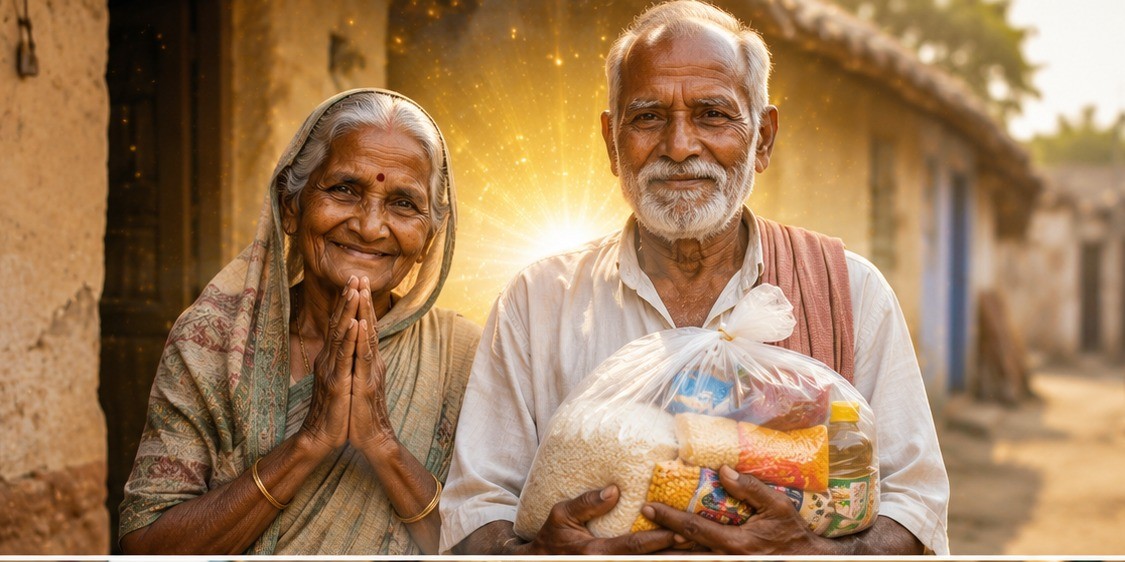
At Jyotirgamaya, our Annadana seva during Adhik Maas 2026 involves offering food and essential groceries to residents of old age homes and children in orphanages throughout the sacred month running from 17 May 2026 to 15 June 2026.
Every contribution is made with a full sankalpa taken in your name and gotra. When Annadana is performed with your name in the sankalpa, the punya generated reaches you and your family completely, extending across your lineage as the Puranas describe.
What Annadana during Adhik Maas 2026 brings:
- Extraordinary punya karma, the highest form available in Sanatana Dharma
- Deep and sustained karma shuddhi, dissolving karmic patterns across multiple layers
- Direct blessing of Bhagwan Vishnu as Narayana, who receives the offering through every hungry person fed
- Peace for ancestors: the punya of Annadana reaches pitrus and brings their blessings to your family
- Protection and wellbeing for the entire household across generations
- Inner peace and emotional relief, the quiet settledness that comes when deep karma lifts
- The blessings of the elderly and of children, which carry unique spiritual potency
Annadana can be performed as a standalone seva or combined with our other Adhik Maas 2026 sevas for a complete offering during this sacred month.
Our other Adhik Maas 2026 sevas include:
- Kamala Ekadashi Maha Puja Seva: For karmic balance, peace, prosperity, and spiritual and material progress
- Parama Ekadashi / Purushottam Ekadashi Maha Puja Seva: For deep karma shuddhi and divine grace
- Akhanda Deepa Seva on 30 May and 01 June 2026: For success, health, wealth, and wish fulfillment
- Gau Seva throughout Adhik Maas: For karmic balance, inner peace, and graha and pitru dosha relief
- Navagraha Shanti Homa on 24 May or 14 June 2026: For sarva graha dosha nivaran and all-round progress
Book your Annadana and other Adhik Maas 2026 sevas here: Adhik Maas Puja Seva Booking at Jyotirgamaya
Frequently Asked Questions
Q. Why is Annadana considered the highest daana in Sanatana Dharma?
The Skanda Purana declares Na annad danam param danam, there is no daana superior to Annadana. Food is called Annam Brahma in the Taittiriya Upanishad, meaning food is the divine itself in its most immediate form. When you offer food to a hungry person, you offer the foundation of all life and all possibility. You are also performing Narayana Seva, serving Bhagwan Vishnu directly in the form of the hungry person, since the tradition teaches that Bhagwan Narayana is present in all beings.
Q. Does Annadana help with karma shuddhi?
Yes. The Skanda Purana states that sincere Annadana can dissolve karma accumulated over many births. This is because Annadana operates at the most fundamental level of existence, the sustaining of life itself, and karma accumulated at that fundamental level responds to acts that work at the same depth.
Q. Why is Annadana during Adhik Maas more powerful?
Bhagwan Vishnu as Purushottama presides over Adhik Maas personally. Bhagwan Vishnu is also Narayana, who appears in the form of every hungry person who receives food. Performing Annadana during Purushottam Maas therefore means feeding Narayana during Narayana's own month. The Padma Purana states that this generates punya equivalent to performing thousands of Annadanas during ordinary months.
Q. Why is feeding the elderly and orphaned children specifically recommended?
The Puranas identify the elderly and children without parents as among the most deserving recipients of Annadana. The elderly carry the dimension of Pitru and parental blessing in the tradition. Bhagwan appears frequently in child form across the Puranas. Feeding those who are most vulnerable and who have no natural protector generates the purest form of Annadana punya.
Q. Can Annadana help with Pitru Dosha?
Yes. The Garuda Purana states that food offered to a hungry person with a sankalpa dedicated to ancestral peace reaches the pitrus as spiritual nourishment. Annadana is one of the most direct and accessible everyday forms of pitru tarpan and is specifically recommended during Purushottam Maas for those dealing with Pitru Dosha.
Q. Can I participate in Annadana if I cannot physically be present?
Yes. When Annadana is performed with your name and gotra in the sankalpa by a trusted organisation, the punya reaches you fully regardless of your physical location. At Jyotirgamaya, all sevas are performed with proper sankalpa and prasadam is dispatched to your home.
Conclusion: The Simplest Offering. The Deepest Grace.
Among all the sevas available during Adhik Maas 2026, Annadana may be the most quietly powerful.
It does not require elaborate preparation. It does not require Vedic expertise or ritual knowledge. It requires only the willingness to feed another person, to see Bhagwan Narayana in the hungry face before you, and to offer what you can with a sincere and open heart.
The Puranas have said it across thousands of years and across every tradition within Sanatana Dharma: there is no daana superior to this. And during Purushottam Maas, when Bhagwan Vishnu Himself presides over the month, when every act of devotion is multiplied and every offering reaches Him directly, this highest daana becomes something extraordinary.
Seven generations of your lineage, forward and back, can receive the blessing of one sincere act of Annadana during these 30 days.
The hungry person who receives your food carries within them the presence of Bhagwan Narayana. The elderly resident of an old age home who eats a meal provided in your name carries in their gratitude the quality of a blessing that the tradition has always recognised as profound.
Mal Maas 2026 runs from 17 May to 15 June. Thirty days in which the highest daana becomes the most powerful offering of the three-year cycle.
Do not let it pass without offering something.
Perform your Annadana and Divine Sevas this Purushottam Maas. Invite Peace. Invite Prosperity. Invite Divine Grace.
Book Your Adhik Maas 2026 Seva at Jyotirgamaya
Om Namo Bhagavate Vasudevaya Annam Brahma. Raso Vishnu. Bhoktha Devo Maheshwara.