


Why Ekadashi Is a Special Day for Dhanvantari Homam
By: Pratima Argade
20 November 2026 at 3:23 AM
Ekadashi, the eleventh tithi of each lunar fortnight, is dear to Bhagwan Vishnu, and Bhagwan Dhanvantari is a form of Bhagwan Vishnu. For this reason, many families treat Ekadashi as one of the most favoured days for a Dhanvantari Homam. You do not need to fast to take part, and no day is too late if your family needs prayer now. The Homam is spiritual support, and it works alongside medical care.
When families plan a Dhanvantari Homam, one of the first questions is, “Which day is best?” Priests and elders often answer, “Ekadashi.” The answer comes up so often that many people assume that the Homam can only be done on this day. In truth, Ekadashi is a traditionally loved day, but it is not the only good one.
In this post, we will explain what Ekadashi is and why it is dear to Bhagwan Vishnu. We will look at why it is considered favourable for a Dhanvantari Homam, and also be honest about when you should not wait for it. We will also share important notes on fasting safety, and practical tips for planning your Homam. We have not mentioned any dates, so that this post stays useful in any year. If you wish to know more about Bhagwan Dhanvantari, you can read our post on who Bhagwan Dhanvantari is.
What Is Ekadashi?
Ekadashi is the eleventh tithi, or lunar day, of each fortnight in the Hindu calendar. Since there are two fortnights in a lunar month, the bright one called Shukla Paksha and the dark one called Krishna Paksha, there are two Ekadashis in every month, and usually twenty four in a year. In some years, with an extra month, there are twenty six.
Each Ekadashi has its own name, such as Utpanna Ekadashi, Mokshada Ekadashi, Parivartini Ekadashi, Indira Ekadashi and many more. Each has its own story and its own special meaning, told in the Puranas.
Ekadashi is also called Hari Vasara, the day of Hari, which is a name of Bhagwan Vishnu. It is observed as a day of simplicity, prayer and self control, and many devotees keep a vrata, which is a fast or a light diet, on this day.
Why Is Ekadashi Dear to Bhagwan Vishnu?
Ekadashi is closely linked with Bhagwan Vishnu in the Puranic tradition. The Padma Purana and other texts describe the glory of Ekadashi. One well known story, told in connection with Utpanna Ekadashi, says that a fierce Asura named Mura was troubling the Devas. When Bhagwan Vishnu was resting, a radiant Devi came forth from his own body and defeated Mura. Pleased with her, Bhagwan Vishnu named her Ekadashi and gave her the blessing that those who keep the vrata of this day with devotion would be dear to him.
Another much loved story is that of King Ambarisha, told in the Bhagavata Purana. Ambarisha was a great devotee of Bhagwan Vishnu who kept the Ekadashi vrata faithfully. Once, the sage Durvasa came to his palace at the end of the vrata and became angry over a small matter, and sent a fierce force against the king. Bhagwan Vishnu’s Sudarshana Chakra protected Ambarisha and then followed Durvasa, until the sage himself asked the king for forgiveness. The story is told to show the power of humility and devotion.
Because of these stories, Ekadashi is remembered as a day when the heart turns easily towards Bhagwan Vishnu. You can read about related traditions in our post on Dhanvantari Homam vs Ayushya Homam vs Sudarshana Homam.
Why Is Ekadashi Linked With Dhanvantari Homam?
The link is simple and beautiful. Bhagwan Dhanvantari is a form of Bhagwan Vishnu, who rose from the Kshira Sagara with the Amrit Kalash. This is described in the Vishnu Purana and the Bhagavata Purana, and we have shared the story in our post on Dhanvantari in the Puranas. When a family offers a Homam to Bhagwan Dhanvantari on a day that is dear to Bhagwan Vishnu, the prayer seems to find a natural home.
Many families therefore feel that Ekadashi is a fitting day to seek the blessings of the divine physician for the health and wellbeing of their loved ones. They are joining the prayer of the day with the prayer for healing.
Why Do Families See Ekadashi as Favourable for a Homam?
Beyond the link with Bhagwan Vishnu, there are a few other reasons that families and teachers mention.
- A day of inner calm. Ekadashi is traditionally a day of simplicity and quiet. Many people feel that the mind settles more easily on this day, as the household slows down and turns to prayer. A calm mind is a good state for any sacred ritual.
- A day of discipline. The vrata asks for restraint in food and in speech, and some also add extra prayer or reading. This sense of discipline gives the Homam a feeling of sincerity.
- A day of shared devotion. On Ekadashi, many families and communities are praying at the same time. Temples are busy with bhajans, Vishnu Sahasranama and special pujas. Taking part in a Homam on such a day can feel like being a part of a larger wave of prayer.
- A long tradition. Our elders and teachers have chosen Ekadashi for important prayers over many generations. This itself gives the day a special feel in the family memory.
- These are traditional views, and a matter of faith and feeling. They are not medical or scientific claims.
Is Ekadashi Really the Best Day?
We would like to be honest here. Ekadashi is one of the most loved days for a Dhanvantari Homam, but it is not the only one. Other days that families choose include Thursdays, which are dear to Bhagwan Vishnu, Trayodashi, which is linked with Dhanteras, the day of your Janma Nakshatra, a birthday or the start of a new year of life, or the day after a surgery or a recovery as a thanksgiving.
Most importantly, if a loved one is unwell and the family needs to pray right now, please do not wait for an Ekadashi. If a doctor has advised treatment or a surgery, please follow the doctor’s schedule, and pray in whatever way and on whichever day is possible for you. The sincere prayer of the family is itself the best muhurta. We have written more about this in our post on prayers before and after surgery.
In short, Ekadashi is a favoured day, and the best day is the day when your heart is ready to pray.
Do You Need to Fast to Take Part in a Homam on Ekadashi?
No. You do not need to fast in order to join a Dhanvantari Homam, whether it falls on Ekadashi or any other day. The Homam is performed by trained priests, and the Sevakartha, who is the person for whom it is done, takes part with faith and a calm mind. Many families sit quietly, in person or online, and follow along in their hearts.
For those who do keep the Ekadashi vrata, the traditional form often includes avoiding grains such as rice and wheat, as well as beans and lentils, and taking only fruits, milk, roots and simple sattvic food, or sometimes only water. The fast is broken the next morning, on Dwadashi, at the proper time, called Parana. Customs differ, so please follow your family tradition and the advice of your priest.
Who Should Be Careful About Fasting?
Fasting is not suitable for everyone, and this is an important point. Please speak to your doctor before keeping any fast if you have a health condition, if you take regular medicines, if you are elderly, or if you are recovering from an illness or a surgery. Pregnant and breastfeeding women, children, and people who are unwell should not fast without medical advice. A long gap between meals, or a change in food and water, can sometimes cause problems, especially for people who take medicines at fixed times.
If you feel weak, dizzy or unwell during a fast, please stop and eat something. Do not skip or delay any medicine to keep a vrata. Many teachers say that devotion does not depend on hunger. A simple light meal, a lamp, a mantra and an act of seva can be a beautiful Ekadashi observance in themselves.
If someone in the family is the patient for whom the Homam is being done, the Sevakartha does not have to fast, and should follow the doctor’s advice on food and rest.
How Do You Plan a Dhanvantari Homam on Ekadashi?
A few simple points help the planning.
- Check the tithi. The Ekadashi tithi may begin on one day and end on the next, and different traditions may observe the vrata on different days. For example, some Smartha and Vaishnava families follow different rules. A good priest or a panchang will tell you the exact days and timings. Please ask your priest which day suits your tradition.
- Think of time zones. If you live abroad, the tithi may start and end at a different time for you than in India. The priests will perform the Homam at the time of the temple or sacred place in India, and you can join in your heart. For your own observance at home, please ask your priest to guide you.
- Book early. Ekadashi is a popular day, so it helps to arrange the Homam in advance.
- Share the details. You will usually be asked for the name, gotra and nakshatra of the Sevakartha, and the purpose of the prayer. Share your wish in simple words, and the priests will take the Sankalpa with care.
- Keep it simple at home. On the day, light a lamp, offer a few Tulasi leaves and chant a mantra, in line with your tradition.
What Simple Practices Can You Do at Home on Ekadashi?
Whether or not you keep a Homam, there are gentle ways to observe Ekadashi at home.
Light a lamp in the morning and evening, and offer a few fresh Tulasi leaves to Bhagwan Vishnu. Chant the Dhanvantari mantra, “Om Namo Bhagavate Vasudevaya Dhanvantaraye Amrita Kalasha Hastaya Sarva Amaya Vinashaya Trailokya Nathaya Dhanvantari Maha Vishnave Namah”, or “Om Namo Narayanaya”. Read or listen to the Vishnu Sahasranama or a few verses of the Bhagavata Purana. Eat a simple, light meal, as your doctor allows. Spend a quiet hour in prayer or meditation. Share food with someone who needs it, or call an elder in the family.
If you wish to do a Dhanvantari Puja, you can follow the steps in our post on how to do Dhanvantari Puja at home. Please take care not to stay awake for long hours, or take on strict practices, if you are unwell or elderly.
How Should We See Ekadashi Prayers and Medical Care Together?
The Dhanvantari Homam and Ekadashi observances are forms of spiritual support. They are not a replacement for medical advice, diagnosis or treatment. They do not promise any result, and they should never delay or replace the care of a doctor.
The best way to see them is as companions to good care. The doctor treats the body, the family looks after the person, and the prayer gives strength, hope and calm to the mind. Please continue to follow your doctor’s guidance, and never stop or change a treatment because of a ritual or a fast.
Where Can You Book a Dhanvantari Homam?
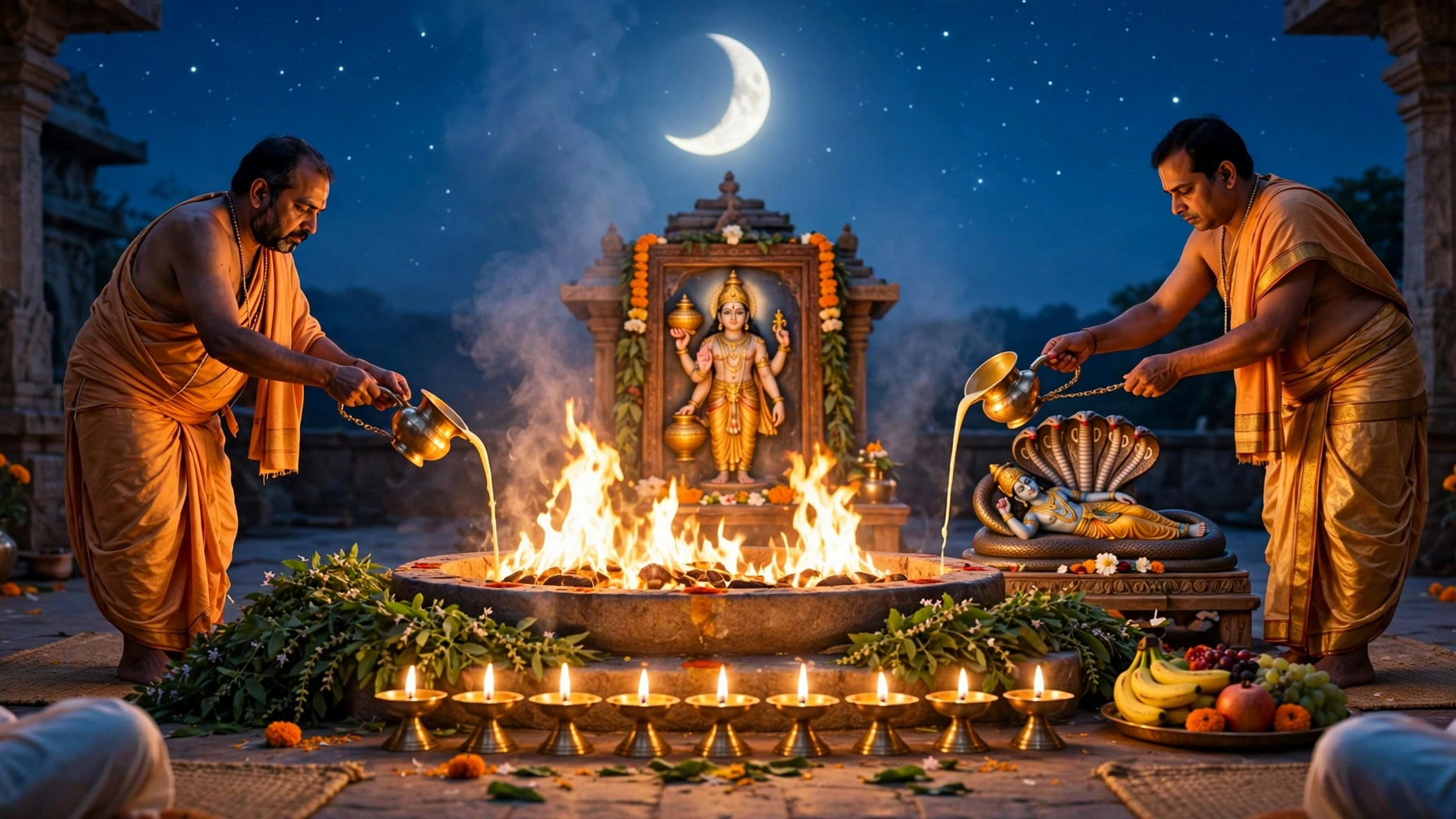
The Dhanvantari Homam can be booked online with Jyotirgamaya, so you can arrange it for yourself or your loved ones from anywhere in the world. The Homam is a Vedic fire ritual that honours Bhagwan Dhanvantari, and it is traditionally performed to seek blessings for health, strength and peace of mind. The priests take a Sankalpa in the name of the person, with their gotra and nakshatra, chant the Dhanvantari mantras and offer ghee and sacred herbs into the sacred fire. You can read more in our post on what the Dhanvantari Homam is, and on our Dhanvantari Homam page.
Key Takeaways
- Ekadashi is the eleventh tithi of each lunar fortnight and is dear to Bhagwan Vishnu, who is also known as Hari.
- Bhagwan Dhanvantari is a form of Bhagwan Vishnu, which is why Ekadashi is a loved day for a Dhanvantari Homam.
- Families see Ekadashi as favourable for its calm, discipline, shared devotion and long tradition, as a matter of faith and not of medicine.
- Ekadashi is not the only good day, and you should never wait for it if a loved one needs prayer or treatment now.
- You do not need to fast to take part in a Homam, and fasting is not suitable for everyone, so please ask your doctor first.
- A Homam is spiritual support and works alongside medical care, never in place of it.
Frequently Asked Questions
Q. Why is Ekadashi good for Dhanvantari Homam?
Ekadashi is dear to Bhagwan Vishnu, and Bhagwan Dhanvantari is a form of Bhagwan Vishnu. Many families also see the day as calm, disciplined and full of devotion, which they feel is fitting for a Homam.
Q. Is Ekadashi the only day for Dhanvantari Homam?
No. Thursdays, Trayodashi, Dhanteras, your Janma Nakshatra day, birthdays and thanksgiving days are also loved. If a loved one needs prayer or treatment now, please do not wait for an Ekadashi.
Q. Do I need to fast for a Dhanvantari Homam on Ekadashi?
No. You can take part without fasting. If you wish to fast, please ask your doctor first, especially if you have any health condition, take medicines, are elderly, pregnant or breastfeeding.
Q. Can a patient fast on Ekadashi?
Please do not fast without the doctor’s advice. Patients and people on regular medicines should follow the doctor’s guidance on food and rest, and can observe Ekadashi through prayer instead.
Q. How do I find the right Ekadashi day?
Ask your priest or check a panchang. The tithi can fall across two days, and different traditions may observe the vrata on different days.
Q. Can NRI families do a Homam on Ekadashi?
Yes. The priests perform the Homam at the temple or sacred place in India, and you can join the prayer in your heart. Please ask your priest to guide your own observance at home, since time zones can change the tithi.
A Note on Health and Faith
The Dhanvantari Homam and Ekadashi observances are forms of spiritual support. They are not a substitute for medical advice, diagnosis or treatment. Please continue to follow your doctor’s guidance and take care of your health along with your prayers.
Seek the Blessings of Bhagwan Dhanvantari
If you wish to pray for the health and wellbeing of your family with the full Vedic method, you can book the Dhanvantari Homam with Jyotirgamaya from anywhere in the world. Visit the Dhanvantari Homam page.