Who Is Bhagwan Dhanvantari? Story of Samudra Manthan and the Amrit Kalash
By: Pratima Argade
7 October 2026 at 11:12 AM
Bhagwan Dhanvantari is the divine physician of the Devas and an avatar of Bhagwan Vishnu. According to the Puranas, he rose from the Kshira Sagara during the Samudra Manthan, holding a kalash filled with Amrit. He is worshipped as the source of Ayurveda and is remembered by devotees for health, healing and wellbeing.
When someone in the family falls sick, most of us do two things together. We call the doctor, and we fold our hands in prayer. This habit is very old in India. Long before modern hospitals, families went to the Vaidya for treatment and turned to Bhagwan for strength and peace of mind. At the centre of this tradition stands one name, Bhagwan Dhanvantari.
He is called the divine physician, the Vaidya of the Devas and the source of Ayurveda. In this post, we will walk through his story from the Puranas, the meaning of his form, his link to Ayurveda and Sushruta, his place in Dhanteras, and the simple ways devotees remember him even today.
Who Is Bhagwan Dhanvantari?
Bhagwan Dhanvantari is the Bhagwan of Ayurveda, the ancient Indian science of life. The Puranas describe him as an amsha, or a divine portion, of Bhagwan Vishnu who appeared for the good of all beings. He came with Amrit, the nectar of immortality, and with the knowledge of healing.
Many traditional Vaidyas remember Bhagwan Dhanvantari before they begin their work. Ayurveda students, doctors and families across India pray to him for the health of their loved ones. In temples of Bhagwan Vishnu, he is often worshipped in a small shrine of his own, especially in the south of India.
It is important to understand one thing at the start. Bhagwan Dhanvantari is not worshipped as a replacement for treatment. Devotees pray to him for blessings, courage and peace of mind, and for the wisdom of the doctors who care for them. This balance between faith and good care has always been part of the Ayurvedic way of life.
What Is the Story of Dhanvantari and Samudra Manthan?
The best known story of Bhagwan Dhanvantari comes from the Samudra Manthan, the churning of the cosmic ocean. You can read this story in the Vishnu Purana, the Bhagavata Purana, and in the Adi Parva of the Mahabharata. The details differ a little from text to text, but the heart of the story is the same.
In the story, the Devas lose their strength and their prosperity after a curse by the sage Durvasa. They go to Bhagwan Vishnu for help. Bhagwan Vishnu advises them to join hands with the Asuras and churn the Kshira Sagara, the ocean of milk, to bring out Amrit. The Devas then regain their strength by drinking it.
Mandara mountain becomes the churning rod, and the great serpent Vasuki becomes the rope. As the mountain begins to sink, Bhagwan Vishnu takes the form of Kurma, the great tortoise, and holds it on his back. The Devas and Asuras pull from both sides, and the ocean begins to give out many things.
The first thing to rise is the deadly poison Halahala, whose heat frightens all the worlds. Bhagwan Shiva drinks it to protect everyone and holds it in his throat. This is why he is known as Neelakantha. After this, the ocean gives out wonderful treasures, called ratnas. These include Kamadhenu the divine cow, the white elephant Airavata, the horse Uchchaihshravas, the Kaustubha gem, the Parijata tree, the Apsaras, Devi Lakshmi and the moon. The order of the ratnas is a little different in different Puranas.
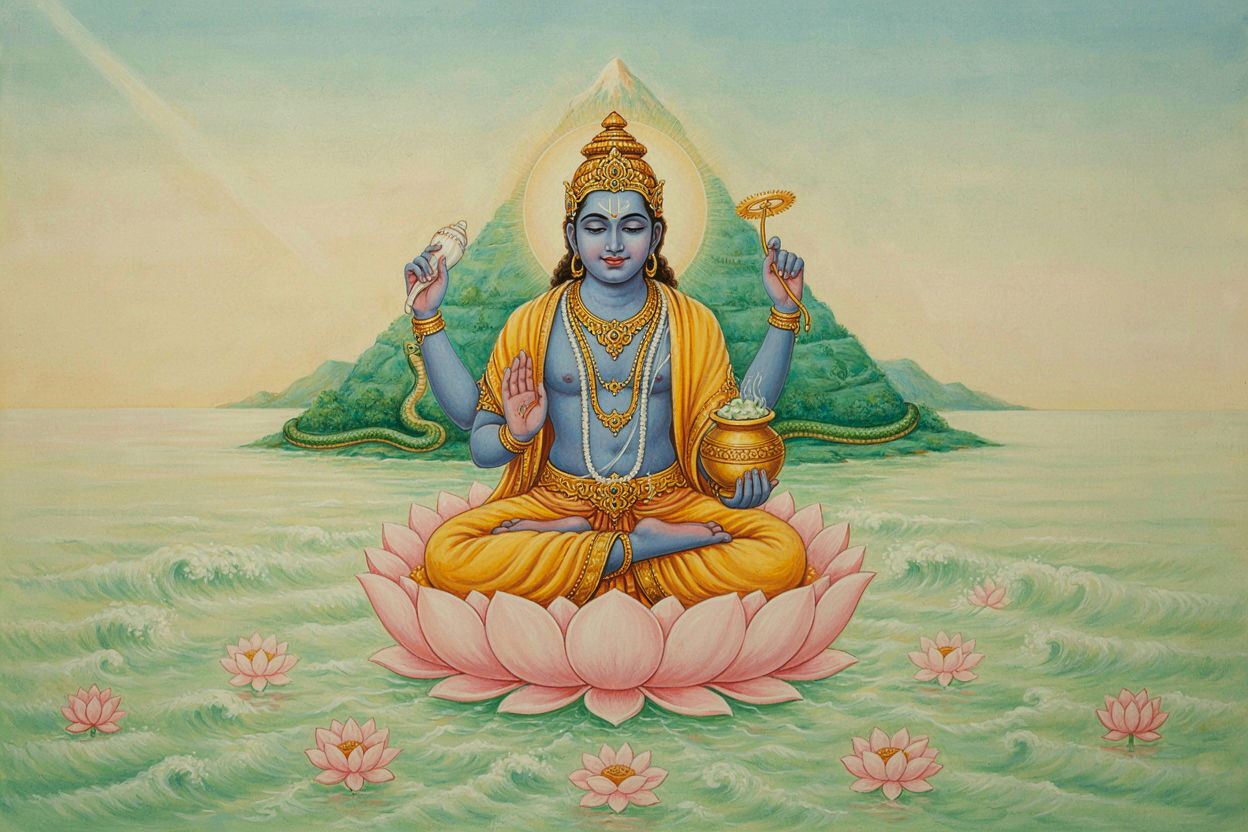
Near the end of the churning, a radiant figure rises from the waves. He is strong and youthful, with a calm face, wearing a garland and fine ornaments, and he carries a kalash full of Amrit in his hands. This is Bhagwan Dhanvantari. The Bhagavata Purana, in its Eighth Canto, describes his arrival and calls him a portion of Bhagwan Vishnu himself.
The Asuras quickly grab the kalash, and a fight begins. Bhagwan Vishnu then takes the beautiful form of Mohini, and with her wisdom the Amrit reaches the Devas. This is the story that gave us the Amrit Kalash, and it is why Bhagwan Dhanvantari is remembered every time we speak of health and long life.
Why Does Dhanvantari Hold the Amrit Kalash?
In Indian devotion, every symbol carries a meaning. The Amrit Kalash in the hands of Bhagwan Dhanvantari is the most important of them all. Amrit is the nectar that removes decay and brings life. The kalash shows that true health is a gift that has to be received with care and thankfulness.
Many pictures and murals show Bhagwan Dhanvantari with four hands. In these forms he holds a shankha, a chakra, a jalauka (a medicinal leech) and the Amrit Kalash. Some forms also show him with healing herbs. Each of these symbols has a traditional meaning.
The shankha and the chakra are the signs of Bhagwan Vishnu, and they remind us that Dhanvantari is Vishnu's own form. The shankha stands for the sacred sound that clears the mind. The chakra stands for protection and for the cycle of time. The jalauka is a link to the old medical practice of using leeches, which the Sushruta Samhita describes in detail. The Amrit Kalash stands for life, vitality and the hope of healing.
Together, these symbols give a simple message. Health is a mix of right knowledge, right treatment, right care and divine blessings. Bhagwan Dhanvantari holds all of these in his hands.
What Do the Puranas and Other Texts Say About Dhanvantari?
Besides the Samudra Manthan, the Puranas speak of Bhagwan Dhanvantari in other ways too. The Bhagavata Purana, in its Ninth Canto, speaks of Dhanvantari being born again in the royal line of Kashi. In this account, he is a teacher and spreader of Ayurveda, and he is called a portion of Vasudeva. The same text says that even remembering his name is believed to remove suffering.
The Vishnu Purana also tells the story of the churning and describes Dhanvantari coming out of the ocean with a vessel of Amrit. In the Garuda Purana, you will find parts of the Ayurvedic teaching given in the form of a conversation between Dhanvantari and the sage Sushruta. Traditional Vaidyas value these chapters for the way they connect medicine with dharma.
Because of these different accounts, some learned people see two moments in the story of Dhanvantari. In the first, he rises from the ocean as an avatar of Bhagwan Vishnu. In the second, he appears in Kashi as a royal teacher of Ayurveda. Many devotees do not separate the two, and they simply worship him as the one Bhagwan of healing.
What Is the Connection Between Dhanvantari and Ayurveda?
Ayurveda is called the Upaveda of the Atharva Veda, and its tradition says that the knowledge came down from Brahma through a line of divine and human teachers. The Ashwini Kumaras, the twin physicians of the Devas, are also an important part of this line. In the tradition of the Sushruta Samhita, Bhagwan Dhanvantari is the one who passed the science of medicine and surgery to humankind.
The opening chapter of the Sushruta Samhita describes how Sushruta and other students go to Divodasa, the king of Kashi, who is identified with Dhanvantari. They ask him to teach them the full science of healing. This is why Sushruta is remembered as the father of surgery, and why the Dhanvantari tradition and the Sushruta tradition are so closely joined.
Ayurveda sees good health as a balance of the body, the senses, the mind and the spirit. The Charaka Samhita says that health is the best foundation for dharma, artha, kama and moksha. The same idea is found in the old saying "Sharira madhyam khalu dharma sadhanam", which means that the body is the first means for fulfilling our duties in life. Bhagwan Dhanvantari stands for this very idea in Indian thought.
Why Is Dhanteras Linked to Bhagwan Dhanvantari?
Dhanteras falls on Trayodashi Tithi, just before Diwali. It is the day on which, as the tradition goes, Bhagwan Dhanvantari appeared with the Amrit Kalash. Many people think of Dhanteras only as a day for buying gold or new metal vessels. The old meaning is deeper than that.
On this day, families remember that health is the first wealth. Ayurveda doctors and Vaidyas worship Bhagwan Dhanvantari, and many homes light a lamp to him in the evening. Some families link the custom of buying a new metal vessel to the Amrit Kalash that he carried. The idea is simple. Before we pray for money and success, we first give thanks for a healthy body and a peaceful mind.
How Do Devotees Worship Bhagwan Dhanvantari?
There are many simple ways to remember Bhagwan Dhanvantari. The most common one is the chanting of his mantra. The mantra that devotees recite is:
Om Namo Bhagavate Vasudevaya Dhanvantaraye Amrita Kalasha Hastaya Sarva Amaya Vinashaya Trailokya Nathaya Dhanvantari Maha Vishnave Namah
This mantra calls upon Dhanvantari, the holder of the Amrit Kalash, who is remembered as the remover of all sickness across the three worlds. People often chant it with a calm mind, sitting before a lamp, after a bath, preferably in the morning.
At home, devotees keep a picture or idol of Bhagwan Dhanvantari in a clean place, light a ghee lamp, offer fresh Tulasi leaves and flowers, and place a simple naivedya offering. They then pray for the health of the family, and for the wellbeing of anyone who is going through a hard time with their health. Many families also pray for the doctors and caregivers who look after their loved ones.
Others choose to take part in the Dhanvantari Homam, a Vedic fire ritual in which the priests chant the Dhanvantari mantra and offer sacred herbs and ghee into the fire with the Sevakartha's Sankalpa. This homa is traditionally performed to seek blessings for health, recovery and peace of mind. Families who live far from home, including NRI families, often book it for their parents in India. You can read about it on our Dhanvantari Homam page.
What Can We Learn from Bhagwan Dhanvantari Today?
The story of Bhagwan Dhanvantari has a few lessons that are useful even in modern life. The first lesson is that the best things in life come after effort and patience, just as the Amrit rose only after a long churning. The second lesson is that care for the body is also part of dharma. The third lesson is that faith and good medical care can walk together, and neither needs to be given up for the other.
In busy lives, we often delay our health until it becomes a worry. The image of Bhagwan Dhanvantari, calm and smiling with the Amrit Kalash, reminds us to respect our daily routine, to eat and rest well, and to pray with a thankful heart.
Key Takeaways
- Bhagwan Dhanvantari is the divine physician of the Devas and an avatar of Bhagwan Vishnu.
- He rose from the Kshira Sagara during the Samudra Manthan, holding the Amrit Kalash.
- He is traditionally seen as the source of Ayurveda and the teacher of Sushruta, the father of surgery.
- His four hands hold a shankha, a chakra, a jalauka and the Amrit Kalash.
- Dhanteras is the day associated with his appearance.
- Devotees remember him through his mantra, home puja and the Dhanvantari Homam, as spiritual support alongside medical care.
Frequently Asked Questions
Q. Who is Bhagwan Dhanvantari?
Bhagwan Dhanvantari is the divine physician of the Devas and an avatar of Bhagwan Vishnu. He is believed to be the source of Ayurveda and is worshipped for health, healing and wellbeing.
Q. Is Dhanvantari an avatar of Bhagwan Vishnu?
Yes. The Bhagavata Purana and the Vishnu Purana describe Dhanvantari as a portion of Bhagwan Vishnu who appeared during the Samudra Manthan to bring Amrit to the Devas.
Q. Why does Dhanvantari hold the Amrit Kalash?
The Amrit Kalash stands for life, vitality and healing. It reminds devotees that health is a precious gift. It also recalls the Amrit that came out of the Kshira Sagara in the story of Samudra Manthan.
Q. What is the connection between Dhanvantari and Ayurveda?
In the tradition of the Sushruta Samhita, Dhanvantari is the divine teacher who gave the science of medicine and surgery to humankind. He is therefore honoured as the Bhagwan of Ayurveda.
Q. Why is Dhanteras linked to Dhanvantari?
Dhanteras is traditionally the day on which Bhagwan Dhanvantari appeared with the Amrit Kalash. Families remember him on this day and give thanks for good health before praying for wealth.
Q. How can I worship Bhagwan Dhanvantari at home?
Light a ghee lamp before his picture, offer Tulasi leaves, flowers and a simple naivedya offering, and chant the Dhanvantari mantra with a calm mind. You may also take part in a Dhanvantari Homam online.
A Note on Health and Faith
Worship of Bhagwan Dhanvantari and the Dhanvantari Homam are forms of spiritual support. They are not a substitute for medical advice, diagnosis or treatment. Please continue to follow your doctor's guidance and take care of your health along with your prayers.
Seek the Blessings of Bhagwan Dhanvantari
If you wish to pray for the health and wellbeing of your family, you can take part in the Dhanvantari Homam with Jyotirgamaya from anywhere in the world. Our experienced priests perform the ritual with your Sankalpa, and you can watch it live. Visit the Dhanvantari Homam page or explore all rituals at JyotirGamaya Online Puja.