Spiritual Support for Families During Long Treatment or a Hospital Stay
By: Pratima Argade
20 October 2026 at 10:07 AM
During a long treatment or a hospital stay, families can find calm through short mantras said quietly in the mind, a small daily prayer routine at home, verses from the Bhagavad Gita and simple acts of seva. Please follow hospital rules, avoid open flames and incense inside the hospital, and keep the doctor informed about everything the patient takes. Prayer supports the family, and works alongside medical care.
A hospital changes the sense of time. Days and nights blur together, the corridor becomes a second home, and every message from a doctor or nurse can lift or lower the heart. Families often say that the hardest part is not only the illness, but the long waiting and the feeling that nothing is in their hands.
In this post, we will share how to pray respectfully inside a hospital, which short mantras are easy to carry, a simple daily rhythm for the family, and ways to keep faith alive at home. We will also speak about caring for yourself, talking to children, and what to avoid so that spiritual practice and medical care go hand in hand. If you wish to know more about Bhagwan Dhanvantari, you may like to read our post on who Bhagwan Dhanvantari is.
Why Does a Hospital Stay Feel So Heavy for Families?
There are many reasons. The first is uncertainty. Families often do not know how long the treatment will take, or what the next report will say. The second is tiredness. Sitting through the night in a chair, eating at odd hours and managing phone calls with relatives is hard on the body. The third is helplessness. We want to do something, but the doctors and nurses are doing the work.
On top of this, there may be worry about costs, about the other family members at home, or about work and children. The mind carries all of this at once. It is natural to feel angry, afraid, numb or tearful, sometimes within the same hour. These feelings do not mean that your faith is weak. They mean that you love someone deeply.
What Can the Bhagavad Gita Teach Us During Long Treatment?
The Bhagavad Gita begins with the despair of Arjuna. In the first chapter, the great warrior puts down his bow, his body trembles and his mind is clouded with sorrow. This is a powerful reminder that even the strongest person can be overwhelmed. Bhagwan Krishna does not scold him. He listens and then slowly gives him strength and clarity.
Two ideas from the Gita are especially helpful for families. The first is in the second chapter, where Bhagwan Krishna says that we have a right to our actions, but not to the fruits of those actions. For a family, this can mean that we do our best, such as following the doctor’s advice, staying present and caring with love, and then we leave the result in the hands of Bhagwan. This does not mean giving up. It means releasing the heavy grip of worry about what we cannot control.
The second idea is equanimity, which is steadiness of mind in success and failure, in pleasure and pain. The Gita calls this a form of yoga. During a hospital stay, a few moments of steadiness, even if short, are a real gift to yourself and to the patient who senses your calm.
How Can We Pray Inside a Hospital Respectfully?
A hospital is a shared space with strict safety rules, and it is important to follow them. Here are a few simple guidelines.
Do not light a lamp, camphor or incense inside a ward or a room. Fire and smoke are not safe around medical equipment and oxygen, and other patients may be sensitive to smells. If you wish to pray, do it quietly in your mind or in a soft whisper, without disturbing other patients or staff.
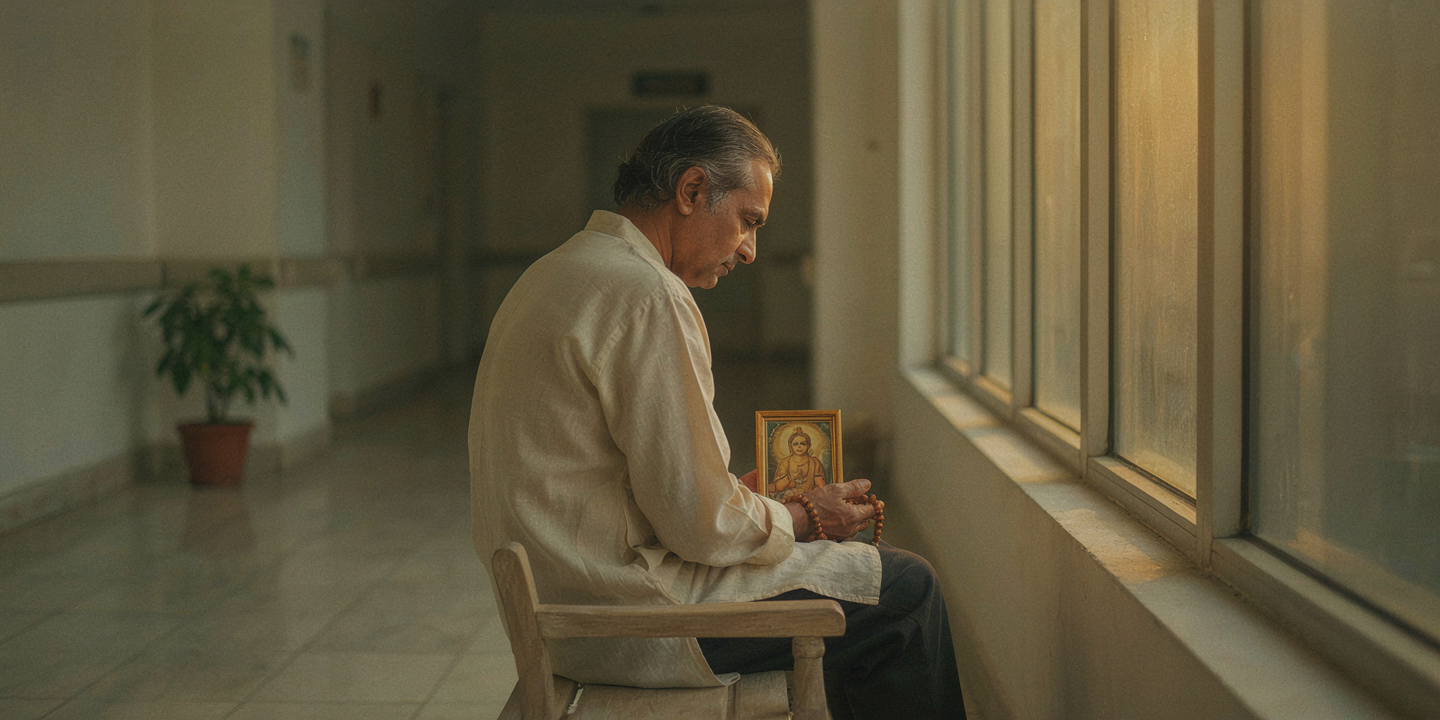
You may keep a small picture of Bhagwan Dhanvantari or your Ishta Devata at the bedside, if the hospital allows it. A small mala, a small book of prayers, or a mobile phone with soft audio on headphones are easy ways to pray without trouble. Many hospitals also have a quiet room or a small prayer area, and you may ask the staff about it.
If you wish to bring prasadam, holy water, sacred ash or a herbal preparation from a temple or a Vaidya, please check with the nurse or doctor first. Some patients are on strict diets or medicines, and even a small item can sometimes cause a problem. A sincere prayer in the heart needs no permission and causes no harm.
Which Short Prayers and Mantras Are Easy to Carry?
In a hospital, short mantras are easier to hold. You can repeat them in your mind while you sit, walk in the corridor or wait outside the room. Here are some that families often choose.
- Om Shri Dhanvantaraye Namah. A short salutation to Bhagwan Dhanvantari, the divine physician. You can read the full meaning in our post on the Dhanvantari mantra.
- Om Namo Narayanaya. The eight syllable mantra of Bhagwan Vishnu, which many families repeat for peace and shelter.
- Om Namah Shivaya. The five syllable mantra of Bhagwan Shiva, loved by families across India.
- The Maha Mrityunjaya mantra. “Om Tryambakam Yajamahe Sugandhim Pushtivardhanam, Urvarukamiva Bandhanan Mrityor Mukshiya Maamritat”, a prayer to Bhagwan Shiva for protection and courage.
- The Gayatri mantra. A prayer for a clear and bright mind.
- Rama Nama or Krishna Nama. Simply repeating the name of Bhagwan Rama or Bhagwan Krishna, which anyone can do, however tired.
- The Hanuman Chalisa. Many families listen to it softly for courage and inner strength.
Choose one or two that feel natural, and stay with them. It is better to repeat one mantra with a quiet heart than to try many in a restless way.
What Is a Simple Daily Rhythm for the Family?
A small rhythm gives structure to days that otherwise feel shapeless. Here is one idea that you can change to suit your own situation.
- Morning. Before the day begins, take two minutes to fold your hands and offer a prayer. You may say, “Bhagwan, give us strength for today.” If you are at home, light the lamp at your family shrine. If you are at the hospital, simply close your eyes and bring the picture of Bhagwan to mind.
- Midday. When you get a short break, step outside for fresh air if possible. Take a few slow breaths, repeat a mantra 11 times in your mind, and drink some water. Even a three minute pause helps the body and the mind.
- Evening. When the day winds down, offer a short prayer of thanks, for the doctors and nurses, for the family that stands with you, and for the small good things that happened today, however small. At home, another family member can light the evening lamp and chant for the patient.
- Night. If you cannot sleep, do not fight it. Lie down, breathe slowly and repeat a mantra softly in the mind. Rest, even without sleep, is valuable.
How Can We Keep Faith Alive at Home During the Hospital Stay?
Family members who are not at the hospital can also take part in the prayer. This is a good way to share the load and to feel that everyone is involved.
Light a lamp at the home shrine each morning and evening, with the patient’s name in your Sankalpa. Chant a mantra together as a family, at a fixed time, even for five minutes. Water the Tulasi plant and offer a few quiet words of prayer. Visit a nearby temple when you can, and offer a prayer for the patient and for all those who are unwell.
Many families also take up acts of seva during this time, such as feeding a hungry person, giving to a hospital or helping a neighbour in need. The Vedic tradition values daana, or giving, as a way to bring peace to the giver. Please give only within your means, and do not feel pressure to spend beyond your comfort.
How Can You Look After Yourself and Share the Load?
The caregiver at the hospital is often the first person to run out of strength. Please remember that you cannot pour from an empty cup. A few simple steps can help.
Share the hospital duties among family members, even if only for a few hours each. Eat regular meals, even if they are simple, and drink enough water. Rest when someone else can sit with the patient. Step outside for fresh air and sunlight when you can. Keep a small notebook for the doctor’s instructions, medicines and questions, so that your mind does not have to hold everything.
Accept help when friends and neighbours offer it, such as bringing a meal or looking after a child. If you feel very low, very anxious or unable to cope, please speak to the hospital counsellor, your doctor or a trusted professional. Asking for support is a sign of wisdom, and not a lack of faith.
How Do We Talk to Children and Elders in the Family?
Children notice more than we think. If a loved one is in the hospital, it is better to tell them in simple and honest words, suited to their age, than to leave them guessing. You may say something like, “Dadi is unwell, and the doctors are taking good care of her. We are praying for her, and we will visit when we can.” Invite them to take part in a small prayer, such as lighting the lamp or drawing a picture for the patient.
Elders in the family may feel the worry very deeply, and some may try to hide it. Include them in the daily prayer, give them regular updates and keep their routine as steady as possible. A short time of sitting together and chanting can help them feel calm.
What Should We Avoid During Long Treatment?
A few cautions help to keep spiritual practice safe and helpful.
Do not delay or replace medical care because of a ritual, a remedy or a promise. No honest priest, astrologer or healer can promise a cure. Do not give the patient any herbs, powders, holy water or home remedies without asking the doctor, as these can interact with medicines. Always tell the treating doctor about everything the patient is taking.
Do not spend beyond your means on rituals, and be careful with anyone who creates fear or pressure. Do not blame the patient or the family by saying that the illness is due to karma or a lack of faith. And do not push a long ritual on a patient who is tired or unwell. Their comfort and rest come first.
Can a Homam Support the Family During Treatment?
Many families choose to arrange a Homam while a loved one is in treatment. The Dhanvantari Homam is a Vedic fire ritual that honours Bhagwan Dhanvantari, the divine physician. It is traditionally performed to seek blessings for health, strength and peace of mind. The priests take a Sankalpa in the name of the patient, chant the Dhanvantari mantras and offer ghee and sacred herbs into the fire.
The advantage of a Homam is that it is done at a temple or sacred place, so the family does not have to leave the patient. It can also be booked online, which is a great help to families who are far from home, including NRI families. The family can sit quietly at the hospital or at home, and join the prayer in their hearts. Some families also choose the Maha Mrityunjaya Homam or the Ayushya Homam. Our posts on Dhanvantari Homam vs Maha Mrityunjaya Homam and on Dhanvantari Homam vs Ayushya Homam vs Sudarshana Homam may help you decide. You can read more on our Dhanvantari Homam page.
How Should We See Prayer and Medical Care Together?
Prayer, mantras and the Homam are forms of spiritual support. They are not a replacement for medical advice, diagnosis or treatment. They do not promise any result, and they should never delay or replace the care of a doctor, especially in a serious condition.
The best way to see prayer is as a companion to good care. The doctors and nurses treat the body, the family cares for the person, and the prayer gives strength, hope and calm to the mind. When all three walk together, the family feels supported at every level. Please continue to follow your doctor’s guidance, and never stop or change a treatment because of a ritual.
Key Takeaways
- Short mantras said quietly in the mind are the easiest way to pray inside a hospital.
- Follow hospital rules, and avoid open flames and incense. Check with the nurse before bringing prasadam, holy water or herbs.
- The Gita reminds us to do our best and release the heavy worry about the result.
- A simple daily rhythm of morning, midday, evening and night gives structure to hard days.
- Family members at home can take part through a lamp, a mantra, Tulasi care and seva within their means.
- Never delay or replace treatment because of a ritual, and look after the caregiver as well as the patient.
Frequently Asked Questions
Q. How can I pray for a patient in the hospital?
Pray quietly in your mind or in a soft whisper, repeat a short mantra such as “Om Shri Dhanvantaraye Namah”, keep a small picture or mala at the bedside if allowed, and follow hospital rules. You can also light a lamp at your home shrine with the patient’s name in your Sankalpa.
Q. Can I light a lamp or incense in the hospital?
No. Open flames and incense are not safe in hospitals. Please pray in your mind, or use a quiet prayer room if the hospital has one.
Q. Can I give prasadam or holy water to a patient?
Please ask the doctor or nurse first. Some patients are on strict diets or medicines, and even a small item can sometimes cause a problem.
Q. Which mantra is best during a hospital stay?
There is no single best mantra. Many families choose the Dhanvantari mantra, “Om Namo Narayanaya”, “Om Namah Shivaya”, the Maha Mrityunjaya mantra or the Hanuman Chalisa. Choose the one that feels close to your heart.
Q. Can a Homam be done while the patient is in the hospital?
Yes. Many families book a Homam, often online, and take the Sankalpa in the patient’s name. The family can join the prayer in their hearts from the hospital or from home.
Q. How can I stay calm during a long treatment?
Keep a simple daily rhythm, share duties, eat and rest as best you can, take short pauses for breath and mantra, and speak to a counsellor if you feel very low or anxious. Prayer is a support for your heart, and it works alongside the care of the doctors.
A Note on Health and Faith
Prayer, mantra chanting and the Dhanvantari Homam are forms of spiritual support. They are not a substitute for medical advice, diagnosis or treatment. Please continue to follow your doctor’s guidance and take care of your health along with your prayers.
Seek the Blessings of Bhagwan Dhanvantari
If you wish to pray for the health and wellbeing of your loved one with the full Vedic method, you can book the Dhanvantari Homam with Jyotirgamaya from anywhere in the world. Visit the Dhanvantari Homam page.