


Rahu and Ketu: Health Worries That Are Hard to Explain in Vedic Astrology
By: Pratima Argade
2 November 2026 at 10:37 AM
In Vedic astrology, Rahu and Ketu are the shadow planets linked with the unusual, the sudden and the hard to explain. Rahu is associated with restlessness, overthinking and unclear or unusual matters, and Ketu with detachment and hidden or hard to trace matters. They are traditional lenses for reflection, and never a medical diagnosis. Any symptom that is unexplained should always be checked by a doctor, along with prayer and care.
Few words in Jyotish bring as much worry as Rahu and Ketu. Families say, “The doctors cannot find anything, so it must be Rahu.” Or, “The reports are normal, but the trouble keeps coming back. Is it Ketu?” When a health problem is hard to explain, the mind searches for any answer, and astrology can seem to offer one.
In this post, we will share the story of Rahu and Ketu from the Samudra Manthan, explain what they represent in Vedic astrology, and look at why they are linked with health worries that are hard to explain. We will also say clearly what to do when symptoms are unexplained, which myths to set aside, and which spiritual practices the tradition suggests. If you wish to know more about Bhagwan Dhanvantari, you can read our post on who Bhagwan Dhanvantari is.
Who Are Rahu and Ketu?
The story of Rahu and Ketu comes from the Samudra Manthan, the same churning of the ocean that brought out Bhagwan Dhanvantari with the Amrit Kalash. You can read the main story in our post on who Bhagwan Dhanvantari is.
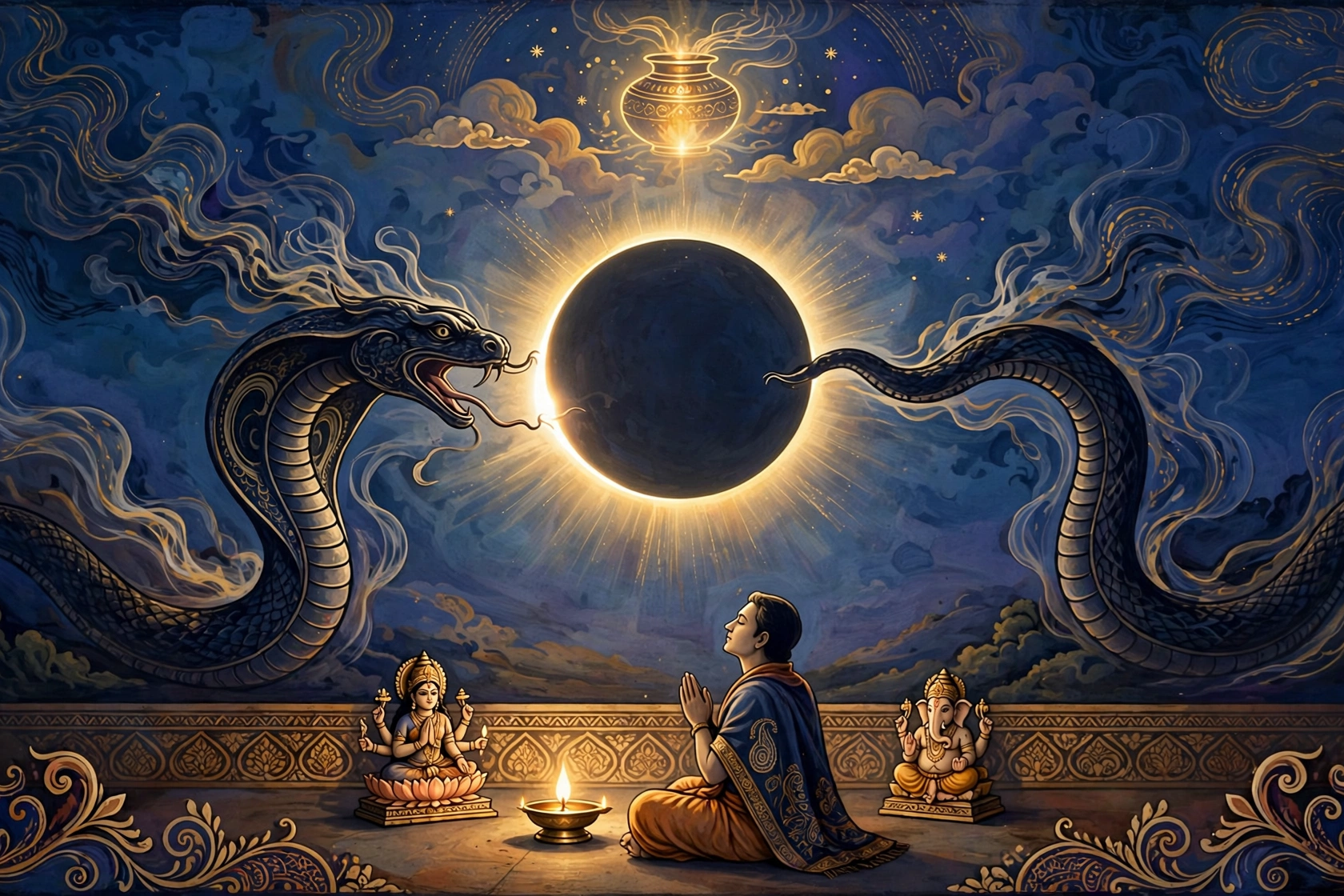
According to the Puranas, when the Amrit was being shared among the Devas, an Asura named Svarbhanu disguised himself as a Deva and sat between Surya and Chandra to drink it. The Sun and the Moon recognised him and told Bhagwan Vishnu, who then used the Sudarshana Chakra. By then, a drop of Amrit had touched the throat of Svarbhanu. His head and body were separated but he did not die. The head became Rahu, and the body became Ketu.
The tradition says that Rahu and Ketu hold a memory of this event, and that is why they chase the Sun and the Moon across the sky, causing eclipses. This is the traditional story, told with devotion and meaning, and it is not a statement of astronomy.
In astronomy, Rahu and Ketu are the two points where the path of the Moon crosses the path of the Sun, called the lunar nodes. They are always exactly opposite each other in the sky, and they move backwards through the zodiac, taking about eighteen months in each sign. In Jyotish, they are called Chhaya Grahas, or shadow planets, since they are not physical bodies but are treated as powerful points.
What Do Rahu and Ketu Represent?
Jyotish teachers describe Rahu and Ketu as a pair, with two sides of the same karmic axis.
Rahu is linked with desire, ambition, illusion, the unfamiliar, foreign lands, technology, sudden rises and falls, and a restless mind. It is said to magnify whatever it touches and to pull a person into new and unusual experiences. Rahu is also linked with confusion, overthinking and a feeling that something is not quite clear.
Ketu is linked with detachment, the past, spirituality, hidden matters and letting go. It is said to cut and to separate, and to turn a person inward. Ketu is also linked with things that are subtle, hard to trace and hard to put into words.
Together, Rahu and Ketu are called karmic planets, because they point to patterns and lessons that run deep in a person’s life.
Why Are Rahu and Ketu Linked With Hard to Explain Health Worries?
Since Rahu and Ketu stand for the unusual, the unclear and the hidden, Jyotishis traditionally connect them with health worries that do not fit a simple pattern. These may be symptoms that come and go, discomforts that are hard to name, or health concerns that take a long time to understand.
For Rahu, the traditional themes include restlessness, anxiety, overthinking, sleep that is disturbed, sensitivity to the environment and symptoms that seem strange or sudden. In terms of the Ayurvedic idea of the doshas, Rahu is often linked with Vata. For Ketu, the themes include discomforts that are subtle and hard to trace, a feeling of low energy or detachment, and also cuts and wounds. Ketu is often linked with the Pitta nature in some schools.
These are traditional themes, and they are not a list of conditions. There are also many different views among Jyotishis. Please treat this as a way of thinking and reflecting, and not as a way of explaining or diagnosing your symptoms.
What Should You Do If Symptoms Are Unexplained?
This is the most important part of this post. A health problem that is hard to explain is a medical matter first. Please do not wait or accept any astrological explanation in place of a proper check.
Please see a doctor and describe your symptoms clearly. Keep a simple record of what you notice, with the date, the time, what makes it better or worse, and any medicines you take. If you feel that your concerns are not being understood, ask for a second opinion or a visit to a specialist. Many conditions take time and several steps to understand, and persistence is not a sign of weakness.
Also remember that the mind and the body are closely linked. Stress, worry and poor sleep can cause real physical symptoms, and a doctor or counsellor can help with these too. Seeking help for mental wellbeing is as important as seeking help for the body. Our post on Vedic practices for peace of mind during stress, worry and sleepless nights has simple practices that may help alongside medical care.
Please never say, or let anyone say, “It is just Rahu” or “It is just Ketu” to dismiss real symptoms. A good Jyotishi will always ask whether you have seen a doctor.
How Do Rahu and Ketu Periods and Transits Work?
In Vedic astrology, there are two main ways in which Rahu and Ketu are said to influence a life.
The first is through the dasha system. In the Vimshottari dasha system, Rahu has a long period of eighteen years, and Ketu has a period of seven years. When such a period is running, their themes are believed to come into focus, and the results depend on their sign, house, strength and the planets connected with them in the birth chart.
The second is through transit, which is the actual movement of Rahu and Ketu in the sky. When they pass over sensitive points in a chart, such as the Lagna or the natal Moon, some people feel that matters of the mind or the body come into focus. Each pass lasts for a limited time, and we have not mentioned any dates in this post, so that it stays useful at any time.
As with all of Jyotish, these influences need a trained reading of the full chart. A single line about Rahu or Ketu is never enough.
What Are Some Myths and Facts About Rahu, Ketu and Health?
Myth: Rahu and Ketu always cause mysterious illness. Fact: They are traditional symbols for the unusual and the hidden. Many people go through Rahu and Ketu periods without any health trouble.
Myth: If the reports are normal, the problem must be astrological. Fact: Normal reports can mean many things, including that more steps are needed. Please keep working with your doctors, and do not use astrology to stop looking for answers.
Myth: Rahu Ketu problems can only be solved by an expensive ritual. Fact: The tradition mostly suggests simple prayer, discipline, seva and patience. There is no need for costly rituals.
Myth: You must avoid food or medicines during an eclipse. Fact: Some families follow customs during eclipses. Please do not skip needed meals or medicines because of them. Pregnant women should follow their doctor’s advice and should not be made to feel afraid by traditional customs.
Myth: A person under Rahu or Ketu is cursed. Fact: These graha are seen as teachers of detachment, depth and inner growth. Many people find that these periods bring new insight and a deeper spiritual life.
What Gentle Self Care Can Help During Such Times?
Self care helps whatever the cause. Keep a regular daily routine for sleep, meals and rest. Limit late night screens and constant news, which can feed restlessness. Take a short walk in daylight, and keep your body gently active, in line with your doctor’s advice. Spend time with people who calm you, and take time to be quiet. Write your worries on paper and take them to your doctor if they are about symptoms. Go for your regular health check ups.
If you notice that worry, panic, low mood or sleeplessness lasts for weeks, please speak to a doctor or a counsellor. Do not wait for a planetary period to change. If you ever have thoughts of harming yourself, please reach out for help right away to a trusted person or a mental health professional, and in an emergency call your local emergency services.
Which Spiritual Practices Does the Tradition Suggest?
The tradition suggests simple devotional practices for Rahu and Ketu, which build calm, clarity and humility. They do not promise any outcome.
Worship of Devi Durga. Many people pray to Devi Durga for Rahu, as she is seen as a protector who removes confusion and fear. The Durga Saptashati and simple Durga prayers are common.
Worship of Bhagwan Ganesha. Bhagwan Ganesha, the remover of obstacles, is the traditional deity for Ketu. Prayers to him help a person start with a clear mind.
Worship of Bhagwan Shiva. Both Rahu and Ketu are connected with Bhagwan Shiva in the tradition, and prayers such as “Om Namah Shivaya” or the Maha Mrityunjaya mantra are common.
Mantras. The simple mantras “Om Raam Rahave Namah” for Rahu and “Om Kem Ketave Namah” for Ketu are chanted with a mala. More detailed beeja mantras are also used. Please let your priest advise on the right form.
Seva and kindness. Feeding street animals, helping those who clean and serve our cities, and supporting those in need are traditional ways of working with these graha. Kind and honest living is the best remedy in Jyotish.
Meditation and quiet. Since Ketu is the graha of inner life, a few minutes of silent prayer or meditation each day is considered very valuable.
Which Remedies Need Extra Care?
Please be careful with high priced gemstones, such as Gomed for Rahu and Cat’s Eye for Ketu. In the tradition, they are very strong stones that may not suit everyone, and they are often sold with fear and a high price. Please do not wear one without careful advice from a trusted Jyotishi, never spend beyond your means, and never use a gemstone in place of treatment.
Please walk away from anyone who creates panic, demands large payments, or tells you to stop medicines or avoid doctors. A good Jyotishi will always encourage you to continue medical care alongside prayer.
Where Does the Dhanvantari Homam Fit In?
The Dhanvantari Homam has a special link with the Rahu and Ketu story. Both are part of the Samudra Manthan, and the Amrit that Bhagwan Dhanvantari carried is the very Amrit that changed the fate of Svarbhanu. For families who are going through a period of hard to explain health worries, Jyotish teachers often suggest the Dhanvantari Homam as a supportive ritual.
It is a Vedic fire ritual that honours Bhagwan Dhanvantari, the divine physician, and it is traditionally performed to seek blessings for health, strength and peace of mind. The priests take a Sankalpa in the name of the person, with their gotra and nakshatra, chant the Dhanvantari mantras and offer ghee and sacred herbs into the fire. The Homam can also be booked online, so you can join the prayer in your heart from anywhere. You can read more on our Dhanvantari Homam page.
How Should We See Astrology and Medical Care Together?
Astrology and the Homam are forms of spiritual guidance and support. They are not a replacement for medical advice, diagnosis or treatment. They do not promise any result, and they should never delay or replace the care of a doctor, especially when symptoms are unexplained.
The best way to see them is as companions to good care. The doctor looks for answers and treats the body, the family offers love and support, and Jyotish and prayer give reflection, patience and calm to the mind. Please continue to follow your doctor’s guidance, and never stop or change a treatment because of an astrological remedy.
Key Takeaways
- Rahu and Ketu are the shadow planets from the story of Svarbhanu in the Samudra Manthan, and they stand for the unusual, the hidden and the karmic.
- Jyotish traditionally links them with health worries that are hard to explain, but this is a lens for reflection and never a diagnosis.
- Unexplained symptoms always need a doctor, and a second opinion or a specialist visit is a sensible step.
- Stress, worry and poor sleep can cause real symptoms, so mental wellbeing needs care too.
- Traditional practices include prayers to Devi Durga, Bhagwan Ganesha and Bhagwan Shiva, simple mantras and seva, and gemstones and costly rituals need great care.
- A Homam is spiritual support and works alongside medical care, never in place of it.
Frequently Asked Questions
Do Rahu and Ketu cause health problems?
In Jyotish, Rahu and Ketu are traditionally linked with unusual and hard to explain matters, but they are symbols for reflection and not causes of illness. Astrology cannot diagnose any condition, and medical advice should always come first.
What should I do if doctors cannot find the cause of my symptoms?
Keep a clear record of your symptoms, ask for a second opinion or a specialist, and also speak about stress and sleep. Do not use astrology to stop looking for answers.
Which mantra is chanted for Rahu and Ketu?
Simple mantras are “Om Raam Rahave Namah” for Rahu and “Om Kem Ketave Namah” for Ketu. Many people also pray to Devi Durga, Bhagwan Ganesha and Bhagwan Shiva. Please let your priest advise on the right form.
Should I avoid eating or taking medicines during an eclipse?
Some families follow customs during eclipses, but please do not skip needed meals or medicines. Pregnant women should follow their doctor’s advice.
Should I wear Gomed or Cat’s Eye?
These stones are very strong and may not suit everyone, and they are often sold at a high price. Please do not wear them without careful advice from a trusted Jyotishi, and never use them in place of treatment.
Can a Homam help with Rahu and Ketu related worries?
Teachers often suggest the Dhanvantari Homam as a supportive ritual. It is spiritual support performed to seek blessings, strength and peace of mind, and it does not replace medical care.
A Note on Health and Faith
Astrology, prayer and the Dhanvantari Homam are forms of spiritual guidance and support. They are not a substitute for medical advice, diagnosis or treatment. Please continue to follow your doctor’s guidance and take care of your health along with your prayers.
Seek the Blessings of Bhagwan Dhanvantari
If you wish to pray for the health and wellbeing of your family with the full Vedic method, you can book the Dhanvantari Homam with Jyotirgamaya from anywhere in the world. Visit the Dhanvantari Homam page.