Prayers for Children Who Often Fall Sick: Guidance for Worried Parents
By: Pratima Argade
22 October 2026 at 1:00 AM
When a child falls sick again and again, parents can find comfort in simple prayers such as the Dhanvantari mantra, the evening deepa shloka “Shubham Karoti”, and short family prayers done together with the child. Please also speak to your child’s doctor about the pattern of illness, and follow the medical advice fully. Prayer gives the family peace, and it works alongside medical care.
Few things worry a parent more than a child who is unwell. When the illness comes back every few weeks, the worry grows into a constant companion. You wake at night to check a forehead, you plan your days around doctor visits, and you wonder whether you are missing something. Many parents also quietly carry a feeling of guilt, even though they are doing everything they can.
In this post, we will share how to take the first practical steps with your child’s doctor, what Hindu tradition says about children and protection, a few easy prayers that children can learn, and a five minute family routine. We will also speak about caring for your own mind as a parent, about traditional customs that need a little care, and about how a Homam can offer support. If you wish to know more about Bhagwan Dhanvantari, you can read our post on who Bhagwan Dhanvantari is.
Why Do Parents Worry So Much When a Child Keeps Falling Sick?
A child cannot always tell us how they feel, and a parent has to guess. This makes every cough, every fever and every night of crying feel heavy. Parents also compare their child with other children, hear advice from relatives and read stories online, which can make the worry louder.
Many parents begin to blame themselves. They ask, “Did I feed the wrong thing? Did I miss a sign? Did I do something wrong?” It is important to say clearly here that children, especially young ones in school or play groups, often fall sick quite a few times a year, as their bodies are still learning to deal with the world. The blame that a parent places on themselves is almost never fair.
At the same time, a pattern of repeated illness should never be ignored. This brings us to the first and most important step.
What Is the First Step? Talk to Your Child’s Doctor
If your child falls sick often, please speak to a paediatrician. Share a simple record of what has happened, such as the dates, the symptoms, how long each illness lasted and what treatment was given. Ask the doctor whether the pattern is expected for your child’s age, and whether any check is needed.
Please follow the doctor’s advice on medicines, food, rest and vaccinations, including the vaccine schedule that has been recommended for your child. Do not give any medicine, herb, home remedy or holy water to a young child without asking the doctor, as small bodies can react in ways that adults do not expect.
Please see a doctor at once if your child has trouble breathing, a high fever that does not settle, unusual sleepiness or weakness, signs of dehydration, a fit, or any sign that makes you feel that something is not right. A parent’s feeling is worth listening to. Prayer is a support for the family and never a reason to wait.
What Does Hindu Tradition Say About Children and Protection?
Children hold a very special place in Hindu tradition. The sixteen samskaras, or life sacraments, begin even before birth, and several of them are prayers for the child’s health, long life and good character. The Jatakarma at birth, the Namakarana at the naming and the Annaprashana at the first feeding all include blessings for the wellbeing of the child.
The Puranas also tell us of young devotees who were protected by their faith. In the Bhagavata Purana, little Prahlada held on to his love for Bhagwan Vishnu in the face of great trouble, and the boy Dhruva reached a place of lasting honour through his devotion. The sage Markandeya, as a boy, was blessed with a long life through his devotion to Bhagwan Shiva. These stories are not promises that every prayer will bring an exact result. They show us the deep Indian belief that a child’s pure heart is dear to Bhagwan.
The Dhanvantari tradition adds another layer. Bhagwan Dhanvantari is the divine physician, and families have long prayed to him for the health of all family members, including children.
Which Prayers and Mantras Can Parents and Children Say?
Children respond best to short, sweet and simple prayers. Here are some options, which you can use with a child of any age.
- The evening deepa shloka. “Shubham Karoti Kalyanam, Arogyam Dhana Sampadam, Shatru Buddhi Vinashaya, Deepa Jyotir Namostute”. It means, “I bow to the light of the lamp, which brings what is auspicious, wellbeing, health and prosperity, and which removes negative thoughts.” Many Indian children grow up hearing this verse at dusk. You can read it as a loving evening habit.
- A morning shloka. “Karagre Vasate Lakshmih, Karamadhye Saraswati, Karamule Tu Govindah, Prabhate Karadarshanam”. It is a gentle prayer to see the palms on waking and to remember Lakshmi, Saraswati and Govinda, with a thankful heart.
- The short Dhanvantari mantra. “Om Shri Dhanvantaraye Namah”. A salutation to Bhagwan Dhanvantari that parents can chant for the child. You can read more in our post on the Dhanvantari mantra.
- Om Namo Bhagavate Vasudevaya. A twelve syllable mantra of Bhagwan Vishnu, which the Bhagavata Purana links with the boy Dhruva.
- The Gayatri mantra. A prayer for a bright and clear mind, which many children learn.
- A Shanti prayer for learning. “Om Saha Navavatu, Saha Nau Bhunaktu, Saha Viryam Karavavahai, Tejasvi Navadhitamastu, Ma Vidvishavahai, Om Shantih Shantih Shantih”. It means, “May Bhagwan protect us both, may he nourish us both, may we work together with energy, may our learning be bright, and may we never quarrel. Om peace, peace, peace.” It is a beautiful prayer for a parent and child to say together.
- Bala Krishna or Bala Hanuman prayers. Many parents like to pray to the child form of Bhagwan Krishna or to Bhagwan Hanuman, as children feel a natural love for them.
You do not have to use all of these. Choose one or two that your family feels close to, and let the child grow into the others over time.
What Is a Five Minute Family Prayer Routine for Children?
A short and joyful routine teaches children that prayer is a happy part of the day, and not a duty. Here is a simple idea.
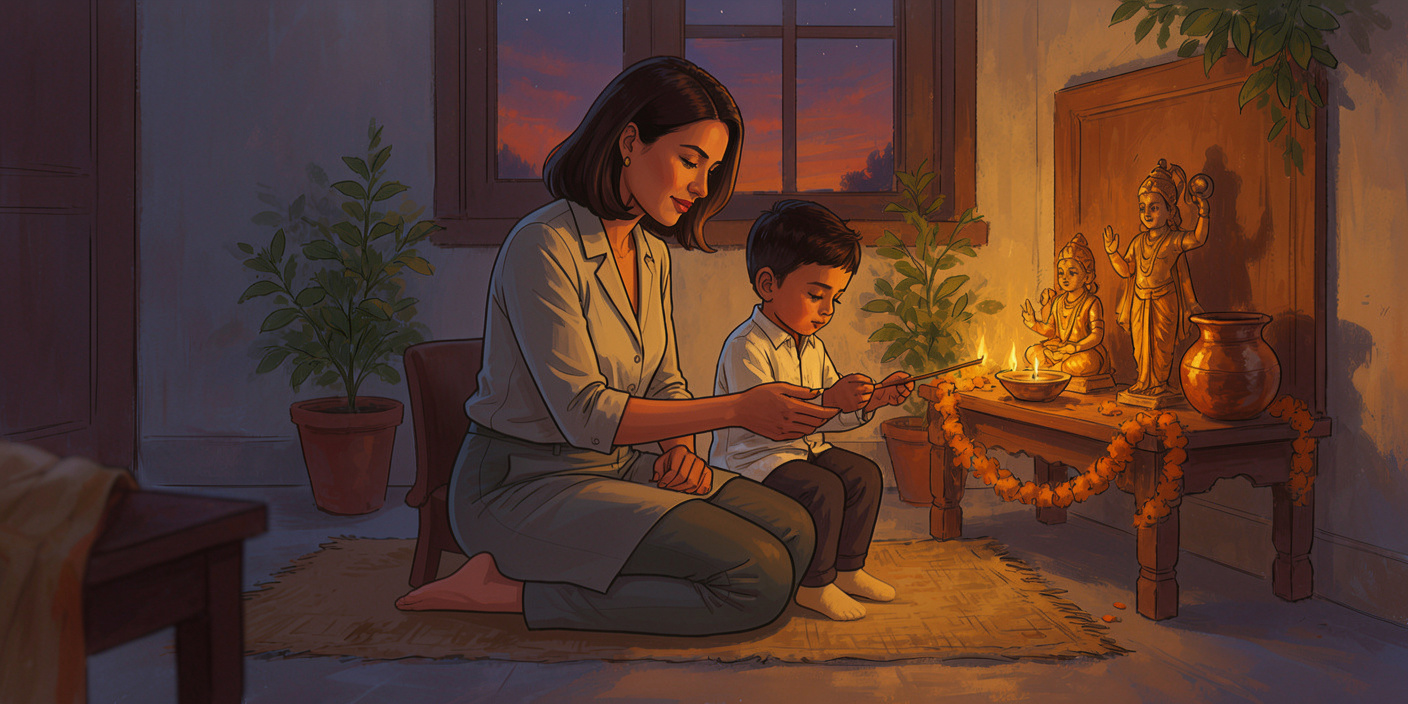
- Light the lamp together. Let the child help to light a small lamp, with your supervision and care for safety. Children love this little task.
- Fold hands and take a breath. Ask the child to close their eyes, take three slow breaths and think of something they are thankful for.
- Say a short prayer. Say the deepa shloka or a short mantra together, once or three times. Young children can simply repeat after you.
- Add a loving wish. Say in simple words, “May we all be healthy and happy.” Let the child add their own wish, such as “May Dadi be well.”
- End with a hug. A warm embrace at the end gives the child a feeling of safety, which is a gift in itself.
If your child is unwell and tired, there is no need to push. A parent can chant softly near the child, or the child can listen while resting. Comfort comes first.
How Can Parents Keep Their Own Mind Calm?
A child feels the mood of the home very strongly. When the parent is calm, the child often feels safe. This does not mean that parents should hide their worry or pretend that all is well. It means that parents also need care.
Share the night duties with your partner or another family member, so that each of you can sleep. Speak openly with your partner about your worries, and avoid blaming each other. Talk to friends, relatives or other parents who have been through the same, as you will often find that you are not alone. Keep a few minutes each day for your own prayer or quiet time, even if it is just a moment with a mantra while the child sleeps.
Please also remember that you are not at fault. If the worry becomes very heavy, if you cannot sleep or eat, or if you feel very low, please talk to your doctor or a counsellor. Looking after yourself is looking after your child.
What About Traditional Customs Like Nazar and Amulets?
Many Indian families follow customs to protect children from the evil eye, such as a small black dot on the forehead or foot, the nazar utarna ritual with salt or chillies, or a black thread. These are family customs, and most are harmless and carry a lot of love.
A few points need care, though. Doctors generally advise against applying kajal or surma inside or very close to a baby’s eyes, as it can cause irritation or infection. Small threads, beads or amulets can be a danger to a baby, as they may be pulled, swallowed or may press on the skin. Rituals that involve smoke, fire or burning near a child need extra caution. Please ask your paediatrician about any custom that touches the child’s skin, eyes, mouth or breathing.
The loving intention behind these customs is beautiful. If a custom is not safe, you can replace it with a simple prayer, a lamp and a mantra, which carry the same love without any risk.
What Does Jyotish Say About a Child Who Often Falls Sick?
Some Jyotishis relate repeated illness in a child to certain planetary periods or placements in the horoscope, and suggest simple prayers or Homams. Others may say nothing. Every horoscope is different, and Jyotish is a guide for reflection and spiritual practice, and not a medical opinion.
Please do not be frightened by anything that you hear. If a Jyotishi speaks in a way that makes you afraid, or asks for large payments, or tells you to stop treatment, please step back and speak to your doctor and to someone you trust. A good Jyotishi will always encourage you to continue medical care along with prayer.
Can a Homam Be Done for a Child?
Yes, many parents arrange a Homam for their child’s wellbeing. The Dhanvantari Homam is a Vedic fire ritual that honours Bhagwan Dhanvantari, the divine physician. It is traditionally performed to seek blessings for health, strength and peace of mind. The priests take a Sankalpa in the name of the child, with their gotra and nakshatra, chant the Dhanvantari mantras and offer ghee and sacred herbs into the sacred fire.
Parents often choose to perform it at the start of a new year of the child’s life, or at a time when the family is feeling worried. Some families also choose the Ayushya Homam for long life. You can read about the differences in our post on Dhanvantari Homam vs Ayushya Homam vs Sudarshana Homam.
The Homam can also be booked online, which is a great help for families who are far from their temple or their elders, including NRI families. The child does not need to be present, and the family can join the prayer in their hearts from anywhere. You can read more on our Dhanvantari Homam page.
How Should We See Prayer and Medical Care Together?
Prayer, mantras and the Homam are forms of spiritual support. They are not a replacement for medical advice, diagnosis or treatment. They do not promise any result, and they should never delay or replace the care of a doctor, especially for a child.
The best way to see prayer is as a companion to good care. The paediatrician treats the child, the parents look after the child, and the prayer gives strength, hope and calm to the family. Please continue to follow your doctor’s guidance, and never stop or change a treatment because of a ritual.
Key Takeaways
- Speak to your child’s paediatrician about repeated illness, and follow the medical advice and vaccine schedule they recommend.
- Please see a doctor at once for trouble in breathing, a high fever that does not settle, unusual sleepiness, dehydration or any sign that worries you.
- Short prayers such as “Shubham Karoti”, the Dhanvantari mantra and a family Shanti prayer suit children well.
- A five minute family routine with a lamp, a prayer and a hug helps children feel safe.
- Parents are not at fault, and they also need rest, support and calm.
- Ask the doctor about customs that touch a baby’s eyes or skin, and never delay treatment because of a ritual.
Frequently Asked Questions
Q. Which mantra can I chant for my child’s health?
Many parents chant the short Dhanvantari mantra “Om Shri Dhanvantaraye Namah”, the Gayatri mantra, or “Om Namo Bhagavate Vasudevaya”. You can also say the evening deepa shloka “Shubham Karoti” with your child.
Q. How can I teach my child to pray?
Keep it short, warm and joyful. Let the child light the lamp with your help, repeat a simple shloka after you, and share one thing they are thankful for. End with a hug.
Q. Is it normal for children to fall sick often?
Many young children fall sick several times a year as their bodies learn to deal with germs. If the pattern worries you, or if illnesses are long or severe, please speak to your paediatrician.
Q. Are customs like nazar and kajal safe for babies?
Many are harmless, but some need care. Doctors usually advise against kajal near a baby’s eyes, and small threads or amulets can be unsafe. Please ask your paediatrician about any custom that touches a baby’s eyes or skin.
Q. Can a Homam be done for a child?
Yes. Parents often book a Dhanvantari Homam for a child’s wellbeing, with the Sankalpa taken in the child’s name, gotra and nakshatra. It is spiritual support and does not replace medical care.
Q. Does Jyotish say why a child falls sick?
Some Jyotishis link repeated illness with planetary periods, but this is guidance and not a medical opinion. Please do not be frightened, and always continue medical care along with prayer.
A Note on Health and Faith
Prayer, mantra chanting and the Dhanvantari Homam are forms of spiritual support. They are not a substitute for medical advice, diagnosis or treatment. Please continue to follow your doctor’s guidance and take care of your health along with your prayers.
Seek the Blessings of Bhagwan Dhanvantari
If you wish to pray for the health and wellbeing of your child with the full Vedic method, you can book the Dhanvantari Homam with Jyotirgamaya from anywhere in the world. Visit the Dhanvantari Homam page.