Mangal Dosha Nivaran Puja Complete Guide - Vidhi Benefits Mantras and What Actually Works
By: Pratima Argade
24 June 2026 at 3:53 AM
Mangal Dosha Nivaran Puja - The Complete Guide to the Most Performed Marriage Remedy in India
Every year, in temples and homes across India and in Indian communities around the world, millions of people commission this puja.
They commission it after a Jyotishi tells them they are Manglik. They commission it when a marriage proposal falls through because the other family discovered a Mangal Dosha in the kundali. They commission it as a preventive measure before beginning the marriage search. They commission it in quiet desperation after years of marriage delay that has been attributed to this dosha.
Mangal Dosha Nivaran Puja is the single most widely performed marriage remedy puja in the entire Vedic tradition. More people perform it than any other single marriage-related puja. And yet the quality of understanding with which it is approached varies enormously. Some people approach it with genuine knowledge of what the puja is doing and why. Many approach it with little more than the hope that performing it will somehow make the dosha go away.
This blog is for those who want the full picture. Because a puja performed with genuine understanding and genuine intention is many times more effective than the same ritual performed without either.
The Foundation: Understanding What Mangal Dosha Nivaran Puja Is Actually Doing
Before going into the vidhi and the mantras, it is essential to understand the spiritual logic of what Mangal Dosha Nivaran Puja is actually doing. Because this understanding is what enables the person performing or commissioning the puja to bring the right intention and the right quality of devotion to it.
Mangal Dosha arises when Mangal, the planet Mars, is placed in specific houses of the natal kundali in ways that introduce his fierce, aggressive and conflict-generating energy into the domain of marriage and intimate partnership.
The Vedic tradition understands Mangal as a graha with specific qualities. He is the commander of the deva army. He is fiery, courageous, direct and powerful. These are genuinely valuable qualities in many domains of life. But in the seventh house of marriage and in the other houses that create Mangal Dosha, these qualities create a specific kind of friction, aggression and instability that can undermine the gentle, harmonious and yielding quality of energy that marriage requires.
Mangal Dosha Nivaran Puja is not attempting to eliminate Mangal from the kundali. That is not possible and not desirable. Mangal's energy is needed. His courage, his vitality and his capacity for decisive action are assets in many areas of life.
What the puja is doing is specifically seeking to redirect Mangal's energy in the marriage-related houses of the kundali away from its more destructive and friction-generating expressions toward its more protective, courageous and righteous expressions. It is asking Mangal, through sincere worship and appropriate offerings, to be a friend to the marriage rather than a threat to it.
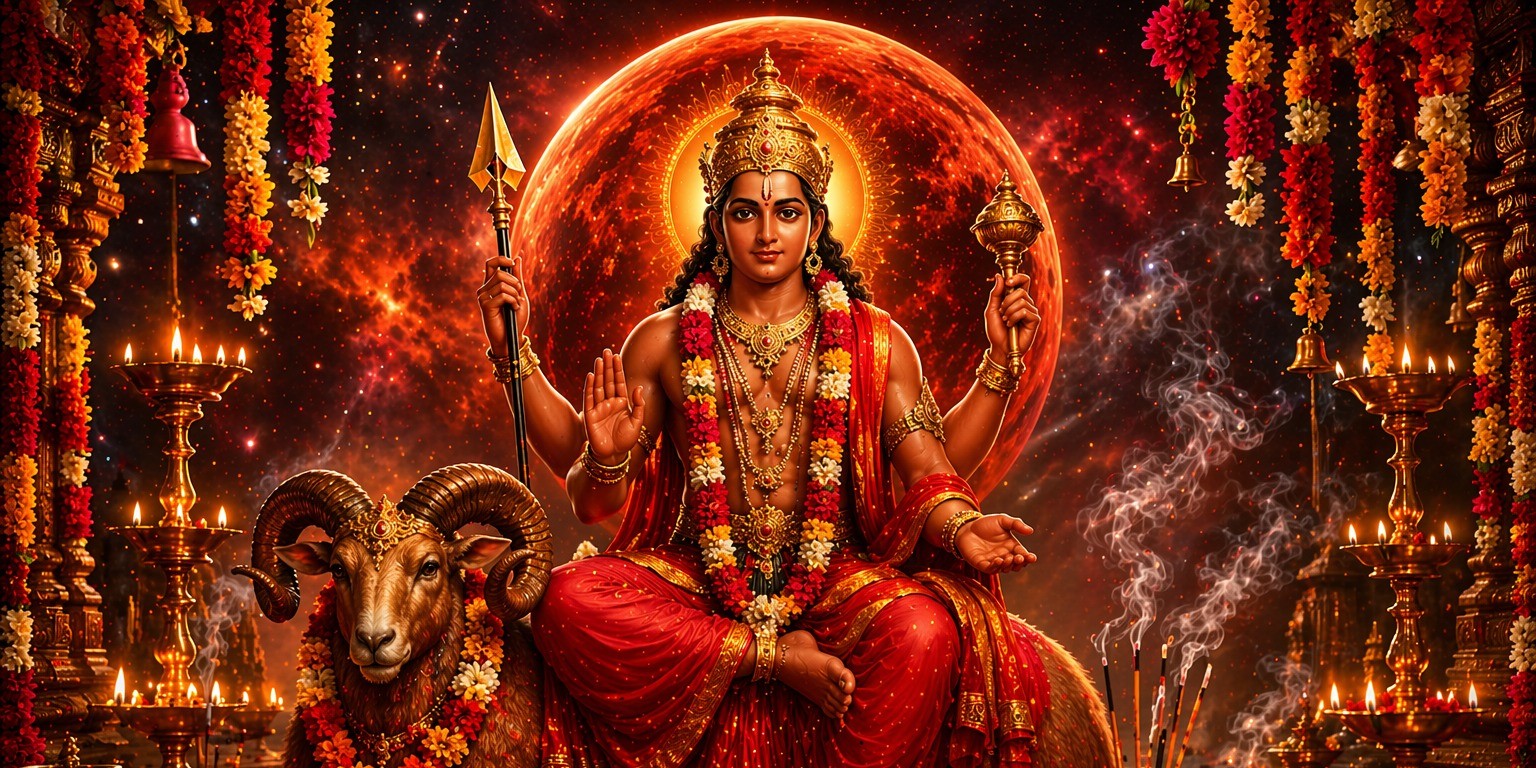
And it is asking the presiding deities of Mangal grah, primarily Bhagwan Kartikeya and Bhagwan Hanuman, to receive the person's sincere worship and to use their own divine relationship with Mangal's energy to temper its more aggressive qualities in the specific area of the person's marriage.
The Presiding Deities of Mangal Grah and Why They Matter
Understanding which divine presences are invoked in Mangal Dosha Nivaran Puja and why they are appropriate is essential for understanding the puja's spiritual logic.
Bhagwan Kartikeya is the primary presiding deity of Mangal grah in the Vedic and Shaiva traditions. He is the son of Bhagwan Shiva and Maa Parvati, born specifically for the purpose of leading the deva army against the demon Tarakasura. He is the commander of divine forces, the warrior deity who directs the energy of courageous action in the service of dharma rather than destruction.
The connection between Bhagwan Kartikeya and Mangal is not merely symbolic. Mangal's energy as the commander of planetary forces is understood as the cosmic expression of the same divine quality that Bhagwan Kartikeya embodies in the personal and devotional realm. When Mangal's energy is worshipped through Bhagwan Kartikeya, it is asking that the fierce and commander-like quality of Mangal be directed toward the righteous protection of the marriage rather than its disruption.
Bhagwan Kartikeya is also known as Murugan in the South Indian tradition, where he is one of the most widely and most devotionally worshipped deities. His specific worship for the pacification of Mangal-related challenges is deeply embedded in both the North Indian Shaiva tradition and the South Indian Shaiva-Murugan tradition.
Bhagwan Hanuman is the second and equally important presiding deity for Mangal-related remedies. The connection between Bhagwan Hanuman and Mangal is both astrological and devotional.
Astrologically, Bhagwan Hanuman is considered to be born under the energy of Mangal. His strength, his courage, his capacity for extraordinary physical action and his completely selfless devotion to Bhagwan Ram are all expressions of Mangal's energy at its highest and most constructive.
The famous story of Bhagwan Hanuman's interaction with Shani Dev, in which Shani's attempted influence on Bhagwan Hanuman was neutralised by Hanuman's extraordinary power, is understood in the tradition as establishing Bhagwan Hanuman as a protector specifically against the more challenging planetary influences. This protective quality extends to Mangal's more challenging expressions as well.
When Bhagwan Hanuman is worshipped as part of Mangal Dosha Nivaran Puja, the puja is invoking the highest possible expression of Mangal's energy, the completely devoted, completely selfless and completely righteous service of Bhagwan Hanuman, as the template for how Mangal's energy should express itself in the person's marriage.
Bhagwan Shiva is also invoked in many traditions of Mangal Dosha Nivaran Puja, particularly in the South Indian tradition where the puja is often performed at Shiva temples. Bhagwan Shiva as Mangaleshwar, the one who makes the inauspicious auspicious, is specifically relevant for Mangal Dosha since his name in this aspect means the one who transforms Mangal's potential for harm into Mangal's potential for blessing.
The Scriptural Authority for Mangal Dosha Nivaran Puja
The Vedic tradition does not perform any significant ritual without scriptural authority. The authority for Mangal Dosha Nivaran Puja comes from several important sources.
- The Brihat Parashara Hora Shastra identifies Mangal Dosha clearly and in the same sections describes the principle of graha shanti, the pacification of planetary energies through worship, as the primary remedial approach. Sage Parashara's teaching is explicit that the negative effects of any graha placement can be reduced through sincere worship of the graha and its presiding deity.
- The Skanda Purana contains specific descriptions of the worship of Bhagwan Kartikeya as the presiding deity of Mangal and the specific blessings that his sincere worship provides for those experiencing Mangal-related challenges including in the area of marriage.
- The Navagraha Stotra attributed to Sage Vyasa contains a specific verse addressed to Mangal that forms one of the central recitations of Mangal Dosha Nivaran Puja. The verse is: Dharani garbha sambhutam vidyut kanti samaprabham kumaram shakti hastam cha mangalam pranamamy aham. This verse describes Mangal as born from the Earth's womb, shining with lightning-like brilliance, holding Shakti in hand and invokes him for blessings.
- The Yajurveda contains the Navgrah Sukta which includes specific mantras for Mangal that are used in the havan portion of Mangal Dosha Nivaran Puja.
Who Needs Mangal Dosha Nivaran Puja and When
While Mangal Dosha is present in the kundalis of approximately forty to fifty percent of people, not everyone with Mangal Dosha needs to perform the Nivaran Puja. As discussed in the earlier blog on Mangal Dosha in this series, many cases of Mangal Dosha are cancelled or significantly mitigated by specific cancellation conditions.
Mangal Dosha Nivaran Puja is most specifically needed when:
- Mangal Dosha is confirmed by a learned Jyotishi after checking all cancellation conditions and the dosha is found to be genuinely active.
- The person is experiencing the specific pattern of marriage proposals coming close and then breaking at the final stage, particularly when this pattern is specifically attributed to Mangal Dosha by the families involved.
- The person is in a Mangal Mahadasha or Mangal Antardasha period and experiencing the intensification of Mangal-related challenges in the marriage area.
- The person is Manglik and their potential partner is not Manglik and the families are seeking a specific remedial puja before proceeding with the marriage.
- There is a pattern of conflict and aggression in an existing marriage that has been identified through kundali assessment as having a Mangal Dosha root.
- The person wishes to perform the puja preventively before beginning the marriage search, as a way of ensuring that Mangal's energy is in its most constructive and most marriage-supportive expression from the start.
The Ideal Timing and Location for Mangal Dosha Nivaran Puja
The timing and location of Mangal Dosha Nivaran Puja significantly affect its power.
Timing:
Tuesday is the day of Mangal grah and performing the puja on a Tuesday is the most natural and most resonant timing choice.
The most powerful Tuesdays for this puja are those that fall during:
- The Mangal hora, the planetary hour of Mangal, on a Tuesday. A learned priest can calculate this specific time for any given Tuesday.
- The waxing moon fortnight, Shukla Paksha, is generally considered more auspicious for performing beneficial pujas than the waning fortnight.
- During favorable transit conditions, particularly when transiting Guru is aspecting the natal Mangal or the seventh house, performing Mangal Dosha Nivaran Puja within that favorable transit window creates the most potent combination of the puja's remedial energy with the supportive planetary transit.
- The Mangal Jayanti, the birth anniversary of Mangal grah, is observed on the Trayodashi of the Shukla Paksha of the month of Vaishakha. Performing Mangal Dosha Nivaran Puja on this specific tithi is considered extremely powerful.
Location:
Certain temples are specifically associated with Mangal grah and performing the puja at these temples carries the additional power of the sacred space's concentrated Mangal energy.
In South India, the Mangal temple at Vaitheeswaran Koil in Tamil Nadu is considered one of the most powerful locations for Mangal Dosha remedies. This ancient Shiva temple houses a specific idol of Mangal and is famous across the tradition for the effectiveness of its Mangal-related rituals.
In North India, temples dedicated to Bhagwan Kartikeya and temples specifically known for their Mangal related worship are the most appropriate locations.
Bhagwan Hanuman temples, which are among the most widely available sacred spaces across all of India and in Indian communities worldwide, are accessible and highly effective locations for Mangal-related worship and are specifically recommended for those who cannot travel to the more specialized Mangal temples.
The Complete Vidhi of Mangal Dosha Nivaran Puja
A properly performed Mangal Dosha Nivaran Puja follows a specific and complete sequence. The performance of this puja by a learned pandit who knows the complete vidhi is essential for its full effectiveness. Here is an overview of all the major elements:
- Preparation: The puja space is thoroughly cleaned. Red cloth is placed on the puja platform. A Mangal Yantra is established in the center of the puja space. The yantra may be a copper plate with the Mangal yantra inscribed or a freshly drawn geometric form. Red flowers, red sandalwood paste, red cloth, masoor dal (red lentils), copper vessel, red coral if available, and specific herbs associated with Mangal are gathered.
- Sankalpa: The formal statement of intention is made before the puja begins. The pandit announces the name, gotra and nakshatra of the person on whose behalf the puja is being performed, along with the specific intention. For Mangal Dosha Nivaran Puja, the Sankalpa specifically states the presence of Mangal Dosha in the kundali, the desire for its nivaran (removal or pacification) and the specific blessing sought for auspicious and timely vivah.
- Punyahavachana: The ritual purification of the space, the materials and the participants through specific mantras and sprinkling of Ganga Jal.
- Kalash Sthapana: The establishment of the sacred Kalash representing the divine presence and all sacred rivers.
- Ganapati Puja: All Vedic pujas begin with Bhagwan Ganesha's invocation. This is particularly significant in Mangal Dosha Nivaran Puja because Bhagwan Ganesha and Bhagwan Kartikeya are brothers, sons of Bhagwan Shiva and Maa Parvati. Invoking Bhagwan Ganesha first honors this familial connection within the divine family that is central to this puja.
- Navgrah Puja: All nine grahas are propitiated with brief individual worship. For Mangal Dosha Nivaran Puja, the Navgrah puja is performed with particular attention to Mangal's individual invocation but with the harmonisation of all nine grahas as the foundational energetic context.
- Mangal Avahana: Mangal grah is formally invoked into the Mangal Yantra through specific mantras. The invocation uses the Mangal Avahana mantra from the classical Navgrah invocation tradition.
- Shodashopachara for Mangal: The sixteen forms of ritual service are offered specifically to Mangal. Each upachara is accompanied by the specific mantra appropriate to Mangal.
- Mangal Stotra Recitation: The specific stotras dedicated to Mangal from the classical Jyotish and Puranic tradition are recited. These include the Navagraha Stotra's Mangal verse, the Angaraka Stotra and specific stotras from the Skanda Purana.
- Bhagwan Kartikeya Puja: A full puja to Bhagwan Kartikeya as the presiding deity of Mangal is performed. This includes his invocation, his archana with red flowers and his specific stotras. In the South Indian tradition, the Kanda Sashti Kavacham, the powerful protective hymn to Bhagwan Murugan/Kartikeya, is recited as part of this section.
- Bhagwan Hanuman Puja: A full puja to Bhagwan Hanuman is performed with sindoor, red flowers, sesame oil and the recitation of the Hanuman Chalisa.
- Mangal Havan: The havan is the most important and most powerful element of Mangal Dosha Nivaran Puja. A sacred fire is established and specific offerings are made to Mangal through the fire. The havan materials specific to Mangal include ghee, masoor dal (red lentils), red sandalwood powder, specific herbs including guduchi and chitraka, red kumkum and specific combinations of materials prescribed for Mangal in the classical havan texts. The number of havan offerings (ahutis) determines the power of the puja. Standard Mangal Dosha Nivaran Puja performs 1008 ahutis. For more severe Mangal Dosha conditions, 4008 or 10008 ahutis are performed. The number corresponds to the classical prescription of performing one percent of the specified japa count as havan offerings.
- The Mangal Beej Mantra is recited with each ahuti. The mantra is: Om Kram Kreem Kroum Sah Bhaumaya Namah Svaha: The addition of Svaha at the end is the specific modification of the beej mantra for havan use.
- Mangal Japa: 108 or 1008 or 10008 repetitions of the Mangal Beej Mantra are performed on a coral mala (rosary), the gemstone associated with Mangal, in addition to the havan offerings.
- Kumkum Archana: 108 names of Mangal are offered with kumkum and red flowers. The 108 names of Mangal are drawn from classical Jyotish texts and each name describes a specific quality of Mangal's energy.
- Dana: Specific charitable donations are made for Mangal. The traditional dana for Mangal includes red lentils (masoor dal), red cloth, copper items, red coral and red flowers, given to a Brahmin or to a temple with sincere intention.
- Prasad distribution: The puja concludes with the distribution of prasad that has been offered to the deities and blessed through the complete ritual.
The Most Effective Daily Practices Alongside Mangal Dosha Nivaran Puja
The formal puja creates the foundational energetic shift. Daily practices maintain and deepen that shift over time. The following daily practices are most effective for those with Mangal Dosha:
- Hanuman Chalisa recitation every Tuesday, preferably at a Bhagwan Hanuman temple but also very effective when performed at home with a genuine image of Bhagwan Hanuman and a sesame oil diya.
- Mangal Beej Mantra japa, Om Kram Kreem Kroum Sah Bhaumaya Namah, 108 times every Tuesday morning, ideally at sunrise facing east, on a red coral mala.
- Offering of red flowers and masoor dal at a Bhagwan Hanuman temple or a Mangal temple every Tuesday with sincere prayer for the harmonious and constructive expression of Mangal's energy in the marriage area.
- Fasting on Tuesdays with devotion to Bhagwan Hanuman and Bhagwan Kartikeya. The traditional fast on Tuesdays for Mangal is one of the most widely practised and most consistently effective daily upays in the tradition.
- Avoiding initiating important decisions related to marriage and partnerships on Tuesdays. While working actively toward marriage is appropriate on all days, the signing of agreements, the formal fixing of proposals and similar committed actions are traditionally avoided on Tuesdays for those with Mangal Dosha.
- Wearing red on Tuesdays to resonate with Mangal's color energy.
- Wearing red coral (moonga) in a copper or gold ring on the ring finger of the right hand, but only if explicitly recommended by a learned Jyotishi based on the complete kundali assessment.
The Kuja Dosha Shanti Puja Variation
In some regional Jyotish traditions, particularly in South India, the Mangal Dosha Nivaran Puja is referred to as Kuja Dosha Shanti Puja, using the Sanskrit name Kuja for Mangal rather than the more commonly used North Indian name.
The Kuja Dosha Shanti Puja as practised in South Indian temples, particularly at Vaitheeswaran Koil, has a slightly different vidhi tradition that reflects the regional specifics of Shaiva worship in Tamil Nadu and surrounding areas. While the underlying intention and the presiding deities are the same, the specific mantras, the specific ritual sequence and the specific offerings may vary from the North Indian tradition.
For those whose family roots are in South India, performing the Kuja Dosha Shanti Puja at Vaitheeswaran Koil is considered one of the most powerful available remedies for Mangal Dosha and is specifically recommended by experienced South Indian Jyotishis.
What Differentiates an Effective Mangal Dosha Nivaran Puja From an Ineffective One
This is perhaps the most practically important question for anyone commissioning this puja, and it deserves a direct and honest answer.
The effectiveness of Mangal Dosha Nivaran Puja depends on several factors that vary significantly across the many contexts in which this puja is performed.
- The learning and sincerity of the pandit. A pandit who knows the complete vidhi, recites the mantras correctly with proper pronunciation and intonation, performs the havan with the correct materials and the correct number of ahutis, and approaches the entire ritual with genuine devotion and genuine intention creates a puja whose energetic effect is many times more powerful than one performed mechanically with abbreviated procedures and minimal mantras.
- The completeness of the vidhi. A Mangal Dosha Nivaran Puja that includes only a brief havan and a few mantra recitations is significantly less effective than one that includes the complete sequence described above, particularly the full Bhagwan Kartikeya Puja, the complete Bhagwan Hanuman Puja, the correct number of havan ahutis and the proper Mangal Japa.
- The sincerity of the Sankalpa. The Sankalpa, the formal statement of intention, is the element that directs the puja's energy toward the specific person and the specific intention. A Sankalpa performed carelessly, without the correct name, gotra and nakshatra of the person, with an imprecise or generic statement of intention, creates a puja whose energy is less specifically directed and therefore less specifically effective.
- The quality of the materials. Genuine red coral, actual masoor dal, authentic copper vessels and genuinely sourced red sandalwood create a resonance with Mangal's energy that lower quality or substituted materials cannot match.
- The devotion of the person commissioning the puja. Even when the puja is being performed by a pandit on behalf of someone who cannot be present, the quality of the commissioning person's own sincerity and devotion at the time of the puja creates a karmic intention that amplifies the puja's effectiveness. Those who commission a puja with genuine devotion and genuine faith receive significantly more of its benefit than those who commission it as a mechanical transaction.
Special Considerations for NRIs and Those Commissioning Remote Pujas
For NRIs and others who cannot physically attend the puja, commissioning a remote performance through a reliable and genuinely learned pandit or puja service is a completely valid and fully effective alternative.
The Vedic tradition has always recognised that the karmic benefit of a puja performed on behalf of a person reaches that person regardless of their physical distance from the puja location. What matters is the correctness of the Sankalpa that includes the person's name and intention, the completeness and sincerity of the vidhi, and the quality of the puja's performance.
When commissioning a remote Mangal Dosha Nivaran Puja, the following information should be provided to ensure the most effective Sankalpa:
Full name. Gotra (if known). Birth nakshatra. Date of birth. The specific Mangal Dosha condition identified in the kundali, including which house Mangal is placed in. The specific intention of the puja.
Photographs of the completed puja and the prasad are typically sent to the person commissioning a remote puja, providing confirmation that the vidhi was properly performed.
How Jyotirgamaya Can Help
At Jyotirgamaya, we perform Mangal Dosha Nivaran Puja with the complete vidhi described in this blog by learned and experienced pandits. Our puja includes:
The complete Mangal Dosha Nivaran Puja sequence with proper Sankalpa in your name. Full Bhagwan Kartikeya Puja and Bhagwan Hanuman Puja as part of the complete sequence. The Mangal Havan with the appropriate number of ahutis based on your specific Mangal Dosha severity. Proper Mangal Japa with correct mantra pronunciation. The complete dana for Mangal after the puja. Photographs of the puja proceedings sent to you. Prasad from the puja sent to you where logistics permit.
For NRIs and those unable to attend in person, the puja is performed on your behalf with your complete Sankalpa details formally included.
Book your Mangal Dosha Nivaran Puja here
A Final Thought
Bhagwan Kartikeya, whose fierce and courageous divine energy is the highest expression of Mangal grah, is not just a warrior deity. He is also, in the Tamil Shaiva tradition, the deity who holds the lance of wisdom, the Vel, that cuts through ignorance with perfect precision and absolute compassion.
This is the deepest teaching of Mangal Dosha Nivaran Puja. Mangal's energy is not something to fear or to suppress. It is something to elevate. The fierce energy of Mangal, when directed through sincere worship toward its highest expression in Bhagwan Kartikeya's divine courage and Bhagwan Hanuman's selfless devotion, becomes not the destroyer of marriages but their most fierce and most loyal protector.
The puja does not ask Mangal to leave your kundali. It asks Mangal to be the best version of himself within it.
And when Mangal is the best version of himself, the marriage that happens under his energy is not fragile. It is strong. It is passionate. It is deeply committed. And it is protected by a force of fierce loyalty that makes it one of the most enduring and most genuinely vital marriages possible.
May Bhagwan Kartikeya and Bhagwan Hanuman bless your marriage with exactly that quality of fierce and enduring protection.
Om Angarakaya Namah.