Mahadasha and Antardasha Periods and Health in Vedic Astrology
By: Pratima Argade
5 November 2026 at 2:04 AM
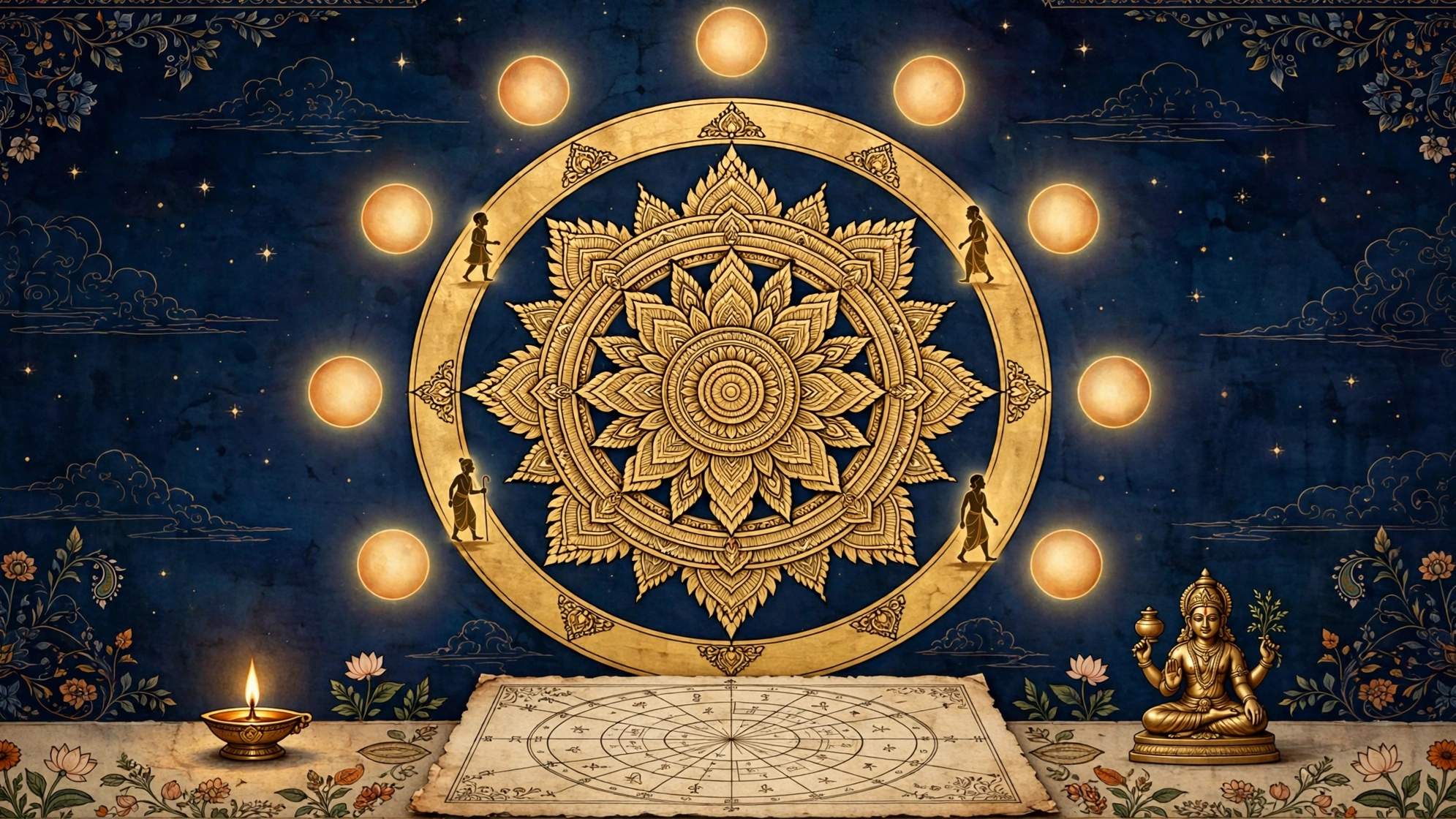
In Vedic astrology, a Mahadasha is a long planetary period, and an Antardasha is a sub period within it. Each period brings the themes of its planet into focus, including themes of vitality, the mind and the body. The Vimshottari system, the most widely used, divides a life into planetary periods totalling 120 years. Dasha knowledge is a tool for reflection and self care, and never a medical diagnosis.
If you have ever consulted a Jyotishi, you have probably heard a sentence like “You are running Shani Mahadasha” or “Your Rahu Antardasha is starting.” For many people, the next question is, “Will it affect my health?” The words Mahadasha and Antardasha carry a lot of weight in Indian homes, and they can create more worry than they should.
In this post, we will explain what these periods are, how the Vimshottari system works, and how dashas are linked with health in the Jyotish tradition. We will share the general themes of each Mahadasha, explain the idea of dasha sandhi, clear a few common myths, and give practical ways to use this knowledge for self care. We have not mentioned any dates, so that the post remains useful at any time. If you wish to know more about Bhagwan Dhanvantari, you can read our post on who Bhagwan Dhanvantari is.
What Are Mahadasha and Antardasha?
In Vedic astrology, time itself is divided into periods that are ruled by the nine grahas. A Mahadasha is the main period ruled by one planet. It can last from six to twenty years. Within each Mahadasha, there are smaller sub periods, called Antardasha or Bhukti, each ruled by one of the nine planets, in a fixed order. Within each Antardasha, there are still smaller periods, called Pratyantar Dasha.
The idea is that, at different times of life, different planets come to the front, and their themes are felt more strongly. A period is like a season in a person’s life. The nature of a season depends on the planet in charge, its position in the birth chart, and its relation with other planets.
How Does the Vimshottari Dasha System Work?
There are several dasha systems in Jyotish, but the Vimshottari dasha is the most widely used. It is described in the classical text Brihat Parashara Hora Shastra. The name Vimshottari means one hundred and twenty, which is the total number of years in the full cycle.
The system starts from the position of the Moon at the time of birth, specifically from the nakshatra, or the lunar star, that the Moon was in. Each of the nine planets rules three nakshatras, and the lord of the birth nakshatra gives the first Mahadasha, and only the remaining balance of that period is counted at birth.
The nine Mahadashas always come in the same order, and their lengths are fixed.
- Ketu for 7 years
- Shukra (Venus) for 20 years
- Surya (Sun) for 6 years
- Chandra (Moon) for 10 years
- Mangala (Mars) for 7 years
- Rahu for 18 years
- Guru (Jupiter) for 16 years
- Shani (Saturn) for 19 years
- Budha (Mercury) for 17 years
Together, they add up to 120 years. Since most people do not live a full cycle, a person usually passes through only a few of these periods in life.
How Are Dashas Linked With Health in Jyotish?
In Jyotish, a dasha does not “cause” anything. It is seen as a kind of lens that brings certain planets, houses and themes into focus. To judge what a dasha may mean for health, a Jyotishi looks at several points together.
They look at the planet that rules the period, its sign, house and strength. They look at which houses that planet rules, since a planet that rules the 6th, 8th or 12th house, or one that is placed in them, may bring the themes of those houses into focus. You can read about these in our post on the 6th, 8th and 12th houses and health. They look at the relation of the dasha planet with the Lagna and its lord, and with the Moon. They also look at the planets that look at it, and at the planet’s position in divisional charts.
This is a complex art, and there is no single rule. The same Mahadasha can feel very different for two people. For one person, Shani Mahadasha may be a time of hard work and steady progress. For another, it may be a period of stress. Please do not judge a dasha from one line in a book or an app.
What Health Themes Do People Associate With Each Mahadasha?
We share these as general traditional themes, and not as predictions or diagnoses. They are meant to help with self care.
- Ketu Mahadasha (7 years). A period often linked with detachment, inwardness, spiritual interest and a feeling of withdrawal. Some people feel low in energy or less attached to usual routines. A time to nurture a calm and regular life.
- Shukra Mahadasha (20 years). A long period linked with comfort, enjoyment, relationships and the pleasures of life. A good time to watch habits around food, rest and indulgence, and to keep a balance.
- Surya Mahadasha (6 years). Linked with vitality, confidence, responsibility and authority. A time to look after your energy, your eyes and your overall stamina.
- Chandra Mahadasha (10 years). Linked with the mind, emotions, family and sleep. A period that asks for attention to emotional balance and rest.
- Mangala Mahadasha (7 years). Linked with energy, drive, courage and haste. A time to channel energy wisely, take safety seriously and manage temper.
- Rahu Mahadasha (18 years). A long period linked with ambition, restlessness, the unfamiliar and change. A time to watch overthinking, sleep and the pace of life, and to have steady routines.
- Guru Mahadasha (16 years). Linked with growth, wisdom, expansion and protection. It is traditionally seen as a supportive period, though growth also asks for attention to balance in food and habits.
- Shani Mahadasha (19 years). Linked with discipline, endurance, hard work and responsibility. A time that rewards steady habits and regular care of bones, rest and routine.
- Budha Mahadasha (17 years). Linked with the intellect, communication, learning and the nervous system. A time to watch mental fatigue and to give the mind regular rest.
Please remember that these are only themes. A Mahadasha is always read together with the whole chart.
What Do Antardasha and Pratyantar Dasha Change?
Within each Mahadasha, the Antardasha adds a second colour. For example, in a Shani Mahadasha, the Antardasha of Guru will feel different from the Antardasha of Rahu. The result of a sub period depends on how the sub period planet relates to the main period planet, and on its own position in the chart.
Some Antardashas are traditionally seen as smooth, and some as demanding. A demanding sub period does not mean trouble. It means that the themes of that planet are strongly in focus. Pratyantar Dashas are even smaller periods, usually lasting for weeks or months, and are used by astrologers for fine timing.
How Do Dashas and Transits Work Together?
Jyotishis do not read dashas alone. They also look at gochara, which is the actual movement of the planets in the sky today. A dasha shows the themes that are active, while the transit shows when the planets touch sensitive points in the chart.
For example, a person who is running a demanding dasha may feel the themes more strongly when a slow planet like Shani or Rahu passes over a sensitive point in their chart. You can read about two such examples in our posts on Shani and health and on Rahu and Ketu. When both are supportive, the period may feel easy and smooth.
What Is Dasha Sandhi?
Dasha sandhi is the junction, or the transition, between two Mahadashas. Many Jyotishis teach that the months before and after a change of Mahadasha can feel like a time of transition, when life themes shift and things may feel uncertain.
This is a traditional belief, and not a rule. Many people pass through a dasha sandhi without any difficulty. A helpful way to use the idea is to treat it as a reminder to be kind to yourself in a time of change, to keep a steady routine, to get enough rest, and to have a regular health check up.
What Are Some Myths About Dashas and Health?
Myth: Rahu Mahadasha is always bad for health. Fact: Rahu’s period brings its own themes, such as change and restlessness, and many people find it a time of growth and opportunity. It depends on the chart.
Myth: Shani Mahadasha means illness. Fact: Shani is a teacher who rewards discipline. Many people build strength, stability and health during this period.
Myth: A Mahadasha of the 6th, 8th or 12th lord means that you will fall sick. Fact: These houses have many meanings, and this is only one theme. A skilled reading of the whole chart is needed.
Myth: You can predict an illness from a dasha. Fact: Astrology cannot diagnose any condition or predict an illness. Only a doctor can do that.
Myth: Only an expensive ritual can change a bad dasha. Fact: The tradition mostly suggests simple prayer, discipline and seva. There is no need for costly rituals.
How Can You Find Your Dasha Properly?
To know your dasha, you need your exact date, time and place of birth. Even a few minutes of difference in the birth time can change the later sub periods. A trusted Jyotishi or reliable astrology software can calculate the dasha for you.
Please be careful with free apps that give generic and scary predictions. A good reading looks at the whole chart, explains the reasons, and ends with calm and practical advice. If someone tells you that a dasha will bring a particular disease or a disaster, please step back and speak to your doctor and to someone you trust.
How Can You Use Dasha Knowledge for Self Care?
The best use of dasha knowledge is to plan wisely. Think of it as a weather forecast for the mind and body, and not as a verdict.
If a period has the themes of energy and haste, such as Mars, put extra care into safety and anger management. If it has the themes of the mind, such as Moon or Mercury, take extra care of sleep and rest. If it has the themes of discipline, such as Saturn, build a steady routine. If it has the themes of comfort, such as Venus, keep a balance in habits. If it has the themes of restlessness, such as Rahu, keep a calm schedule.
In every period, please keep your regular health check ups, take your medicines as advised, eat well, rest well and see a doctor when you feel unwell. These are the best remedies in any dasha.
Which Spiritual Practices Does the Tradition Suggest?
The tradition suggests simple and gentle practices connected with the dasha lord. Many people worship the deity linked with the planet. For example, Surya Arghya and the Aditya Hridayam for the Sun, worship of Bhagwan Shiva on Mondays for the Moon, prayers to Bhagwan Hanuman and Bhagwan Kartikeya for Mars, prayers to Bhagwan Vishnu for Mercury, worship of one’s Guru for Jupiter, prayers to Devi Lakshmi for Venus, prayers to Bhagwan Hanuman for Saturn, and prayers to Devi Durga and Bhagwan Ganesha for Rahu and Ketu.
Acts of seva, such as caring for parents and elders, helping the poor, feeding the hungry and treating those who work with us with respect, are said to be among the best remedies for any period. A daily routine of lamp, mantra and a few minutes of quiet is also a fine support.
Please be careful with expensive gemstones and special rituals sold with fear. Gemstones are not a medical treatment, and they do not suit everyone. Please speak to a trusted Jyotishi before wearing one, and never spend beyond your means.
Where Does the Dhanvantari Homam Fit In?
When the horoscope shows a period in which health feels like a concern, Jyotish teachers often suggest the Dhanvantari Homam as a supportive ritual. It is a Vedic fire ritual that honours Bhagwan Dhanvantari, the divine physician, and it is traditionally performed to seek blessings for health, strength and peace of mind. The priests take a Sankalpa in the name of the person, with their gotra and nakshatra, chant the Dhanvantari mantras and offer ghee and sacred herbs into the fire.
Some families also choose the Maha Mrityunjaya Homam for protection. Our posts on Dhanvantari Homam vs Maha Mrityunjaya Homam and on Dhanvantari Homam vs Ayushya Homam vs Sudarshana Homam may help you decide. The Homam can also be booked online, so you can join the prayer in your heart from anywhere. You can read more on our Dhanvantari Homam page.
How Should We See Astrology and Medical Care Together?
Astrology and the Homam are forms of spiritual guidance and support. They are not a replacement for medical advice, diagnosis or treatment. They do not promise any result, and they should never delay or replace the care of a doctor.
The best way to see them is as companions to good care. The doctor treats the body, the family looks after the person, and Jyotish and prayer give reflection, patience and calm to the mind. Please continue to follow your doctor’s guidance, and never stop or change a treatment because of an astrological remedy.
Key Takeaways
- A Mahadasha is a long planetary period, an Antardasha is a sub period within it, and the Vimshottari system divides a full cycle into 120 years.
- The dasha sequence starts from the Moon’s nakshatra at birth, and the lengths are Ketu 7, Venus 20, Sun 6, Moon 10, Mars 7, Rahu 18, Jupiter 16, Saturn 19 and Mercury 17 years.
- A dasha brings the themes of its planet into focus, and does not cause or predict an illness.
- The result depends on the whole chart, the houses the planet rules, its strength and its transits.
- Use dasha knowledge as a weather forecast for self care, with steady routines, regular check ups and good rest.
- A Homam is spiritual support and works alongside medical care, never in place of it.
Frequently Asked Questions
Q. What is Mahadasha in astrology?
A Mahadasha is a long planetary period in Vedic astrology, ruled by one of the nine grahas and lasting from six to twenty years. In the Vimshottari system, the full cycle is 120 years.
Q. What is Antardasha?
An Antardasha, or Bhukti, is a sub period within a Mahadasha. It adds a second colour to the main period and depends on how the sub period planet relates to the main planet.
Q. Can a dasha show health problems?
A dasha brings the themes of its planet into focus, but astrology cannot diagnose or predict any illness. It can be used as a reminder to look after your health, and a doctor’s advice should always come first.
Q. Which Mahadasha is the most difficult?
There is no single difficult Mahadasha. Every period has its own themes, and the results depend on the whole chart. Many people find that even demanding periods bring growth.
Q. What is dasha sandhi?
It is the transition between two Mahadashas. Many Jyotishis see it as a sensitive time of change. It is a good time to keep a steady routine, rest well and keep your health check ups.
Q. Can a Homam help during a difficult dasha?
Teachers often suggest the Dhanvantari Homam for health worries and the Maha Mrityunjaya Homam for protection. They are spiritual support performed to seek blessings, strength and peace of mind, and they do not replace medical care.
A Note on Health and Faith
Astrology, prayer and the Dhanvantari Homam are forms of spiritual guidance and support. They are not a substitute for medical advice, diagnosis or treatment. Please continue to follow your doctor’s guidance and take care of your health along with your prayers.
Seek the Blessings of Bhagwan Dhanvantari
If you wish to pray for the health and wellbeing of your family with the full Vedic method, you can book the Dhanvantari Homam with Jyotirgamaya from anywhere in the world. Visit the Dhanvantari Homam page.