


Janma Nakshatra Homam: Why a Personal Homa Is Traditionally Preferred
By: Pratima Argade
24 November 2026 at 11:48 AM
A Janma Nakshatra Homam is a Vedic fire ritual performed on the day when the Moon is in your birth star, with a Sankalpa taken in your own name, gotra and nakshatra. Many families traditionally prefer such a personal Homa because it is offered for one person with a clear intention, and because the birth star is seen as closely linked with the mind. It is spiritual support, and it works alongside medical care.
When you book a puja, one of the first questions is always the same. "What is your nakshatra?" For many people, the nakshatra is a part of their identity, written on the family horoscope, spoken by elders and used in every temple archana. Yet few families know why this single detail carries so much weight, or why a Homam done in one's own name feels different from a general prayer.
In this post, we will explain what a Janma Nakshatra Homam is and how a personal Homa differs from a group one. We will look at the reasons why a personal Homa is traditionally preferred, and also be honest about the value of group Homams. We will share how often families do it, how to find your nakshatra day, and how to take part. We have not mentioned any dates, so that this post remains useful at any time. If you wish to know more about Bhagwan Dhanvantari, you can read our post on who Bhagwan Dhanvantari is.
What Is Janma Nakshatra Homam?
Your Janma Nakshatra is the lunar star in which the Moon stood at the time of your birth. We have explained this in our post on Janma Nakshatra and health. The Moon moves through all twenty seven nakshatras in about twenty seven days, so it returns to your birth star a little more than once a month. Each of these days is called your Janma Nakshatra day.
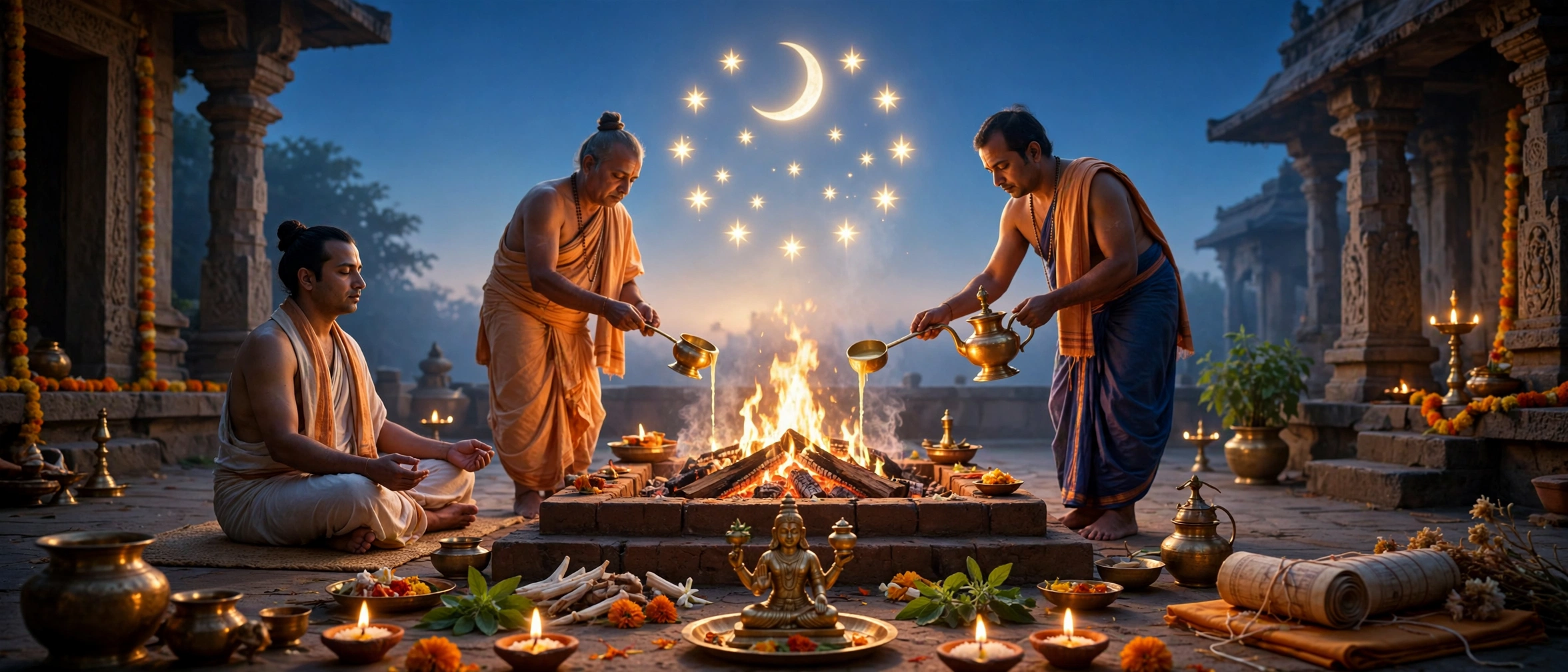
A Janma Nakshatra Homam is a Homam done on such a day, for the person born under that star. It is performed by trained priests, who take a Sankalpa in the person's name, gotra and nakshatra, invite the deity of the nakshatra along with the main deity of the Homam, and make offerings into the sacred fire with mantras.
The main deity may be chosen according to the purpose. For health and wellbeing, many families choose Bhagwan Dhanvantari. For long life, they may choose the Ayushya Homam. For protection, they may choose the Maha Mrityunjaya Homam. You can read about these choices in our posts on Dhanvantari Homam vs Maha Mrityunjaya Homam and on Dhanvantari Homam vs Ayushya Homam vs Sudarshana Homam.
What Is a Personal Homa and What Is a Group Homa?
A personal Homa is one that is offered for a single person or a single family. The Sankalpa names that person, and the whole ritual is held with their intention.
A group Homa, also called a common or sarva Homa, is one in which many devotees take part together. The priests usually take one common Sankalpa, and sometimes read out many names, and the blessings are shared among all those who have joined. These Homams are common at temples during festivals and on special days.
Both types of Homa are accepted and loved in the tradition. They simply serve different needs.
Why Is a Personal Homa Traditionally Preferred?
Many families, priests and teachers say that, when it is possible, a personal Homa in one's own name has a special place. There are a few reasons that are often mentioned. These are matters of tradition and faith, and not medical claims.
- The Sankalpa is made only for you. The Sankalpa is the spoken resolve that connects the ritual to the person. In a personal Homa, the priest names the day, the place, the deity, your name, your gotra, your nakshatra and your purpose, all for you alone. Many people feel that this makes the prayer clear, direct and fully their own.
- The birth star is closely linked with the mind. In Jyotish, the Moon is the karaka of the mind, and the nakshatra of the Moon at birth is seen as a key to a person's inner nature. A Homa on your Janma Nakshatra day, with your nakshatra named in the Sankalpa, is felt to be in tune with your own rhythm. Many people find that the day has a special quiet feeling.
- The deity of your nakshatra is invited. Every nakshatra has a presiding deity. In a personal Homa on your nakshatra day, the priests can invite that deity by name, along with the main deity of the Homam. The Nakshatra Suktam, a hymn from the Taittiriya Brahmana that praises the deities of the nakshatras, is also traditionally used in some rituals.
- The ritual can be adapted to your need. In a personal Homa, the purpose, the number of mantras and the details can be shaped around your family's wish, such as health, recovery, a milestone birthday or thanksgiving.
- It brings a sense of personal involvement. When a ritual is done in your name, you tend to take part with more attention and sincerity. You prepare for it, you think about it, and you pray along with it. In Indian tradition, this shraddha, or faith with attention, is seen as a vital part of any ritual.
- It follows a long family habit. Many families have always done a nakshatra puja or Homa on their star day, and they pass this on to the next generation. This itself gives the practice a special place in memory.
Is a Group Homa Less Valid?
No. We would like to be very clear on this. A group Homa is not less valid, less sincere or less blessed. It is a time honoured way for a community to pray together. Many people gain great comfort from taking part in a common Homa at a temple, among other devotees, and many families cannot or do not wish to arrange a personal one.
Cost, time and convenience are all real considerations. A group Homa is a lovely choice for someone who wishes to join a larger prayer, or who is just beginning. A personal Homa is a lovely choice for someone who wishes to offer a prayer in a more focused way, on a particular day or for a particular reason.
If your family follows a particular tradition or has a Guru who advises one over the other, please follow that advice. The best Homa is the one that you can take part in with a sincere heart. Please do not feel pressure from anyone to choose a bigger or more expensive form.
How Is a Homa on Your Nakshatra Day Different?
The basic steps of a Homam are the same, whichever day you choose. They include the Ganapati puja, the Sankalpa, the placing of the kalash, the invocation of the sacred fire, the chanting of mantras with offerings, the final offering called Purnahuti and the aarti. We have described these in our posts on what the Dhanvantari Homam is and on how an online Homam works.
On a Janma Nakshatra day, the following details are usually added or emphasised.
The Sankalpa names the nakshatra of the day as your birth star. The deity of the nakshatra is invited and worshipped. The priests may chant prayers for the nakshatra, such as a few verses from the Nakshatra Suktam, in line with their tradition. The main Homam, such as the Dhanvantari Homam, is then performed for your purpose.
The details differ from family to family and teacher to teacher, so please follow the method of your priest.
How Often Do Families Do a Janma Nakshatra Homam?
There is no single rule. Families follow different habits.
Some do a simple prayer or archana at a temple on their Janma Nakshatra day every month. Some do a Homam once a year, on the nakshatra day that falls nearest to their Hindu birthday. In the traditional calendar, a person's birthday is marked by the tithi and nakshatra of birth, and many families celebrate this day, called the nakshatra birthday, with prayers. Some do a Homam at milestone ages, such as the sixtieth birthday, when the Ayushya Homam is often performed on the nakshatra day. Some do it at special times, such as before or after a surgery, in a time of worry or as a thanksgiving.
Please choose a rhythm that is comfortable for you and your family. A simple practice, done with sincerity, is more valuable than a large one done under pressure.
How Do You Find Your Janma Nakshatra Day?
First, you need to know your Janma Nakshatra. This needs your exact date, time and place of birth, and can be found by a Jyotishi or from a reliable panchang or astrology software. If your birth time is not certain, or is close to the boundary between two nakshatras, a Jyotishi can help you.
Once you know your nakshatra, a panchang will tell you the days when the Moon is in that star. This happens about once in every twenty seven days. Many temples and priests also share a list of these days. If you are booking a Homam, the priests can tell you the nearest suitable day.
If you cannot find the exact nakshatra day, or if the day is not convenient, please do not worry. The most important thing is the sincerity of your prayer, and you can choose another day if needed.
For Whom Can a Janma Nakshatra Homam Be Done?
It can be done for any person, and the Sankalpa is taken in their name.
You can do it for yourself, at a time of gratitude, a new beginning or a need for peace of mind. You can do it for your parents or elders, whose wellbeing is close to your heart. Many NRI families arrange it for their parents in India, as we have explained in our post on Dhanvantari Homam for NRI families. You can do it for your spouse, or for your children, in which case the parents take part as the family. For a young child, the parents are the Sevakartha who sit for the Sankalpa. You can also do it for the whole family, naming each member.
If you do it for someone else, please speak to them first, and respect their wishes, as this is a matter of respect.
How Can You Take Part?
Whether you attend in person or join online, a few simple points help.
- Before. Confirm your nakshatra, choose the day, and share your name, gotra, nakshatra and a general purpose with the priests. Please do not share personal medical details. Talk to your family, and agree on a time to sit together.
- During. Take a bath, wear clean clothes, and sit quietly. Light a lamp before a picture of Bhagwan Dhanvantari. Offer a few flowers or Tulasi leaves, and say a short Sankalpa in your own words. Chant a simple mantra, such as "Om Shri Dhanvantaraye Namah", or a salutation to the deity of your nakshatra. If you are watching online, join in your heart, and know that you do not need to stay awake at an odd hour.
- After. Offer thanks, and share the blessings with your family. Receive the prasadam if it is included, and use it with care. Continue with a small daily prayer. Please also use the day as a gentle health check in, with a few questions to yourself. Am I sleeping and eating regularly? Is a health check up due? Do I need rest or support? We have shared this idea in our post on Janma Nakshatra and health.
How Does the Dhanvantari Homam Fit Your Nakshatra Day?
The Dhanvantari Homam is a Vedic fire ritual that honours Bhagwan Dhanvantari, the divine physician. It is traditionally performed to seek blessings for health, strength and peace of mind. Many families like to perform it on or around their Janma Nakshatra day as a personal offering, with the nakshatra named in the Sankalpa.
You can combine your prayer to the deity of your nakshatra, whose simple salutations we have shared in our post on Janma Nakshatra and health, with the Dhanvantari Homam. The Homam can also be booked online, so you can join from anywhere in the world. You can read more on our Dhanvantari Homam page.
How Should You Choose Well?
Please choose with care and without fear. A good Homam is performed by trained priests, with a proper Sankalpa, in a clear and open way. The provider should answer your questions politely and be clear about the cost and what is included. Please see our post on how an online Homam works for a list of questions to ask.
Please be careful with anyone who tells you that you must do a personal Homa on a particular day or something bad will happen, who claims that a group Homa will not work, who promises a cure or a guaranteed result, or who pushes you to pay more. A Homam is spiritual support, and no honest priest can promise a medical or worldly result.
How Should We See a Homam and Medical Care Together?
A Homam is a form of spiritual support. It is not a replacement for medical advice, diagnosis or treatment. It does not promise any result, and it should never delay or replace the care of a doctor.
The best way to see it is as a companion to good care. The doctor treats the body, the family looks after the person, and the prayer gives strength, hope and calm to the mind. Please continue to follow your doctor's guidance, and never stop or change a treatment because of a ritual.
Key Takeaways
- A Janma Nakshatra Homam is a Vedic fire ritual done on the day when the Moon is in your birth star, with a Sankalpa in your own name, gotra and nakshatra.
- A personal Homa is traditionally preferred by many because the Sankalpa is made for you alone, the birth star is linked with the mind, the nakshatra deity can be invited and the ritual can be shaped to your wish.
- A group Homa is equally valid and loved, and the best Homa is the one you can take part in with sincerity.
- Your Janma Nakshatra day comes about once in every twenty seven days, and families choose monthly, yearly or milestone observances.
- You can do it for yourself, for parents, for a spouse, for children or for the whole family, after speaking to them.
- A Homam is spiritual support and works alongside medical care, never in place of it.
Frequently Asked Questions
What is Janma Nakshatra Homam?
It is a Vedic fire ritual performed on the day when the Moon is in your birth star, with a Sankalpa taken in your name, gotra and nakshatra, often together with a main Homam such as the Dhanvantari Homam.
Why is a personal Homa preferred over a group Homa?
Many families feel that a personal Homa has a clear Sankalpa made only for them, is in tune with their birth star and can be shaped to their purpose. This is a matter of tradition and faith, and a group Homa is also valid and sincere.
How often should I do a Janma Nakshatra Homam?
There is no fixed rule. Some families pray monthly on their nakshatra day, some do a Homam once a year, and some do it at milestone birthdays or special times.
How do I find my Janma Nakshatra day?
You need your exact date, time and place of birth to find your nakshatra. A Jyotishi or a panchang will then tell you when the Moon is in that star, which happens about once in every twenty seven days.
Can I do a Janma Nakshatra Homam for my parents?
Yes. Many families do this, including NRI families who arrange it for parents in India. Please speak to your parents first and respect their wishes.
Can a Janma Nakshatra Homam cure illness?
No. It is spiritual support performed to seek blessings, strength and peace of mind. It does not claim to cure any illness, and it should always go along with proper medical care.
A Note on Health and Faith
The Dhanvantari Homam and the Janma Nakshatra Homam are forms of spiritual support. They are not a substitute for medical advice, diagnosis or treatment. Please continue to follow your doctor's guidance and take care of your health along with your prayers.
Seek the Blessings of Bhagwan Dhanvantari
If you wish to pray for the health and wellbeing of your family with the full Vedic method, you can book the Dhanvantari Homam with Jyotirgamaya from anywhere in the world. Visit the Dhanvantari Homam page.