How to Do Dhanvantari Puja at Home: A Simple Step by Step Method
By: Pratima Argade
18 November 2026 at 10:06 AM
To do Dhanvantari Puja at home, take a bath in the morning, set up a clean place with a picture or idol of Bhagwan Dhanvantari, light a ghee lamp, state your Sankalpa, offer flowers, Tulasi leaves, incense and a naivedya offering, chant the Dhanvantari mantra, and close with an aarti. The puja takes about twenty to thirty minutes, and it is a form of spiritual support that works alongside medical care.
Many families want to pray to Bhagwan Dhanvantari for the health and peace of their loved ones, but they are not sure how to begin. They worry about doing it wrongly, about missing a step, or about not having the right items. The good news is that a home puja does not need to be complicated. Indian tradition has always taught that a sincere heart is the most important offering.
In this post, we will share a simple and clear method, with the items you need, the best time, the steps in order and the mantras to chant. We will also share safety tips, and explain when you may prefer to book a full Homam instead. Please remember that customs differ from family to family and region to region, so if your family follows a different method, please keep to it. If you wish to know more about Bhagwan Dhanvantari, you can read our post on who Bhagwan Dhanvantari is.
What Is Dhanvantari Puja at Home?
Dhanvantari Puja is a worship of Bhagwan Dhanvantari, the divine physician and the Bhagwan of Ayurveda, who rose from the Kshira Sagara with the Amrit Kalash. At home, it is a short and simple ritual in which the family offers flowers, light and prayer to him, and chants his mantra.
Families do this puja to seek blessings for health, strength and peace of mind, for themselves or for a loved one. Some do it every week, some on special days, and some when a family member is going through a hard time. It is also a common practice among students and practitioners of Ayurveda.
This puja is different from a Homam. A Homam is a Vedic fire ritual with offerings into the sacred fire, and it is performed by trained priests. The home puja is a simpler form of worship that anyone can do.
When Is the Best Time to Do It?
You can do the puja on any day that feels right to you. Traditionally, some days are seen as especially suitable. Bhagwan Dhanvantari is a form of Bhagwan Vishnu, so many families choose Thursdays, or Ekadashi, which is dear to Bhagwan Vishnu. Trayodashi Tithi, which is linked with Dhanteras, is also special for remembering Dhanvantari. Some families choose the day of their birth nakshatra or the start of a new year of life.
The morning is the traditional time, after a bath, when the mind is fresh and the house is calm. If the morning is not possible, any quiet time of the day is fine. You do not have to wait for a particular day if a loved one needs your prayer now.
What Items Do You Need?
You do not need a large list. Here is a simple set of items, and you can use what you have at home.
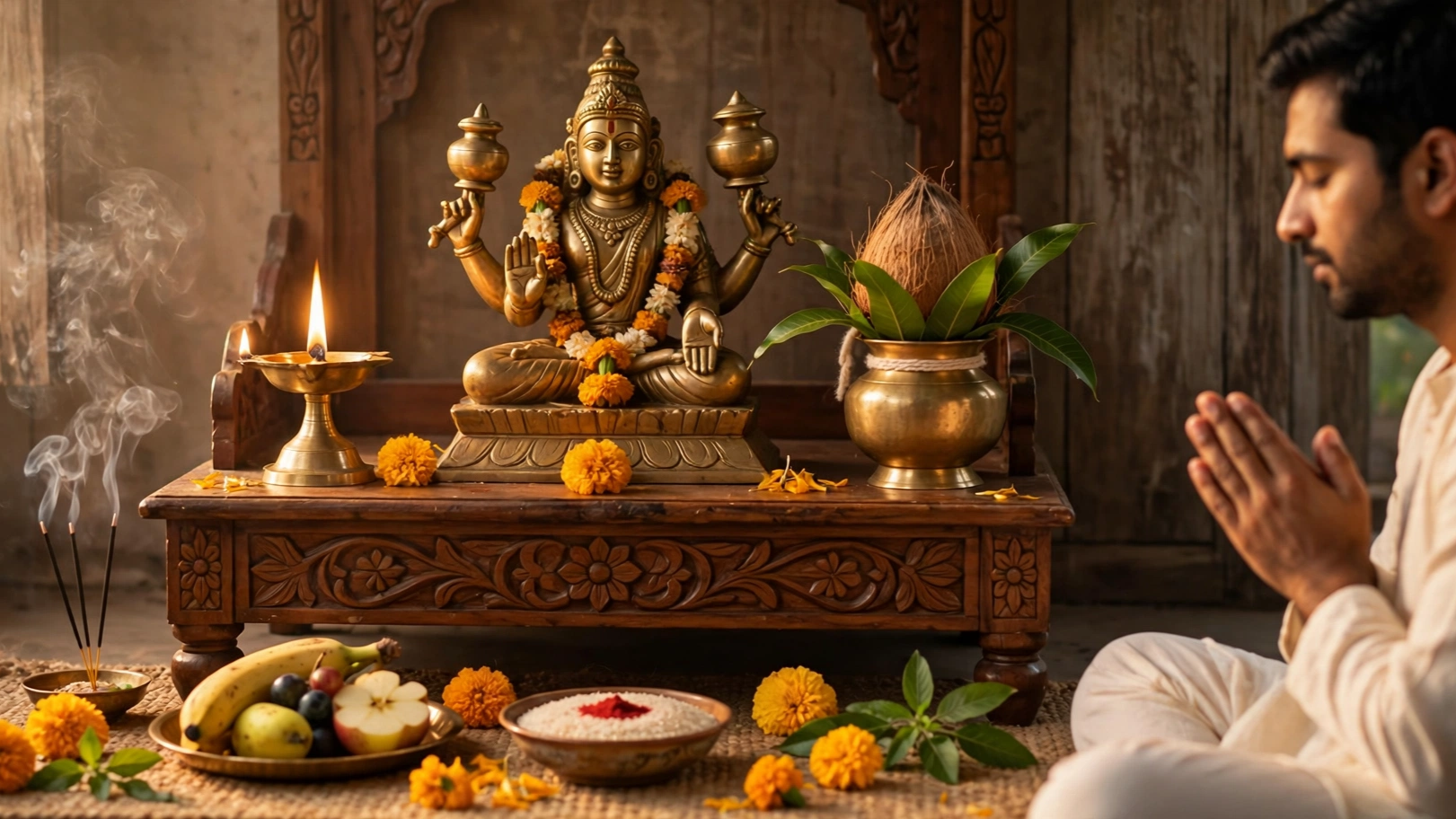
- A picture or idol of Bhagwan Dhanvantari. If you do not have one, you can use a picture of Bhagwan Vishnu, or a kalash.
- A clean cloth or small wooden platform to place the picture or idol on.
- A ghee lamp or oil lamp with a wick, and matches.
- Fresh flowers, and a few Tulasi leaves.
- Incense sticks, if you like.
- A kalash or small copper or brass pot with clean water, a few mango leaves and a coconut. This is optional.
- Rice, kumkum and turmeric, or sandalwood paste, for the tilak.
- A naivedya offering, such as fruit or a simple home made sweet.
- A small bell and a plate for the aarti, with a little camphor.
- A mat or a chair to sit on.
If you do not have something, please do not worry. A lamp, a few flowers, a little water and a sincere prayer are enough.
How Do You Prepare the Space?
Choose a clean and quiet corner of the house, ideally your home shrine. Clean the area and wipe the platform. Spread a clean cloth, and place the picture or idol facing east or north if possible. Place the kalash on the right side or in front, if you are using one.
Keep the items within reach so that you do not need to get up during the puja. Switch off or silence your phone. Make sure that the lamp is placed safely, away from curtains, children and pets.
Take a bath, and wear clean and comfortable clothes. Please remember that your comfort comes first, and you may sit on a chair if sitting on the floor is hard.
What Is the Step by Step Method?
Here is a simple method that takes twenty to thirty minutes. The order may vary a little in your family tradition.
- Sit calmly and take a breath. Sit comfortably, close your eyes for a moment, and take a few slow breaths. Bring a calm mind and a thankful heart.
- Light the lamp. Light the ghee lamp and place it before the picture. Fold your hands and bow to the lamp, as a symbol of light and wisdom.
- Pray to Bhagwan Ganesha. Every puja begins with a short prayer to Bhagwan Ganesha, the remover of obstacles. You may say “Om Gam Ganapataye Namah” three times.
- Take the Sankalpa. Say in simple words, “Bhagwan, on this day, I, your name, perform this puja with faith, to seek your blessings for the health, peace and wellbeing of my family, and especially for the name of the person. May it be accepted.” You may say it in your own language.
- Invite Bhagwan with the dhyana. Close your eyes and picture Bhagwan Dhanvantari, with four hands holding a shankha, a chakra, a leech and a golden Amrit Kalash, calm and smiling. You can read the traditional dhyana shloka and its meaning in our post on the Dhanvantari Gayatri mantra and Stotram.
- Offer water and a seat. Sprinkle a little water before the idol, as a sign of welcome. If you have a small idol, you may gently clean it with clean water and wipe it with a soft cloth, or simply sprinkle a few drops of water on the picture.
- Offer tilak and flowers. Apply a small dot of sandalwood, kumkum or turmeric, and offer fresh flowers.
- Offer Tulasi leaves. Offer a few fresh Tulasi leaves at the feet of Bhagwan, since Tulasi is very dear to Bhagwan Vishnu and his forms. Please do not pluck Tulasi leaves after sunset, or on certain days, if your tradition avoids it.
- Offer incense and light. Wave the incense sticks and the lamp clockwise before the picture, with folded hands.
- Offer naivedya. Place the fruit or the sweet on a clean plate, sprinkle a little water around it, and offer it with a prayer such as “Bhagwan, please accept this offering with love.”
- Chant the mantras. Chant the Dhanvantari mantra with a mala, 11, 21 or 108 times. You can read the full mantra below.
- Perform the aarti. Light a little camphor on the aarti plate, ring the bell, and wave the light slowly in front of the idol while singing a favourite aarti or chanting a prayer.
- Offer pradakshina and namaskara. Walk around the shrine once if there is space, or turn clockwise in place, then bow before Bhagwan with a thankful heart. If you are sitting, simply bow.
- Ask for forgiveness and close. Say, “Bhagwan, please forgive any mistakes I may have made in this puja, and accept my devotion.” Then pray for the wellbeing of all.
- Share the prasadam. Distribute the naivedya among family members, with respect and in small portions.
Which Mantras Can You Chant?
The main mantra for this puja is the Dhanvantari mantra:
Om Namo Bhagavate Vasudevaya Dhanvantaraye Amrita Kalasha Hastaya Sarva Amaya Vinashaya Trailokya Nathaya Dhanvantari Maha Vishnave Namah
A shorter form for daily use is: Om Shri Dhanvantaraye Namah
You may also chant the Dhanvantari Gayatri: Om Tat Purushaya Vidmahe, Amrita Kalasha Hastaya Dhimahi, Tanno Dhanvantari Prachodayat
If you wish, you can recite a few names from the Vishnu Sahasranama, or sing a favourite bhajan. You can read the full meaning of each mantra in our posts on the Dhanvantari mantra and on the Dhanvantari Gayatri mantra and Stotram. Small variations exist across traditions, so please follow the form that your family or Guru uses.
How Should You Handle the Naivedya and Prasadam?
Naivedya is food that is offered to Bhagwan first and then shared. Fresh fruit, a simple home made sweet or a little cooked food are common. Please keep it clean, fresh and simple.
Please take care with the prasadam. Share it in small portions, and keep in mind that some family members may be on special diets or medicines. Do not insist that anyone eat. A person with a health concern may accept the prasadam with respect and take a very small portion, or just touch it to the forehead. Please do not offer or give herbal powders, holy water or home remedies as prasadam to a patient, an infant or an elder without asking the doctor.
Please do not offer food that is spoiled, and keep the prasadam covered and away from pets.
Frequently Asked Practical Questions
Q. What if I do not have an idol?
A picture is perfectly fine. You can also use a kalash, a lamp or a picture of Bhagwan Vishnu.
Q. Can women do this puja?
Yes. Anyone with faith can do the puja. Customs around worship during monthly periods differ among families and traditions, and you may follow your own family practice in a way that feels comfortable to you. You can always pray silently in your heart.
Q. Can children take part?
Yes. Children can help to light the lamp, offer flowers and chant a simple mantra. Please supervise them around fire and keep it joyful.
Q. What if I make a mistake?
Please do not worry. Bhagwan looks at the sincerity of the heart. You can ask for forgiveness at the end of the puja, as in the method above.
Q. Can I do it if I am unwell?
Yes, in a form that is comfortable for you. You can sit on a chair, shorten the puja, or simply light a lamp and chant softly. Rest and your doctor’s advice come first.
Q. Can I do it for someone who lives far away?
Yes. Say their name in the Sankalpa, and pray for them with all your heart.
What Safety Tips Should You Keep in Mind?
Place the lamp on a stable surface, away from curtains and clothes, and never leave it unattended. Keep children and pets at a safe distance. Use a small amount of incense and camphor, and keep the room ventilated, especially if anyone at home has a breathing problem or is sensitive to smoke. Please do not fast for the puja if you are pregnant, unwell, elderly or on regular medicines, unless your doctor agrees. Please do not make a patient sit for a long time or stand for the puja. Keep the water and food clean.
When Should You Book a Homam Instead?
A home puja is lovely for daily and weekly worship. For special occasions, such as before or after a surgery, at a milestone birthday, in a time of deep worry or as a thanksgiving, many families like to arrange a full Dhanvantari Homam. In it, trained priests chant the mantras and make offerings of ghee and sacred herbs into the sacred fire, with a Sankalpa taken in the name, gotra and nakshatra of the person.
You can also do both. Many families do their own puja at home on the day of the Homam, and join the prayer in their hearts. The Homam can be booked online, which helps families who live far away from their elders, including NRI families. You can read more in our post on what the Dhanvantari Homam is, and on our Dhanvantari Homam page.
How Should We See Puja and Medical Care Together?
The home puja and the Homam are forms of spiritual support. They are not a replacement for medical advice, diagnosis or treatment. They do not promise any result, and they should never delay or replace the care of a doctor.
The best way to see them is as companions to good care. The doctor treats the body, the family looks after the person, and the puja gives strength, hope and calm to the mind. Please continue to follow your doctor’s guidance, and never stop or change a treatment because of a ritual.
Key Takeaways
- Dhanvantari Puja at home is a simple worship with a picture or idol, a lamp, flowers, Tulasi, naivedya, the Dhanvantari mantra and an aarti.
- Any day is suitable, and Thursdays, Ekadashi and Trayodashi are traditionally special. The morning is the usual time.
- The method has these steps: Ganesha prayer, Sankalpa, dhyana, offerings, mantras, aarti and sharing the prasadam.
- A lamp, a few flowers, a little water and a sincere prayer are enough, and your family tradition can guide small details.
- Keep the lamp safe, avoid heavy smoke, share prasadam in small portions and never give herbs or remedies as prasadam to a patient.
- The puja is spiritual support and works alongside medical care, never in place of it.
Frequently Asked Questions
Q. How do I do Dhanvantari Puja at home?
Set up a clean place with a picture or idol, light a ghee lamp, pray to Bhagwan Ganesha, take your Sankalpa, offer flowers, Tulasi and naivedya, chant the Dhanvantari mantra and close with an aarti.
Q. Which day is best for Dhanvantari Puja?
You can do it on any day. Thursdays, Ekadashi and Trayodashi are traditionally special, and the morning is the usual time.
Q. Which mantra should I chant in Dhanvantari Puja?
Chant “Om Namo Bhagavate Vasudevaya Dhanvantaraye Amrita Kalasha Hastaya Sarva Amaya Vinashaya Trailokya Nathaya Dhanvantari Maha Vishnave Namah”, or the short form “Om Shri Dhanvantaraye Namah”, 11, 21 or 108 times.
Q. How long does the puja take?
A simple home puja takes about twenty to thirty minutes, and it can be shortened when you are unwell or short of time.
Q. Can I do Dhanvantari Puja without a priest?
Yes. Anyone with faith can do the home puja. For a full Vedic fire ritual, you can book a Homam with trained priests.
Q. Can this puja cure illness?
No. The puja is spiritual support performed to seek blessings, strength and peace of mind. It does not claim to cure any illness, and it should always go along with proper medical care.
A Note on Health and Faith
The Dhanvantari Puja and the Dhanvantari Homam are forms of spiritual support. They are not a substitute for medical advice, diagnosis or treatment. Please continue to follow your doctor’s guidance and take care of your health along with your prayers.
Seek the Blessings of Bhagwan Dhanvantari
If you wish to pray for the health and wellbeing of your family with the full Vedic method, you can book the Dhanvantari Homam with Jyotirgamaya from anywhere in the world. Visit the Dhanvantari Homam page.