Dhanvantari Mantra: Full Text, Meaning and How to Chant It
By: Pratima Argade
10 October 2026 at 12:15 AM
The Dhanvantari mantra is a prayer to Bhagwan Dhanvantari, the divine physician and an avatar of Bhagwan Vishnu. The most well known form is “Om Namo Bhagavate Vasudevaya Dhanvantaraye Amrita Kalasha Hastaya Sarva Amaya Vinashaya Trailokya Nathaya Dhanvantari Maha Vishnave Namah”. Devotees chant it to seek blessings for health, strength and peace of mind.
In many Indian homes, a mantra is the first thing a family turns to when worry enters the house. Someone is unwell, an elder needs care, or a child has a long fever, and the mind wants something to hold on to. For this reason, the Dhanvantari mantra is one of the most searched mantras in India. People want to know the exact words, the meaning and the right way to chant.
In this post, we will give you the full text of the mantra, explain the meaning of each word in simple English, share a short form for daily use, and describe a simple method to chant it at home. We will also be clear about what a mantra can and cannot do, so that your faith stays strong and your choices stay wise.
What Is the Dhanvantari Mantra?
A mantra is a sacred sound or a group of words, given by the seers of old, that helps the mind become still and turn towards Bhagwan. The word itself is often explained as “that which protects the one who reflects on it”. The Dhanvantari mantra is a mantra of this kind, and it is addressed to Bhagwan Dhanvantari, who rose from the Kshira Sagara with the Amrit Kalash during the Samudra Manthan. If you wish to read his full story, please see our post on who Bhagwan Dhanvantari is.
Bhagwan Dhanvantari is remembered in the Puranas as a form of Bhagwan Vishnu, and as the teacher who gave Ayurveda to the world. Because of this, his mantra is chanted by families, by students of Ayurveda, and by many Vaidyas, who traditionally remember him before beginning their work.
What Is the Full Dhanvantari Mantra?
The Dhanvantari mantra, as it is most commonly chanted, is:
Om Namo Bhagavate Vasudevaya Dhanvantaraye Amrita Kalasha Hastaya Sarva Amaya Vinashaya Trailokya Nathaya Dhanvantari Maha Vishnave Namah
You may also find small variations in books and temples. Some traditions say “Shri Maha Vishnave” in place of “Dhanvantari Maha Vishnave”. In a Homam, where the mantra is used for offerings into the fire, the mantra ends with the word Swaha instead of Namah. These are all accepted traditions, and the heart of the mantra remains the same. If your family follows a particular tradition or has been given a mantra by a Guru, please keep to that form.
What Is the Meaning of the Dhanvantari Mantra, Word by Word?
The best way to feel close to a mantra is to know what it says. Here is the meaning of each part in simple words.
- Om is the first sound, the sound that holds all other sounds. It begins almost every Vedic mantra.
- Namo means “I bow” or “salutations”.
- Bhagavate means “to Bhagwan”, the one who holds in full the six divine qualities of wealth, dharma, fame, beauty, knowledge and freedom from attachment.
- Vasudevaya means “to Vasudeva”, the Supreme who lives in all beings and in whom all beings live. It is a name of Bhagwan Vishnu.
- Dhanvantaraye means “to Dhanvantari”, the divine physician.
- Amrita Kalasha Hastaya means “to the one who holds the kalash of Amrit in his hand”.
- Sarva Amaya Vinashaya means “to the one who is remembered as the remover of all amaya”. Amaya is an old Sanskrit word for sickness and suffering.
- Trailokya Nathaya means “to the Master of the three worlds”.
- Dhanvantari Maha Vishnave means “to the great Vishnu in the form of Dhanvantari”.
- Namah means “salutations”, and closes the prayer with humility.
What Is the Overall Meaning in One Line?
Put together, the mantra says: “Om, I bow to Bhagwan Vasudeva, to Dhanvantari who holds the kalash of Amrit, who is remembered as the remover of all suffering, the Master of the three worlds, the great Vishnu. Salutations to him.”
It is a prayer of surrender and trust. It does not ask for a miracle in a demanding way. It simply bows, remembers who Bhagwan Dhanvantari is, and places the worry of the heart at his feet. This is why many people say that the first benefit of the mantra is a quiet mind.
Are There Shorter Dhanvantari Mantras for Daily Use?
Yes. If the full mantra feels long, or if you are just starting out, you can use a short form. The most common short mantra is:
Om Shri Dhanvantaraye Namah
This simple mantra salutes Bhagwan Dhanvantari directly. Many families chant it 11, 21 or 108 times each morning. It is easy to remember, easy for children and elders to join, and can be chanted anywhere with a calm mind.
Another well known prayer is the Dhanvantari Gayatri mantra, which is:
Om Tat Purushaya Vidmahe, Amrita Kalasha Hastaya Dhimahi, Tanno Dhanvantari Prachodayat
In the Gayatri form, the devotee prays that Bhagwan Dhanvantari may guide and brighten the mind. We will explain the meaning of this mantra in a separate post.
How to Chant the Dhanvantari Mantra at Home?
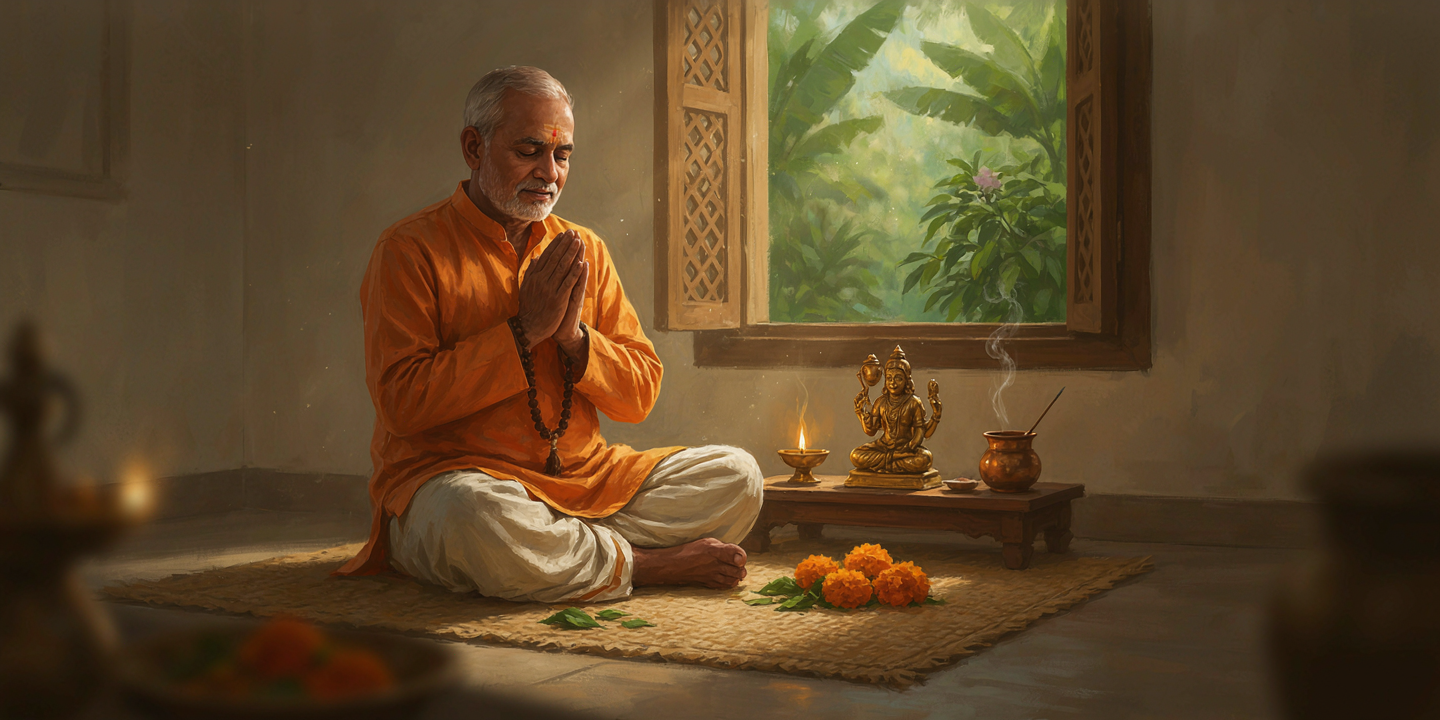
You do not need to be a scholar to chant this mantra. A sincere heart and a few simple habits are enough. Here is an easy method.
- Choose a quiet time. Early morning after a bath is the traditional choice, as the mind is fresh and the house is calm. If this is not possible, you may chant at any peaceful time, including the evening.
- Keep a clean place. Sit on a mat or a cloth, facing east if you can. Place a picture or idol of Bhagwan Dhanvantari or Bhagwan Vishnu in front of you.
- Light a lamp. A ghee lamp or an oil lamp is lit as a sign of welcome. You may offer fresh flowers, Tulasi leaves and a simple naivedya offering.
- Take a calm moment. Close your eyes, take a few slow breaths and bring to mind the form of Bhagwan Dhanvantari with the Amrit Kalash. Say your Sankalpa in your own words, for example, “I chant this mantra for the health and peace of my family”.
- Chant with a mala. A Tulasi mala is considered suitable for the mantras of Bhagwan Vishnu. Use the thumb and the middle finger, and do not cross the top bead.
- Chant slowly and clearly. Pronounce each word with care. It is better to chant slowly and rightly than quickly and wrongly.
- Close with thanks. At the end, sit quietly for a moment, fold your hands and thank Bhagwan. You may also pray for the health of all beings.
How Many Times Should You Chant the Dhanvantari Mantra?
The number of chants depends on your time and comfort. A common practice is to chant it 108 times, which is one full round of a mala. Many people begin with 11 or 21 chants and slowly increase. Some families do a larger practice of 1008 chants on special days, or a fixed number over a fixed number of days.
More important than the count is regularity. Traditional teachers say that a small practice done every day with devotion is better than a large practice done only once in a while. Choose a number that you can keep up, and make it a part of your daily routine.
Teachers also speak of three ways of chanting. The first is aloud, which helps in learning the sounds. The second is in a soft whisper, which others cannot hear. The third is silent, in the mind, which many see as the most inward form. You may choose the way that suits your place and mood.
Who Can Chant the Dhanvantari Mantra?
Any person with faith can chant the Dhanvantari mantra, whatever their age or background. Children, elders, men and women can all take part. You can chant it for yourself, or with the Sankalpa of a loved one in your heart.
If you are unwell or tired, you do not need to sit in a hard posture. You may sit on a chair, or even chant in the mind while resting. Bhagwan looks at the sincerity of the heart and not at the strength of the body. Do not push yourself, and follow your doctor’s advice about rest and activity.
What Are the Traditional Benefits of the Dhanvantari Mantra?
The benefits of a mantra are a matter of faith, tradition and personal experience. They are not medical claims. With this understanding, devotees often speak of these benefits.
The first is peace of mind. When the mind repeats a sacred sound, it slowly becomes calm, and worry becomes lighter. The second is a sense of hope and support. Many people feel that they are not alone in a hard time. The third is discipline. A daily mantra practice brings a regular routine, which is itself good for the mind and the home.
The fourth is thankfulness. As we chant, we also remember the blessings of health that we have, and our attitude towards our own care becomes gentler. Devotees also chant the mantra to seek the blessings of Bhagwan Dhanvantari for the strength and vitality of themselves and their loved ones.
What Is the Link Between the Mantra and the Dhanvantari Homam?
The Dhanvantari mantra is the heart of the Dhanvantari Homam. In the Homam, the priests chant the mantra many times, and after each chant they offer ghee and sacred herbs into the fire with the word Swaha. The Sankalpa made in the name of the Sevakartha gives the ritual its purpose.
Many families chant the mantra at home every day and also book a Homam on special occasions. For example, they may do so before an important treatment, for the health of an elder, or as a thanksgiving. You can read more in our post on what the Dhanvantari Homam is, and you can see the Homam on our Dhanvantari Homam page.
How Should We See Mantra Chanting and Medical Care Together?
This is a very important point. The Dhanvantari mantra is a form of spiritual support. It is not a replacement for medical advice, diagnosis or treatment. Ayurveda, which Bhagwan Dhanvantari gave to the world, itself teaches the value of a good Vaidya, right food, right rest and right medicine.
The best way to see the mantra is as a companion to good care. The doctor treats the body, the family looks after the person, and the mantra gives strength and peace to the mind. Please continue to follow your doctor’s guidance, and never stop or change a treatment because of a mantra or a ritual.
Key Takeaways
- The Dhanvantari mantra is a prayer to Bhagwan Dhanvantari, the divine physician and an avatar of Bhagwan Vishnu.
- The common full mantra is “Om Namo Bhagavate Vasudevaya Dhanvantaraye Amrita Kalasha Hastaya Sarva Amaya Vinashaya Trailokya Nathaya Dhanvantari Maha Vishnave Namah”.
- A short form for daily use is “Om Shri Dhanvantaraye Namah”.
- Chant in a clean, quiet place, preferably in the morning, with a lamp and a Tulasi mala.
- A common practice is 108 chants, but regular daily practice matters more than the count.
- The mantra is spiritual support and works alongside medical care, never in place of it.
Frequently Asked Questions
Q. What is the Dhanvantari mantra?
The Dhanvantari mantra is a prayer to Bhagwan Dhanvantari, the divine physician. The common form begins with “Om Namo Bhagavate Vasudevaya Dhanvantaraye” and ends with “Dhanvantari Maha Vishnave Namah”.
Q. What is the meaning of the Dhanvantari mantra?
It means, “I bow to Bhagwan Vasudeva, to Dhanvantari who holds the Amrit Kalash, who is remembered as the remover of all suffering, the Master of the three worlds, the great Vishnu.”
Q. How many times should I chant the Dhanvantari mantra?
Many devotees chant it 108 times, which is one round of a mala. You can begin with 11 or 21 chants. Regular daily practice is more important than a large number of chants.
Q. What is the best time to chant the Dhanvantari mantra?
Early morning after a bath is the traditional time. However, you may chant at any peaceful time if the morning is not possible for you.
Q. Can women and children chant the Dhanvantari mantra?
Yes. Anyone with faith can chant this mantra. Children can start with the short form “Om Shri Dhanvantaraye Namah”.
Q. Can the Dhanvantari mantra cure diseases?
No. The mantra is a form of spiritual support and does not claim to cure any disease. It is chanted to seek blessings and peace of mind, and it should always go along with proper medical care.
A Note on Health and Faith
Chanting the Dhanvantari mantra and performing the Dhanvantari Homam are forms of spiritual support. They are not a substitute for medical advice, diagnosis or treatment. Please continue to follow your doctor’s guidance and take care of your health along with your prayers.
Seek the Blessings of Bhagwan Dhanvantari
If you wish to pray for the health and wellbeing of your family with the full Vedic method, you can book the Dhanvantari Homam with Jyotirgamaya from anywhere in the world. Visit the Dhanvantari Homam page or explore all rituals at JyotirGamaya Online Pujas.