Dhanvantari in the Puranas: Vishnu Purana and Bhagavata Purana Accounts
By: Pratima Argade
13 October 2026 at 10:04 AM
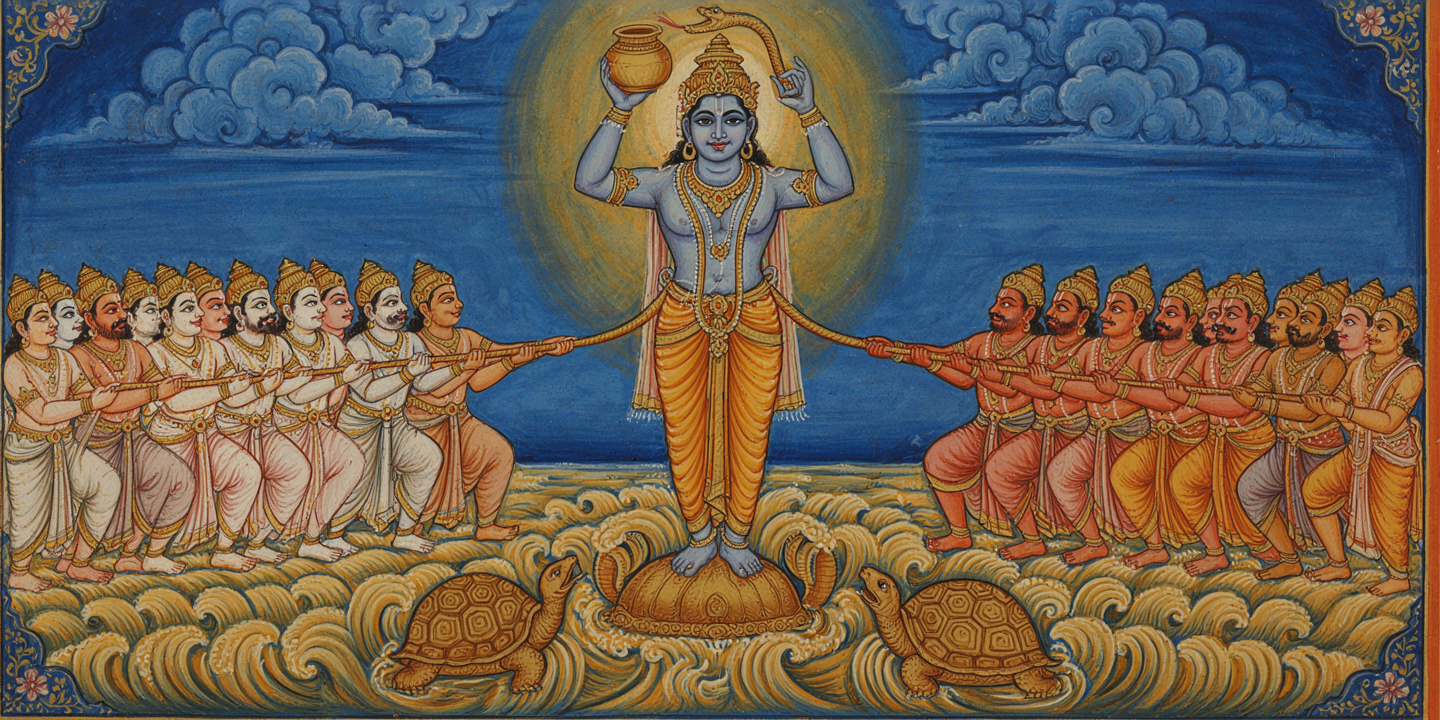
The Puranas describe Bhagwan Dhanvantari in two main ways. In the Vishnu Purana, the Bhagavata Purana and the epics, he rises from the Kshira Sagara during the Samudra Manthan with a vessel of Amrit, as a form of Bhagwan Vishnu. In the same Puranas, he is also described as being born in the royal line of Kashi, as the teacher of Ayurveda.
Many devotees know the name Dhanvantari from the story of the Amrit Kalash, or from the festival of Dhanteras. Fewer people know that the Puranas speak about him in several places, and that each text adds a little more to the picture. When a reader looks at them together, a clear and beautiful portrait of the divine physician appears.
In this post, we will walk through what the Vishnu Purana, the Bhagavata Purana, the Mahabharata, the Ramayana and the Agni Purana say about Bhagwan Dhanvantari. We will also look at why the texts seem to speak of more than one Dhanvantari, and how devotees understand this. If you are new to the subject, you may like to start with our post on who Bhagwan Dhanvantari is.
What Do the Puranas Say About Bhagwan Dhanvantari?
The Puranas are a large body of ancient Hindu texts that preserve stories of the Devas, the creation, the dynasties of kings and the teachings of dharma. Bhagwan Dhanvantari is found in many of them. The main points that appear again and again are these.
First, he appears when the Devas and Asuras churn the Kshira Sagara. Second, he carries the Amrit Kalash. Third, he is a portion, or amsha, of Bhagwan Vishnu. Fourth, he is the source of Ayurveda for the world. Fifth, he is connected with the royal city of Kashi, which is the old name of Varanasi.
The accounts differ in small details, such as the order in which the treasures come out of the ocean, or the exact lines of the Kashi family. This is normal in the Puranas, as they were passed down over many ages and tell the same events from different points of view. The central message stays the same across all of them.
What Does the Vishnu Purana Say About Dhanvantari?
The Vishnu Purana is one of the most respected of the Puranas, and it speaks of Bhagwan Dhanvantari in two places.
In the first book, the Vishnu Purana tells the story of the Samudra Manthan. It begins with the pride of Indra and the curse of the sage Durvasa, which leaves the Devas weak and Devi Lakshmi gone from the three worlds. Bhagwan Vishnu then advises the Devas to churn the ocean with the help of the Asuras. As the churning goes on, many wonderful beings and treasures rise, and finally Dhanvantari appears, carrying a vessel of Amrit in his hand. The Devas and Asuras both look at the vessel with great wonder, and a contest begins.
In the fourth book, the Vishnu Purana lists the royal families of ancient India. In the line of the kings of Kashi, it speaks of Dhanvantari as the son of Dirghatapas. The text describes him as a sharer in the nature of Bhagwan Vishnu and as the one who made the science of Ayurveda known to the world. Traditional readers also note that the text speaks of Ayurveda being taught in eight branches, which matches the later Ayurvedic tradition.
So the Vishnu Purana gives us two pictures. One is of the divine being who rises from the ocean, and the other is of the royal teacher of Kashi who shares the knowledge of healing with humankind.
What Does the Bhagavata Purana Say About Dhanvantari?
The Bhagavata Purana is the most loved of the Puranas among devotees of Bhagwan Vishnu, and its accounts of Dhanvantari are warm and detailed.
In the Eighth Canto, the Bhagavata Purana tells the story of the Samudra Manthan in beautiful words. When the churning goes on, a wonderful person rises from the ocean. He is strong, with long arms, with a dark and glowing body, wearing yellow cloth, bright earrings and a garland, and holding a kalash full of Amrit. The text says clearly that he is a portion of Bhagwan Vishnu, and calls him a seer of Ayurveda. It also says that he was given a share of the offerings in the yajna. This is one reason why Dhanvantari is remembered in Vedic rituals.
In the Ninth Canto, the Bhagavata Purana speaks of the royal line of Kashi. Here, Dhanvantari appears in the family, as the son of Dirghatapas. The text calls him the one who spread Ayurveda, and a portion of Vasudeva. It adds that even the remembrance of his name is believed to remove suffering. This line is a statement of devotion, and we can read it as a sign of how much the old tradition respected him.
The Bhagavata Purana also lists Dhanvantari among the avatars of Bhagwan Vishnu in its lists of avatars in the first and second cantos. In these lists, the purpose of his coming is said to be to remove suffering and to teach Ayurveda. For devotees, this is the reason why Bhagwan Dhanvantari is worshipped as a form of Bhagwan Vishnu and not only as a Deva of medicine.
What Do the Mahabharata and Ramayana Say About Dhanvantari?
The two great epics also speak of Bhagwan Dhanvantari, both in the story of the Samudra Manthan.
The Adi Parva of the Mahabharata describes the churning, and says that Dhanvantari rose from the ocean, holding a white vessel of Amrit. The text then goes on to tell of the race between the Devas and the Asuras, and of the form of Mohini.
In the Bala Kanda of the Valmiki Ramayana, the sage Vishvamitra tells the same story to Rama and Lakshmana. In this telling, Dhanvantari rises with a staff and a kamandalu, which is a water pot. After him, the Apsaras and Varuni come out. The epic does not describe the story in as much detail as the Bhagavata, but it confirms that the story of Dhanvantari was well known in the ancient tradition.
These small differences, such as a white vessel in one text and a kalash in another, are normal. The traditional view is that the same event is told in different texts by different narrators, each in their own way, and the message stays the same.
What Do the Agni Purana and Garuda Purana Say About Dhanvantari?
Besides the stories, some Puranas also keep teachings about medicine, and they link these teachings with Bhagwan Dhanvantari.
The Agni Purana is a large text that covers many subjects, including rituals, kingship, poetry and medicine. According to tradition, it has chapters on medicine that are presented as the teaching of Dhanvantari to the sage Sushruta. In the same way, the Garuda Purana has parts that deal with Ayurveda, and traditional readers connect them with the Dhanvantari and Sushruta tradition.
These chapters show how closely the Puranic tradition and the Ayurvedic tradition were joined. In the Sushruta Samhita itself, the first chapter describes how Sushruta goes with other students to Divodasa, the king of Kashi, who is identified with Dhanvantari, and asks him to teach them the science of healing. We have written about this in our post on the link between Dhanvantari and Ayurveda.
Are There Two Dhanvantaris in the Puranas?
Many readers notice that the Puranas seem to describe Dhanvantari in two ways. In one, he rises from the ocean as a divine being. In the other, he is born as the grandson or descendant of the king of Kashi. This leads to a common question. Is he one person or two?
Traditional teachers explain this in three ways. The first view is that Bhagwan Dhanvantari first appeared at the Samudra Manthan as an amsha of Bhagwan Vishnu, and later took birth in Kashi to teach Ayurveda to humankind. The Bhagavata Purana supports this idea, because it describes his rebirth in the line of Kashi.
The second view is that the Puranas speak of different ages, called kalpas, and that the same divine person appears again and again in different ages. The third view, which some scholars follow, is that the name Dhanvantari was used for a line of great Vaidyas in Kashi, who were all honoured as forms of the divine physician.
For devotees, this question does not change the way they worship. They simply honour Bhagwan Dhanvantari as the divine healer who gives the Amrit and the knowledge of life.
What Are the Common Themes in All These Accounts?
When we read the Puranic accounts together, a few clear themes stand out.
- Bhagwan Dhanvantari is a form of Bhagwan Vishnu, and not a separate Deva.
- He appears at the time of the Samudra Manthan with the Amrit Kalash.
- He is the source of Ayurveda, and he is linked with Kashi and with the teacher of Sushruta.
- He is remembered with respect in Vedic rituals, and a share of the yajna offerings is described as his.
- His name and his form are connected with health, life and hope.
These themes are the reason why Bhagwan Dhanvantari holds a special place in Hindu devotion.
What Can Devotees Learn from These Accounts Today?
The Puranic stories are not only about the past. They give us lessons for daily life. The first lesson is that health is a gift, as precious as the Amrit that came out of the ocean after a long and hard churning. The second lesson is that knowledge of healing is sacred, and should be learned and used with humility. The third is that faith and science walk together. The same Bhagwan who holds the Amrit Kalash is also the teacher of the Vaidyas who give medicine.
This is why traditional families pray to Bhagwan Dhanvantari for the wellbeing of their loved ones and also take care to follow the advice of good doctors and Vaidyas.
How Are These Stories Linked to the Dhanvantari Homam?
The Dhanvantari Homam is a Vedic fire ritual that honours Bhagwan Dhanvantari as described in these Puranas. The Kalasha placed during the ritual stands for the Amrit Kalash of the Samudra Manthan. The mantras chanted in it call upon Bhagwan Vasudeva in the form of Dhanvantari. The offering of ghee and sacred herbs into the fire is a way of honouring the share of the yajna that the Bhagavata Purana describes as his.
If you wish to know more about the ritual, please read our post on what the Dhanvantari Homam is. You can also see the Homam on our Dhanvantari Homam page.
How Should We See Faith and Medical Care Together?
The Dhanvantari Homam and the prayers to Bhagwan Dhanvantari are forms of spiritual support. They are not a replacement for medical advice, diagnosis or treatment. The Puranas and the Ayurvedic texts themselves teach respect for the Vaidya, right food, right rest and right medicine.
The best way to see devotion is as a companion to good care. The doctor treats the body, the family looks after the person, and the prayer gives strength and calm to the mind. Please continue to follow your doctor’s guidance, and never stop or change a treatment because of a ritual.
Key Takeaways
- The Puranas describe Dhanvantari as a form of Bhagwan Vishnu who rises from the Kshira Sagara with the Amrit Kalash.
- The Vishnu Purana and the Bhagavata Purana also describe him as born in the royal line of Kashi, as the teacher of Ayurveda.
- The Mahabharata and the Ramayana tell the story of his rising from the ocean.
- The Agni Purana and Garuda Purana carry teachings on medicine linked to the Dhanvantari and Sushruta tradition.
- Small differences in the texts are normal, and tradition explains them as accounts from different ages and narrators.
- Devotion to Bhagwan Dhanvantari is spiritual support and works alongside medical care.
Frequently Asked Questions
Q. Is Dhanvantari mentioned in the Vishnu Purana?
Yes. The Vishnu Purana describes his rising from the ocean with a vessel of Amrit in the first book, and speaks of him in the royal line of Kashi as the one who made Ayurveda known in the fourth book.
Q. What does the Bhagavata Purana say about Dhanvantari?
The Bhagavata Purana describes him in the Eighth Canto as a radiant person rising from the ocean with the Amrit Kalash, and in the Ninth Canto as a descendant in the royal line of Kashi and a spreader of Ayurveda. It calls him a portion of Bhagwan Vishnu.
Q. Is Dhanvantari an avatar of Bhagwan Vishnu?
Yes. The Bhagavata Purana lists him among the avatars of Bhagwan Vishnu, and the Vishnu Purana describes him as a sharer in Vishnu’s nature.
Q. Is Dhanvantari mentioned in the Mahabharata and Ramayana?
Yes. Both epics tell the story of the Samudra Manthan and describe Dhanvantari rising from the ocean with a vessel of Amrit.
Q. Are there two Dhanvantaris in Hindu tradition?
The Puranas speak of Dhanvantari rising from the ocean and also being born in the line of Kashi. Many devotees see them as the same divine person appearing in two ways, and some teachers explain it through different ages. Either way, he is honoured as the Bhagwan of healing.
Q. Which Purana has the most about Dhanvantari and Ayurveda?
The Bhagavata Purana and the Vishnu Purana give the main accounts of his life, while the Agni Purana and Garuda Purana carry teachings on medicine linked to his tradition.
A Note on Health and Faith
Devotion to Bhagwan Dhanvantari and the Dhanvantari Homam are forms of spiritual support. They are not a substitute for medical advice, diagnosis or treatment. Please continue to follow your doctor’s guidance and take care of your health along with your prayers.
Seek the Blessings of Bhagwan Dhanvantari
If you wish to pray for the health and wellbeing of your family with the full Vedic method, you can book the Dhanvantari Homam with Jyotirgamaya from anywhere in the world. Visit the Dhanvantari Homam page.