Dhanvantari Homam vs Maha Mrityunjaya Homam: Which One Should You Choose?
By: Pratima Argade
15 October 2026 at 10:31 AM
Dhanvantari Homam is dedicated to Bhagwan Dhanvantari, a form of Bhagwan Vishnu, and is performed to seek blessings for health, recovery and wellbeing. Maha Mrityunjaya Homam is dedicated to Bhagwan Shiva and is performed to seek protection, courage and long life. Many families choose one, and many perform both, as one is not better than the other.
When a family faces a hard time with someone’s health, a common question comes up. Should we do the Dhanvantari Homam or the Maha Mrityunjaya Homam? Both are very popular, both are performed with deep faith, and both are linked with health and protection. Because of this, people often feel confused about which one fits their situation.
In this post, we will explain what each Homam is, who the deity is, what the mantra says, and how the two differ. We will also share how families usually decide, and why many choose to do both. If you are new to the subject, you may like to read our posts on what the Dhanvantari Homam is and on who Bhagwan Dhanvantari is.
What Is Dhanvantari Homam?
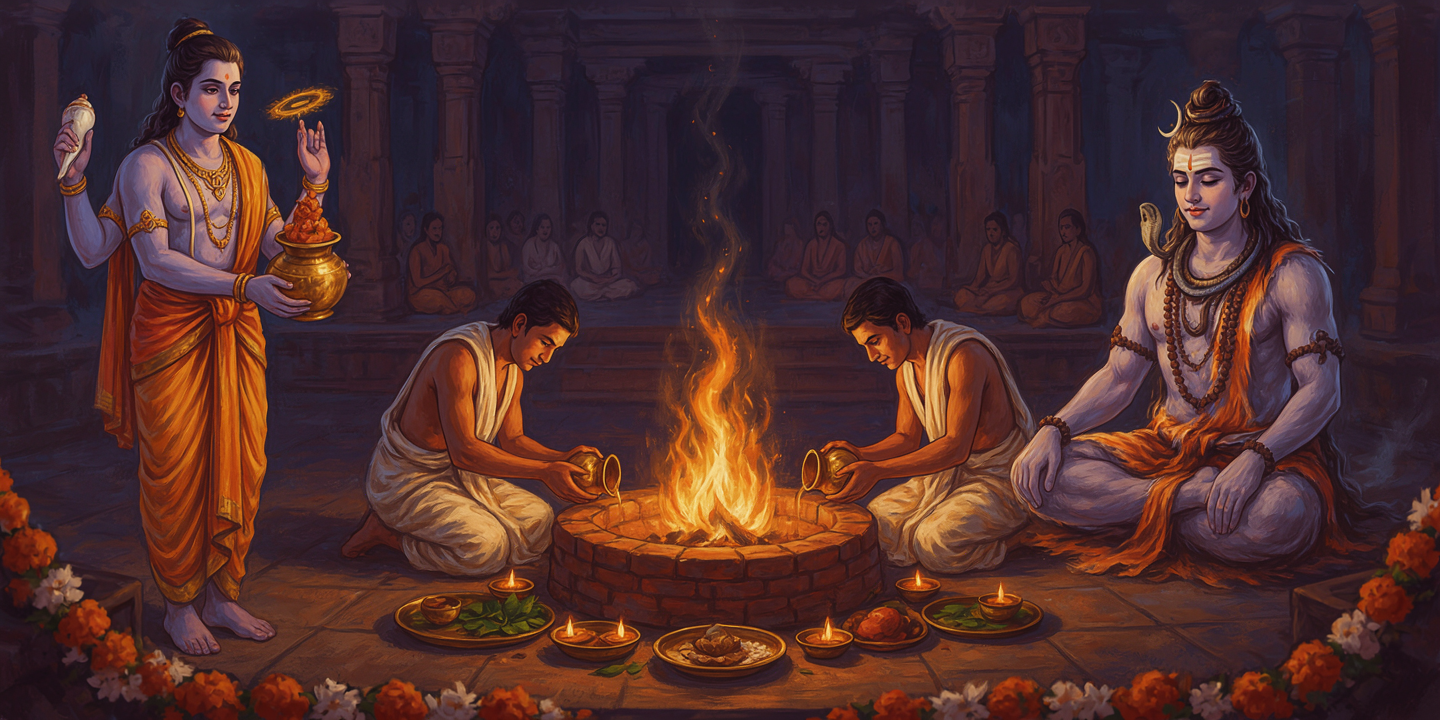
Dhanvantari Homam is a Vedic fire ritual dedicated to Bhagwan Dhanvantari, the divine physician and the Bhagwan of Ayurveda. The Puranas describe him as a form of Bhagwan Vishnu who rose from the Kshira Sagara during the Samudra Manthan, holding the Amrit Kalash.
In the Homam, the priests take a Sankalpa in the name of the Sevakartha, chant the Dhanvantari mantras, and offer ghee and sacred herbs into the fire. The ritual is traditionally performed to seek blessings for health, recovery, vitality and peace of mind. Its focus is on healing, wellbeing and the care of the body and the mind.
What Is Maha Mrityunjaya Homam?
Maha Mrityunjaya Homam is a Vedic fire ritual dedicated to Bhagwan Shiva, who is worshipped here as Tryambaka, the three eyed one, and as Mrityunjaya, the conqueror of fear and death. The word Maha means great, Mrityu means death, and Jaya means victory. Together the name is often understood as “the great victory over the fear of death”.
In this Homam too, the priests take a Sankalpa and chant the Maha Mrityunjaya mantra with offerings into the fire. The ritual is traditionally performed to seek Bhagwan Shiva’s protection, courage, and blessings for a long and healthy life, especially in times of great worry or danger. Its focus is on protection, fearlessness and long life, which is called Ayushya.
What Is the Maha Mrityunjaya Mantra and What Does It Mean?
The Maha Mrityunjaya mantra is one of the oldest and most loved mantras of the Vedic tradition. It is found in the Rigveda, in the hymns attributed to the sage Vasishtha, and also in the Yajurveda. The mantra is:
Om Tryambakam Yajamahe Sugandhim Pushtivardhanam
Urvarukamiva Bandhanan Mrityor Mukshiya Maamritat
In simple English, the mantra means: “We worship the three eyed Bhagwan, who is fragrant and who nourishes all beings. As a ripe cucumber is freed from its stem, may we be freed from the bondage of death, and not from the nectar of immortality.”
The meaning is deep. The image of the ripe cucumber that falls from the vine without effort shows a calm and natural letting go of fear. The prayer is not about escaping life, but about being freed from fear and from bondage, and being established in the nectar of immortality, which the tradition understands as the awareness of the eternal Self. In the Puranas, this mantra is also linked with a tradition known as Mrita Sanjivani.
What Are the Main Differences Between the Two Homams?
Both Homams are Vedic fire rituals, so they share a similar structure. They begin with a Sankalpa, a prayer to Bhagwan Ganesha, the placing of a kalash, the lighting of the fire, mantra chanting with offerings, a final offering and an aarti. The main differences are in the deity, the mantra, the mood and the usual purpose.
- Deity. Dhanvantari Homam honours Bhagwan Dhanvantari, a form of Bhagwan Vishnu. Maha Mrityunjaya Homam honours Bhagwan Shiva as Tryambaka.
- Mantra. The first uses the Dhanvantari mantras. The second uses the Maha Mrityunjaya mantra from the Rigveda and Yajurveda.
- Focus. The first is about healing, wellbeing and vitality. The second is about protection, courage and long life.
- Mood. The first has a gentle, nurturing feeling, like a prayer for care. The second has a strong, protective feeling, like a prayer for shelter.
- Typical occasions. The first is often chosen for health journeys, recovery periods and general wellbeing. The second is often chosen in times of great worry, fear or danger, and for Ayushya.
These are traditional ways of understanding the two Homams, and not strict rules. Families and priests may have their own custom.
What Is the Link Between Bhagwan Shiva and Bhagwan Dhanvantari?
There is a beautiful link between the two in the story of the Samudra Manthan. When the Devas and Asuras churned the ocean, the deadly poison Halahala came out first, and it frightened all the worlds. Bhagwan Shiva drank it to protect everyone and held it in his throat, which is why he is called Neelakantha.
After this, the churning continued, and many treasures rose from the ocean. At the end, Bhagwan Dhanvantari appeared with the Amrit Kalash. So one story shows the protector who took in the poison, and the healer who brought the Amrit. This is why many devotees feel that Shiva and Vishnu, who are seen as one in the idea of Harihara, work together for the wellbeing of all.
Because of this link, it is quite natural for devotees to pray to both Bhagwan Shiva and Bhagwan Dhanvantari when a loved one is going through a difficult time.
When Do Families Choose Dhanvantari Homam?
Families often choose the Dhanvantari Homam when their main wish is for healing, wellbeing and recovery. Some common situations are the following.
A loved one is going through a long period of health worry and the family wants to pray for strength and peace of mind. Someone is preparing for a surgery or a treatment, or is recovering after one. An elderly parent needs care and comfort. A child often falls sick, and the parents want to seek blessings for the child. Someone wants to give thanks for good health, or to start a new year of life with a prayer for vitality. A student or practitioner of Ayurveda wants to honour Bhagwan Dhanvantari.
In all of these, the feeling is one of care and hope, and the family seeks the blessings of the divine physician alongside the care of the doctors.
When Do Families Choose Maha Mrityunjaya Homam?
Families often choose the Maha Mrityunjaya Homam when their main wish is for protection, courage and long life. Some common situations are as follows.
A family is going through a time of deep fear and wants to seek Bhagwan Shiva’s protection. A loved one is in a serious condition, and the family wishes to pray for courage and shelter. Someone has had an accident or a narrow escape and wants to give thanks and seek protection. An elder is entering a new decade of life, and the family wishes to seek blessings for a long and healthy life, as in the Shashtipurti and Shatabhishekam celebrations. A Jyotishi has suggested the Homam for a difficult planetary period.
In these cases, the feeling is of protection and surrender, and the family places its fear in the hands of Bhagwan Shiva.
What Does Jyotish Say About Choosing Between the Two?
In Vedic astrology, the Maha Mrityunjaya Homam is traditionally suggested for periods when a horoscope shows strain on the house of longevity, or during hard planetary periods such as certain Dashas, a difficult Shani period, or the effects of Rahu and Ketu on health. The Dhanvantari Homam is traditionally suggested when the horoscope shows worries about health in the 6th house, or when a person is going through a long health journey.
These are traditional views, and every horoscope is different. Jyotish is a guide for reflection and spiritual practice, and not a medical diagnosis. If you have a doubt, a trusted Jyotishi and an experienced priest can look at the full chart and suggest the right Homam with care. We will explain this in detail in our posts in the astrology and health group.
Can You Perform Both Homams Together?
Yes, many families do both. They may do the Dhanvantari Homam to seek the blessings of the divine physician, and the Maha Mrityunjaya Homam to seek the protection of Bhagwan Shiva. They may do them on the same day or on different days, depending on their situation and the advice of the priest.
There is also a third Homam, the Ayushya Homam, which is performed for long life. Some families choose it as a part of the same prayer. We will explain the differences between the Dhanvantari Homam, the Ayushya Homam and the Sudarshana Homam in a separate post.
Remember that the Homams are not in competition. They are different doors to the same prayer, which is for the wellbeing and protection of a loved one.
How to Decide Which Homam Is Right for You?
If you are not sure, a few simple questions may help.
- What is the main feeling in your heart? If it is care and hope for healing and recovery, the Dhanvantari Homam may feel close. If it is fear and a wish for protection, the Maha Mrityunjaya Homam may feel close.
- Which Bhagwan do you or your family feel most connected to? Devotion is personal, and a Homam done with a close heart is always meaningful.
- Does your family tradition or Guru have a preference? If yes, please follow it.
- Has a Jyotishi or priest given any advice for your situation? If yes, it can be a helpful guide.
- Is it possible to do both? If your family wishes, there is no rule against it.
When you book a Homam, you will usually be asked for the name, gotra and nakshatra of the Sevakartha, and the purpose of the prayer. You can share your wish in simple words, and the priests will take the Sankalpa with care.
How Should We See Homams and Medical Care Together?
Both the Dhanvantari Homam and the Maha Mrityunjaya Homam are forms of spiritual support. They are not a replacement for medical advice, diagnosis or treatment. They do not promise any result, and they should never delay or replace the care of a doctor, especially in a serious condition.
The best way to see a Homam is as a companion to good care. The doctor treats the body, the family looks after the person, and the prayer gives strength, courage and calm to the mind. Please continue to follow your doctor’s guidance, and never stop or change a treatment because of a ritual.
Key Takeaways
- Dhanvantari Homam honours Bhagwan Dhanvantari, a form of Bhagwan Vishnu, and is performed to seek blessings for healing, wellbeing and vitality.
- Maha Mrityunjaya Homam honours Bhagwan Shiva as Tryambaka, and is performed to seek protection, courage and long life.
- The Maha Mrityunjaya mantra is found in the Rigveda and Yajurveda, while the Dhanvantari mantras come from the Puranic tradition.
- The two Homams are linked in the Samudra Manthan story, where Shiva drinks the poison and Dhanvantari brings the Amrit.
- Families may choose one, or both, based on their feeling, tradition and the advice of their priest or Jyotishi.
- Both Homams are spiritual support and work alongside medical care, never in place of it.
Frequently Asked Questions
Q What is the difference between Dhanvantari Homam and Maha Mrityunjaya Homam?
Dhanvantari Homam honours Bhagwan Dhanvantari and is performed to seek blessings for healing and wellbeing. Maha Mrityunjaya Homam honours Bhagwan Shiva and is performed to seek protection, courage and long life.
Q. Which Homam is better for health problems?
Neither is better than the other. Many families choose the Dhanvantari Homam when their wish is for healing and recovery, and the Maha Mrityunjaya Homam when their wish is for protection. Many also do both.
Q. Can I do Dhanvantari Homam and Maha Mrityunjaya Homam together?
Yes. There is no rule against it, and many families perform both, either on the same day or on different days. A priest can advise on what suits your situation.
Q. Is Maha Mrityunjaya Homam only for serious illness?
No. It is traditionally performed for protection, courage and long life, and families also do it for an elder’s milestone birthday, after a narrow escape, or during a hard period in life.
Q. Which Homam is suitable before surgery?
Many families perform the Dhanvantari Homam to seek blessings for a smooth recovery period, and some also perform the Maha Mrityunjaya Homam for protection. Both are spiritual support and do not replace the care of the surgeon.
Q. What is the Maha Mrityunjaya mantra?
It is “Om Tryambakam Yajamahe Sugandhim Pushtivardhanam, Urvarukamiva Bandhanan Mrityor Mukshiya Maamritat”, a mantra from the Rigveda and Yajurveda dedicated to Bhagwan Shiva.
A Note on Health and Faith
The Dhanvantari Homam and the Maha Mrityunjaya Homam are forms of spiritual support. They are not a substitute for medical advice, diagnosis or treatment. Please continue to follow your doctor’s guidance and take care of your health along with your prayers.
Seek the Blessings of Bhagwan Dhanvantari
If you wish to pray for the health and wellbeing of your family with the full Vedic method, you can book the Dhanvantari Homam with Jyotirgamaya from anywhere in the world. Visit the Dhanvantari Homam page.