Dhanvantari Gayatri Mantra and Dhanvantari Stotram: Text and Meaning
By: Pratima Argade
12 October 2026 at 2:47 AM
The Dhanvantari Gayatri mantra is a short prayer that asks Bhagwan Dhanvantari to guide and brighten the mind. Its text is “Om Tat Purushaya Vidmahe, Amrita Kalasha Hastaya Dhimahi, Tanno Dhanvantari Prachodayat”. The Dhanvantari Stotram is a hymn of praise that describes his divine form, holding the shankha, the chakra, the leech and the Amrit Kalash.
Many devotees chant the main Dhanvantari mantra every day and want to go a little deeper. They ask a simple question: what other prayers can we say for Bhagwan Dhanvantari? The answer is the Dhanvantari Gayatri mantra, the Dhanvantari Stotram and its dhyana shloka, which is the verse used to meditate on his form.
In this post, we will share the text of each prayer, explain the meaning in simple English, and describe when and how to chant them. If you are new to this subject, you may like to first read our posts on who Bhagwan Dhanvantari is and on the Dhanvantari mantra.
What Is a Gayatri Mantra Form?
The word Gayatri has two meanings in Vedic tradition. It is the name of a famous Vedic meter, and it is the name of the great Gayatri mantra dedicated to Savitur, the Sun. Over time, the same three part structure was used to create prayers for many Devas. Each of them has the same pattern, which tradition describes as the Vidmahe line, the Dhimahi line and the Prachodayat line.
In the first line, we say that we know or reflect on the Supreme. In the second line, we say that we meditate on the particular form of Bhagwan we love. In the third line, we pray that this Bhagwan may inspire and guide our mind. This simple pattern makes a Gayatri mantra very easy to chant and remember. The Dhanvantari Gayatri mantra follows the same pattern.
What Is the Dhanvantari Gayatri Mantra?
The text of the Dhanvantari Gayatri mantra, as it is commonly chanted, is:
Om Tat Purushaya Vidmahe
Amrita Kalasha Hastaya Dhimahi
Tanno Dhanvantari Prachodayat
Please note that you may also see a small variation in some books, where the first line says “Om Vasudevaya Vidmahe” and the second says “Sudha Hastaya Dhimahi”. Both forms are used by devotees. If your family has a tradition or a Guru, please follow the form that you have been taught.
What Is the Meaning of the Dhanvantari Gayatri Mantra?
Here is the meaning of each part in simple words.
- Om is the first sacred sound, which holds all sounds.
- Tat Purushaya Vidmahe means “We know that Supreme Being” or “We reflect on that Supreme Purusha”. Purusha here means the Supreme Person who lives in all.
- Amrita Kalasha Hastaya Dhimahi means “We meditate on the one who holds the kalash of Amrit in his hand”.
- Tanno Dhanvantari Prachodayat means “May that Dhanvantari guide and inspire our mind”.
Put together, the prayer says: “We reflect on the Supreme Being. We meditate on Bhagwan Dhanvantari, who holds the Amrit Kalash. May he guide and brighten our mind.” You will notice that this mantra does not ask for any particular result. It asks only for a clear and calm mind, and many devotees find this very beautiful.
How to Chant the Dhanvantari Gayatri Mantra?
The Dhanvantari Gayatri can be chanted in the same simple way as other mantras. Sit in a quiet place after a bath, light a lamp before a picture of Bhagwan Dhanvantari, and take a few slow breaths. Say your Sankalpa in your own words, for example, “I chant this for the health and peace of my family”.
A common practice is to chant the mantra 3, 11, 21 or 108 times. You may use a Tulasi mala. Many families choose the morning or the early evening. Pronounce each word slowly and clearly, and finish with a short moment of silent thanks. Regular practice, even for a few minutes, matters more than a long practice done rarely.
What Is the Dhanvantari Stotram?
A stotram is a hymn of praise. Instead of repeating a short mantra, the devotee recites verses that describe the form, qualities and deeds of Bhagwan. The Dhanvantari Stotram praises Bhagwan Dhanvantari as the holder of the Amrit Kalash and the divine teacher of Ayurveda.
Students of Ayurveda and many Vaidyas have traditionally recited verses in praise of Bhagwan Dhanvantari before they start their study or work. Families also recite the stotram, especially on days that are dear to Bhagwan Vishnu, such as Ekadashi, and during the Dhanvantari Homam. There are also long lists of his names, called the Ashtottara Shatanamavali, which has 108 names and is used in puja.
Different books and traditions give different versions of the Dhanvantari Stotram. Below, we share two of the most widely known texts, the dhyana shloka and the Dhanvantari Maha Mantra.
What Is the Dhanvantari Dhyana Shloka and Its Meaning?
A dhyana shloka is a verse that helps the devotee to picture the form of Bhagwan before chanting. The well known Dhanvantari dhyana shloka is:
Om Shankham Chakram Jalaukam Dadhad Amruta Ghatam Charubahubhishchaturbhih
Sukshma Swachchati Hridayam Shuka Parivilasan Maulim Ambhoja Netram
Kalambhodojjwalangam Katitata Vilasat Charu Pitambaradhyam
Vande Dhanvantarim Tam Nikhila Gada Vana Prouda Davagni Leelam
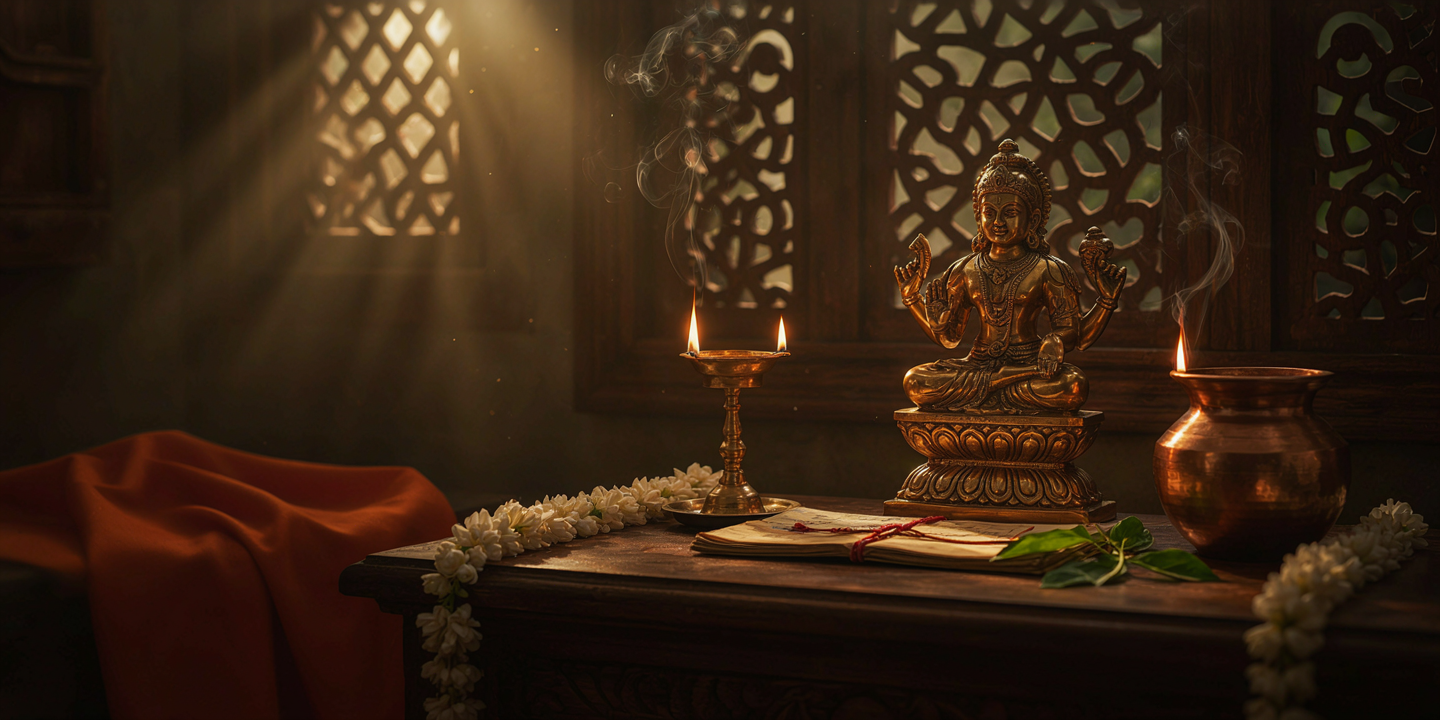
In simple English, the verse paints this picture. Bhagwan Dhanvantari has four beautiful arms. In them, he holds a conch, a chakra, a leech and a pot of Amrit. His heart is pure and gentle. His head shines with a bright crown, and his eyes are like lotus petals. His body glows like a dark rain cloud, and a lovely yellow cloth is wrapped around his waist. The devotee closes with the words, “I bow to Dhanvantari”.
The last line uses a poetic image. It compares Bhagwan Dhanvantari to a great forest fire in the forest of all ailments. This is a devotional picture that shows how deeply devotees respect him as the Bhagwan of healing. It is not a medical statement, and we should read it as an expression of faith.
What Is the Dhanvantari Maha Mantra?
Another prayer that is often chanted along with the stotram is the long form known as the Dhanvantari Maha Mantra:
Om Namo Bhagavate Maha Sudarshanaya Vasudevaya Dhanvantaraye Amrita Kalasha Hastaya Sarva Bhaya Vinashaya Sarva Roga Nivaranaya Trailokya Pathaye Trailokya Nidhaye Shri Maha Vishnu Swarupa Shri Dhanvantari Swarupa Shri Shri Shri Aushadha Chakra Narayana Swaha
This mantra is longer, and it is often used in the Homam, which is why it ends with the word Swaha, used for offerings into the fire. In simple words, it bows to Bhagwan Vasudeva in the form of Dhanvantari, the holder of the Amrit Kalash, who is remembered as the one who removes fear and suffering, the protector and the treasure of the three worlds, who is the form of Shri Maha Vishnu, and who is Narayana as the Lord of the circle of healing herbs.
You can chant this mantra if your family follows it, or if a priest has taught it to you. If you are not sure, the shorter main mantra and the Gayatri are good choices.
What Is the Difference Between the Mantra, the Gayatri and the Stotram?
The three prayers are meant for different moods. The main mantra “Om Namo Bhagavate Vasudevaya Dhanvantaraye...” is a prayer of surrender, and it is used for daily japa. The Gayatri mantra is a prayer for a clear mind, and it is used for quiet meditation. The stotram and the dhyana shloka are verses of praise and imagination, and they are used when the devotee wants to sit with the form of Bhagwan for a few minutes.
You do not have to use all of them. Many families choose one to start with and add another later. A good balance is to chant the main mantra every day and to recite the dhyana shloka on special days.
How to Fit These Prayers into a Daily Routine?
A simple ten minute practice can look like this. Light a lamp and sit down quietly. Recite the dhyana shloka once, with attention to the picture it paints. Chant the Dhanvantari mantra or the Gayatri 11 or 108 times. Close with a moment of silence and a prayer for the health and peace of all beings.
If time is short, even one round of the short mantra “Om Shri Dhanvantaraye Namah” is welcome. Bhagwan looks at the sincerity of the heart, and not at the length of the practice. If you are unwell or tired, you may chant softly in the mind, and rest as your doctor advises.
How Are These Prayers Used in the Dhanvantari Homam?
In the Dhanvantari Homam, the priests chant the Dhanvantari mantras many times and offer ghee and sacred herbs into the fire with the word Swaha. The dhyana shloka is often recited at the start, when Bhagwan Dhanvantari is invited to the ritual. The Gayatri and the other mantras are used during the main offerings.
This is why many families like to learn these prayers. When they sit for a Homam, even online, they can follow along in their hearts. You can read about the ritual in our post on what the Dhanvantari Homam is, and see the ritual on our <a href="https://jyotirgamaya.online/pujas/dhanvantari_homam">Dhanvantari Homam page</a>.
How Should We See Chanting and Medical Care Together?
The Dhanvantari Gayatri mantra, the Stotram and the other prayers are forms of spiritual support. They are not a replacement for medical advice, diagnosis or treatment. Ayurveda, which Bhagwan Dhanvantari gave to the world, itself teaches the value of a good Vaidya, right food, right rest and right medicine.
The best way to see these prayers is as a companion to good care. The doctor treats the body, the family looks after the person, and the prayer gives strength and calm to the mind. Please continue to follow your doctor’s guidance, and never stop or change a treatment because of a mantra or a ritual.
Key Takeaways
- The Dhanvantari Gayatri mantra is “Om Tat Purushaya Vidmahe, Amrita Kalasha Hastaya Dhimahi, Tanno Dhanvantari Prachodayat”.
- It asks Bhagwan Dhanvantari to guide and brighten the mind, and it can be chanted 3, 11, 21 or 108 times.
- The Dhanvantari Stotram is a hymn of praise, and the dhyana shloka helps us picture his four handed form.
- The Dhanvantari Maha Mantra is a longer prayer, often used in the Homam and ending with Swaha.
- Choose the prayer that suits your mood and time, and follow your family or Guru tradition.
- These prayers are spiritual support and work alongside medical care, never in place of it.
Frequently Asked Questions
Q. What is the Dhanvantari Gayatri mantra?
It is a three line prayer, “Om Tat Purushaya Vidmahe, Amrita Kalasha Hastaya Dhimahi, Tanno Dhanvantari Prachodayat”, which asks Bhagwan Dhanvantari to guide and brighten the mind.
Q. What does the Dhanvantari Gayatri mantra mean?
It means, “We reflect on the Supreme Being. We meditate on Dhanvantari who holds the Amrit Kalash. May he guide and inspire our mind.”
Q. What is the Dhanvantari Stotram?
The Dhanvantari Stotram is a hymn of praise to Bhagwan Dhanvantari. It describes his divine form, with the conch, chakra, leech and the Amrit Kalash, and honours him as the Bhagwan of Ayurveda.
Q. How many times should I chant the Dhanvantari Gayatri mantra?
Devotees commonly chant it 3, 11, 21 or 108 times. Regular daily practice matters more than the number of chants.
Q. Can I chant the Dhanvantari Gayatri mantra and the main mantra together?
Yes. Many families chant the main Dhanvantari mantra for japa and the Gayatri for quiet meditation. Choose the order and count that suit you, or follow the way taught by your Guru.
Q. Can these prayers cure diseases?
No. These prayers are forms of spiritual support and do not claim to cure any disease. They are chanted to seek blessings and peace of mind, and they should always go along with proper medical care.
A Note on Health and Faith
Chanting the Dhanvantari mantras and performing the Dhanvantari Homam are forms of spiritual support. They are not a substitute for medical advice, diagnosis or treatment. Please continue to follow your doctor’s guidance and take care of your health along with your prayers.
Seek the Blessings of Bhagwan Dhanvantari
If you wish to pray for the health and wellbeing of your family with the full Vedic method, you can book the Dhanvantari Homam with Jyotirgamaya from anywhere in the world. Visit the Dhanvantari Homam page.