







Dhanvantari and Sushruta: The Link Between Bhagwan Dhanvantari and Ayurveda
By: Pratima Argade
14 October 2026 at 9:48 AM
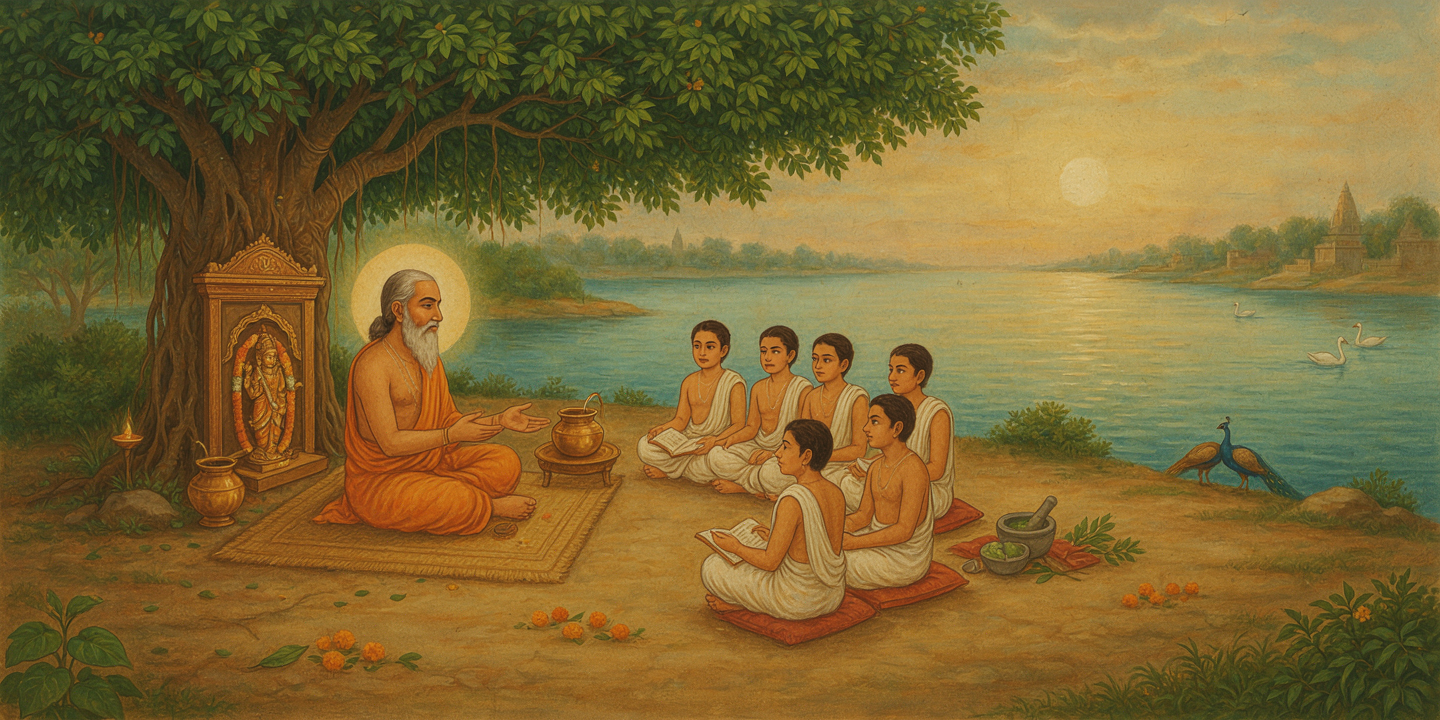
In the Sushruta Samhita, Sushruta and other students go to Divodasa, the king of Kashi, who is identified with Bhagwan Dhanvantari, and ask him to teach the science of healing. Dhanvantari agrees, and teaches them medicine and surgery. Sushruta then writes down this teaching, and for this reason he is remembered as the father of surgery in India.
Anyone who studies Ayurveda soon meets two names again and again, Dhanvantari and Sushruta. One is a divine physician who rose from the Kshira Sagara with the Amrit Kalash. The other is a great teacher and surgeon of Kashi, whose book is still read by students of Ayurveda today. The bond between the two is one of the most beautiful stories of the guru shishya parampara, the tradition of teacher and student.
In this post, we will look at who Sushruta was, what the Sushruta Samhita says about Dhanvantari, how Ayurveda came down to humankind, and what devotees can learn from this link. If you are new to the subject, you may like to start with our posts on who Bhagwan Dhanvantari is and on Dhanvantari in the Puranas.
Who Was Sushruta?
Sushruta was an ancient physician and surgeon of Kashi, which is the old name of Varanasi. He is the author, or the main compiler, of the Sushruta Samhita, one of the greatest texts of Ayurveda. Scholars place the text in ancient times, and opinions on its exact age differ, so we will not try to fix a date here.
Sushruta is best known for his work on Shalya Tantra, the branch of Ayurveda that deals with surgery. In many books and talks, he is called the father of surgery. The Sushruta Samhita describes surgical tools, ways of cutting, stitching and bandaging, the care of wounds, and the training of a surgeon. It also covers many other subjects, such as the body, diet, medicines and the duties of a physician.
Along with the Charaka Samhita and the Ashtanga Hridaya, the Sushruta Samhita is counted among the three great classical texts of Ayurveda, called the Brihat Trayi. Students of Ayurveda study all three with great respect.
What Does the Sushruta Samhita Say About Dhanvantari?
The Sushruta Samhita begins with a scene that is full of meaning. A group of sages and students, among them Sushruta, Aupadhenava and Aurabhra, come to the king of Kashi, Divodasa, who is identified with Dhanvantari. They bow to him and ask him to teach them the science of medicine, with a special wish to learn surgery, for the sake of the sick.
In the text, Divodasa describes himself as Dhanvantari, the first among the Devas, who is remembered as the one who removes old age, disease and death among the Devas. He tells the students that he has come into the world to teach the science of surgery to those who seek it. This is how the text itself presents the link between the divine Dhanvantari and the royal teacher of Kashi. Traditional readers take this as a clear sign that the Dhanvantari who rose from the ocean and the Dhanvantari of Kashi are honoured as the same divine healer.
The students then ask to be accepted, and he agrees to teach them. The rest of the Sushruta Samhita is presented as the teaching that Dhanvantari gave to Sushruta and the other students, and that Sushruta then wrote down.
How Did Ayurveda Come Down to Humankind?
The old texts describe a long line through which the knowledge of Ayurveda came to the world. This is called the parampara, or the chain of teachers.
In the Sushruta tradition, the knowledge begins with Brahma, the creator. Brahma teaches it to Daksha Prajapati. From him, it goes to the Ashwini Kumaras, the twin physicians of the Devas. They teach it to Indra, and from Indra it reaches Dhanvantari. Dhanvantari then teaches it to Sushruta and the other students, and through them it comes to humankind.
The Charaka tradition tells a related story. In that version, the knowledge comes from Brahma through Prajapati and the Ashwini Kumaras to Indra, and then to the sage Bharadvaja, who passes it to Atreya and his students. Both traditions agree on the heart of the story. Ayurveda is seen as a sacred science that came from the divine, and was handed down with humility from teacher to student.
What Are the Eight Branches of Ayurveda?
The Ayurvedic tradition divides the science of life into eight branches, which is why it is called Ashtanga Ayurveda. The Puranas, the Sushruta Samhita and other texts speak of these eight parts.
- Kayachikitsa is general medicine, the care of the whole body.
- Shalya Tantra is surgery, which is the special field of the Dhanvantari and Sushruta tradition.
- Shalakya Tantra is the care of the eyes, ears, nose, throat and head.
- Kaumarabhritya is the care of children and mothers.
- Agada Tantra is the science of poisons and their treatment.
- Bhuta Vidya is the care of the mind and the spirit.
- Rasayana is the science of rejuvenation and long life.
- Vajikarana is the care of strength and reproductive health.
The Sushruta Samhita covers all of these, but it is most famous for its teaching on surgery. This is the part that links Sushruta most closely to Bhagwan Dhanvantari as the teacher of Shalya.
What Did Sushruta Teach About Surgery?
The Sushruta Samhita gives a careful and practical picture of surgery in ancient India. It describes many surgical instruments, both sharp and blunt, and explains how to look after them. It speaks of eight kinds of surgical work, such as cutting, opening, scraping, piercing, searching, removing, draining and stitching.
The text also gives a lot of attention to the training of a surgeon. It teaches that students should first practise on things like gourds, lotus stems and leather bags, before they work with a patient. It stresses a steady hand, clean tools and a calm mind. It also describes the care of wounds and the use of bandages, and even mentions procedures that are still discussed by historians of medicine, such as the repair of a damaged nose.
We share this for its heritage value, to show how deeply the ancient Vaidyas thought about their work. Modern medicine today has grown far beyond these texts. We do not claim that the old methods replace modern care, and we encourage every reader to rely on trained doctors for any health need.
How Did Dhanvantari and Sushruta Shape the Physician’s Code of Conduct?
An important part of the Sushruta Samhita is about the character of the physician. The text describes how a student is welcomed by the teacher in a formal ceremony, and takes a vow to be truthful, disciplined and kind. The student promises to serve the sick with a pure heart and to respect the patient and the family.
The text says that a physician should be clean, patient, calm and well trained, and should treat a patient as a family member. It also speaks about the duty of a doctor to keep learning, and to know the limits of his own skill. This code of conduct has a strong link to dharma, and it is one of the reasons why the Vaidya was respected in ancient society.
Many people see in these lines the real meaning of Bhagwan Dhanvantari as a teacher. He gives knowledge, but he also teaches the right attitude, which is humility and service.
How Is the Dhanvantari Tradition Different From the Charaka Tradition?
Students of Ayurveda often ask how the two great traditions differ. The Charaka tradition is known mostly for kayachikitsa, which is general medicine and the care of the body from inside, including diet, daily routine, and the balance of the doshas. The Sushruta tradition, which is linked to Dhanvantari, is known mostly for Shalya Tantra, which is surgery, and also covers the care of wounds, the study of the body and the use of tools.
The two are not rivals. They are two streams of the same river. A good Vaidya studies both, and many later texts, such as the Ashtanga Hridaya, bring them together. Together they show a complete view of health, in which both the inner balance of the body and the skilled care of injuries have their place.
Why Do Ayurveda Students Honour Dhanvantari Today?
In many Ayurveda colleges and traditional families of Vaidyas, an image of Bhagwan Dhanvantari is kept with respect. Students often offer a prayer to him before beginning their studies or a new year of learning. Some Vaidyas bow to him before they see their first patient of the day.
This habit is not about a request for any special result. It is a way of remembering that knowledge is a gift, and that a physician is only a servant of life. On Dhanteras, many Ayurveda doctors also remember Bhagwan Dhanvantari with a special puja, and thank him for the knowledge that they carry.
What Can Devotees Learn from the Link Between Dhanvantari and Sushruta?
The story of Dhanvantari and Sushruta gives a few simple lessons that anyone can use.
- Knowledge is sacred and should be received with humility, as Sushruta did when he bowed to his teacher.
- Healing is a service, and a good doctor is one who cares deeply for the patient.
- Faith and learning go together, because the same tradition that worships Dhanvantari also values careful study and training.
- Gratitude is a part of health, and we should thank both Bhagwan and the doctors who care for us.
These lessons are a good reason why many families pray for the health of their loved ones and also thank the doctors, nurses and Vaidyas who stand by them.
How Is This Link Connected to the Dhanvantari Homam?
The Dhanvantari Homam is a Vedic fire ritual that honours Bhagwan Dhanvantari as the divine physician and the Bhagwan of Ayurveda. When the priests chant his mantras and offer ghee and sacred herbs into the fire, devotees remember this old line of teachers from Dhanvantari to Sushruta and onward.
Many families also like to include a prayer for the doctors and caregivers of a loved one in the Sankalpa. This is a simple way to join gratitude with devotion. You can read more in our post on what the Dhanvantari Homam is, and you can see the ritual on our Dhanvantari Homam page.
How Should We See Faith and Medical Care Together?
The Dhanvantari Homam and the prayers to Bhagwan Dhanvantari are forms of spiritual support. They are not a replacement for medical advice, diagnosis or treatment. The Sushruta Samhita itself teaches respect for the trained physician, careful care and right medicine.
The best way to see devotion is as a companion to good care. The doctor treats the body, the family looks after the person, and the prayer gives strength and calm to the mind. Please continue to follow your doctor’s guidance, and never stop or change a treatment because of a ritual.
Key Takeaways
- The Sushruta Samhita begins with Sushruta and other students approaching Divodasa, the king of Kashi, who is identified with Bhagwan Dhanvantari, to learn medicine and surgery.
- Sushruta is remembered as the father of surgery in India, and his text covers surgery, the body, medicine and the duties of a physician.
- In the Sushruta tradition, Ayurveda flows from Brahma through Prajapati, the Ashwini Kumaras and Indra to Dhanvantari, and then to Sushruta.
- Ayurveda has eight branches, and the Dhanvantari tradition is especially linked to surgery.
- The Sushruta Samhita also teaches a code of conduct for the physician, based on humility, truth and service.
- Devotion to Bhagwan Dhanvantari is spiritual support and works alongside medical care.
Frequently Asked Questions
Q. What is the link between Dhanvantari and Sushruta?
In the Sushruta Samhita, Sushruta and other students go to Divodasa, the king of Kashi, who is identified with Dhanvantari, and learn the science of medicine and surgery from him. Sushruta then records this teaching in his text.
Q. Who is called the father of surgery in India?
Sushruta, the author of the Sushruta Samhita, is called the father of surgery in India, because of his detailed teaching on surgical tools, procedures and the training of a surgeon.
Q. What is the Sushruta Samhita?
It is one of the three great classical texts of Ayurveda, along with the Charaka Samhita and the Ashtanga Hridaya. It covers surgery, the human body, medicine, diet and the duties of a physician.
Q. What are the eight branches of Ayurveda?
They are Kayachikitsa, Shalya Tantra, Shalakya Tantra, Kaumarabhritya, Agada Tantra, Bhuta Vidya, Rasayana and Vajikarana.
Q. Is the Dhanvantari of Kashi the same as the Dhanvantari of Samudra Manthan?
Many devotees and traditional teachers see them as the same divine healer appearing in two ways. The Sushruta Samhita itself presents Divodasa as Dhanvantari. Some scholars see the name as that of a line of great teachers of Kashi.
Q. Why do Ayurveda students pray to Dhanvantari?
They honour him as the divine source of Ayurveda. The prayer is a way to remember that knowledge is a gift, and that a physician is a servant of life.
A Note on Health and Faith
Devotion to Bhagwan Dhanvantari and the Dhanvantari Homam are forms of spiritual support. They are not a substitute for medical advice, diagnosis or treatment. Please continue to follow your doctor’s guidance and take care of your health along with your prayers.
Seek the Blessings of Bhagwan Dhanvantari
If you wish to pray for the health and wellbeing of your family with the full Vedic method, you can book the Dhanvantari Homam with Jyotirgamaya from anywhere in the world. Visit the Dhanvantari Homam page.